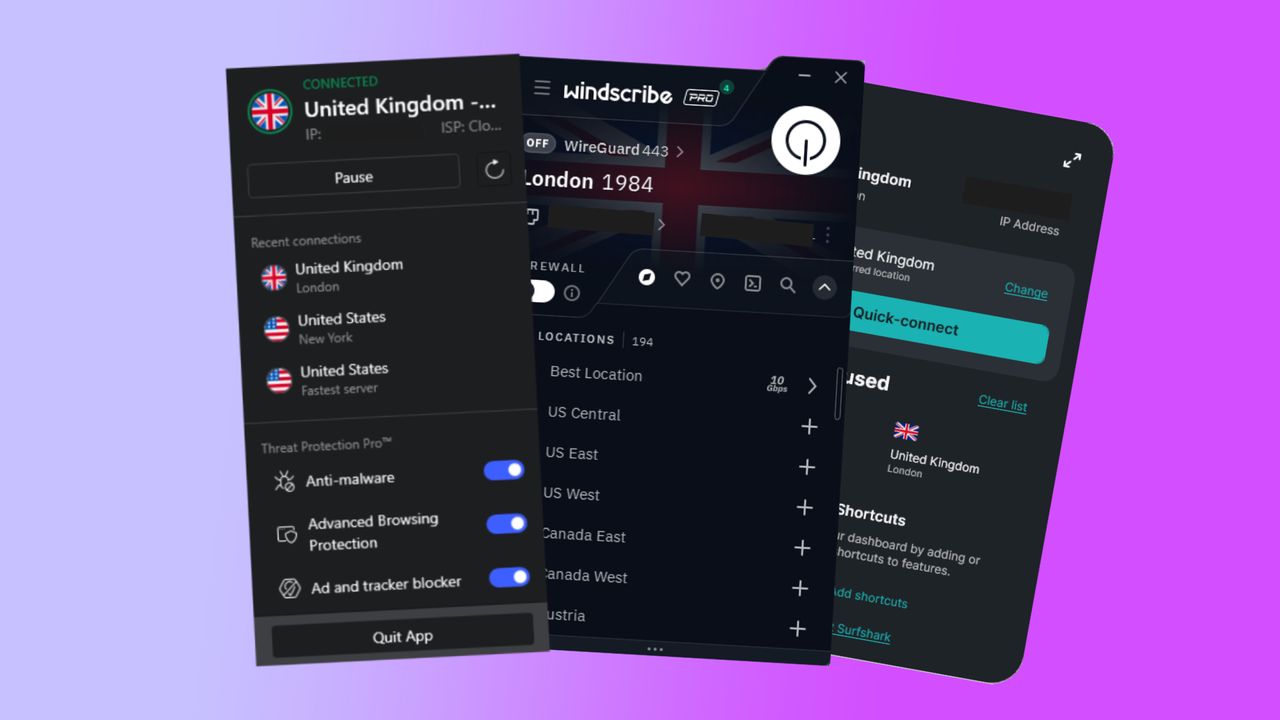
I have always been a staunch advocate for digital privacy. In an era of increasing surveillance, keeping your personal data tucked away from the creeping hand of digital tyranny is essential. However, when it came to gaming, my stance was firm: no VPNs allowed.
As a competitive gamer, latency is everything. I believed that any extra layer between me and the server would inevitably result in lag. That was my assumption—until I spent a full week testing various services to see if VPNs for gaming could actually hold their own under pressure.
The surprising results of my VPN testing
After an extended period of testing, my advice has officially changed. During my evaluation of the best VPNs for gaming, I discovered that it wasn't always a case of making the best of a bad situation. In several instances, my ping actually dropped lower than when I was playing without any protection at all.
This discovery is a game-changer for two main reasons:
- Convenience: You no longer have to manually toggle your VPN on and off or constantly configure "split tunneling" every time you install a new title.
- Security: You can maintain your privacy benefits while playing, providing peace of mind against sketchy opponents or teammates looking to doxx players.
Furthermore, if your ISP is known to engage in bandwidth throttling during peak hours, using a VPN can hide your traffic type, helping to keep your speeds consistent.
Analyzing the performance data
The idea that a VPN might improve connection quality seems counterintuitive, but it makes sense when you consider how data travels to its destination. To prove this, I ran several tests using Counter-Strike 2 and Cloudflare speed tests to compare raw latency and jitter.
Ping and Jitter Comparison
In my testing within the UK, some services performed remarkably close to—or even better than—my native connection:
| Service | Ping (ms) | Jitter (ms) | | :--- | :--- | :--- | | No VPN | 12.58 | 10.66 | | ExpressVPN | 12.22 | 12.07 | | Windscribe | 12.34 | 12.90 | | Mullvad | 12.55 | 12.40 | | NordVPN | 12.73 | 14.06 | | Surfshark | 13.54 | 12.37 | | Proton | 13.80 | 20.70 |
While some services like Proton saw a significant spike in jitter, others like ExpressVPN and Windscribe actually provided a lower average ping in CS2 Deathmatch games than my standard connection.
Download Speeds
When testing large file downloads—specifically a 15.3 GB download of Team Fortress 2 on Steam—the impact on speed was negligible. The difference between a standard connection (271 seconds) and Windscribe (276 seconds) was barely noticeable in a real-world scenario.
Ultimately, my week of testing has proven that you don't have to sacrifice your competitive edge to stay secure. If you choose the right provider, a VPN for gaming can be a powerful tool for both performance and privacy.