Spider-Man: Brand New Day has swung into theaters and shattered numerous records; everyone and their Aunt May went to see this film, it seems. And thankfully, it’s good! After a trilogy of Tom Holland movies that purposefully went in a different direction than what fans had come to expect of the character in prior adaptations--and to divisive results--Brand New Day ties up this iteration of Peter Parker in a much more familiar web.
In the latest film, the hero is devoted to his career of fighting crime, with zero time left for a personal life; he has to wrestle with his moral compass in order to stop the bad guy while remaining the hero; and he lives in a rundown Manhattan apartment that likely still costs multiple thousands of dollars. However, one of the movie’s greatest strengths also doubles as a point of weakness, particularly if you return to the Marvel's Spider-Man games developed by Insomniac after watching it.
Despite Brand New Day’s best intentions to move Spider-Man toward his roots and away from his ties to the broader Marvel Cinematic Universe, the movie is still absolutely a part of the MCU machine. It sees Mark Ruffalo’s Hulk return to the films, while Jon Bernthal’s Punisher finally gets to make his big screen debut. We also get a new iteration of a popular character from Marvel comics, who ultimately acts as the film’s big bad.
Spider-Man and Punisher team up in Spider-Man: Brand New Day.I call this one of the movie’s greatest strengths, because their inclusion, in my opinion, is how Marvel should be handling these kinds of crossovers. Their appearances feel natural and meaningful to the narrative rather than to simply satisfy contractual obligations or have them filmed on green screen to be inserted into existing scenes. Their interactions with Peter, both as himself and his heroic alter ego, help bolster the webhead’s story while teaching the characters meaningful lessons of their own.
However, the inclusion of all these other characters also opens up the film to some critique. While I enjoyed the story director Destin Daniel Cretton and his crew chose to tell with the film’s shadowy villain, the narrative could have been much better served if that role was actually filled by a member of Spider-Man’s rogues gallery.
Early on in the production of the film, it was heavily speculated Brand New Day's story would include Mr. Negative, the villainous alter ego of Martin Li who, when not organizing crime, helps run a charity for the homeless called F.E.A.S.T. While there’s the simple connection that Mr. Negative was introduced in the Brand New Day arc of Spider-Man comics, there’s also the fact that the villain of the movie is able to inhabit the minds of other people.
While Mr. Negative cannot possess others directly, he does have the ability to persuade them to do what he says, and with some tinkering to the script, he easily could have served as the movie’s antagonist while keeping a lot of the other elements of its story intact. Instead, the film features a character in that role that will leave Peter’s world and go onto serve as a foundation in a different corner of the MCU, and because of that choice, Brand New Day is ultimately tainted by sins akin to those in the first Tom Holland trilogy.
Mr. Negative as depicted in Marvel's Spider-Man 2.Over four films, many characters have come and gone from Peter’s orbit, pulled away by the gravity of other MCU projects or have exited due to narrative developments, some of which occur outside of the Spider-Man movies themselves. But one of the big draws to Spidey as a character is how interconnected his web of both allies and enemies is, and that is expertly displayed in the Marvel’s Spider-Man games from Insomniac.
Martin Li is integral to both Marvel's Spider-Man and Marvel's Spider-Man 2. In the first game, his actions as Mr. Negative lead to the death of Miles Morales’ father midway through its campaign. Miles, who becomes another Spider-Man in his own game and serves as one of the protagonists in Marvel's Spider-Man 2, has one of the best moments in all three titles when confronting Li toward the end of that game.
Li, who is trying to repent for his past crimes, teams up with Miles in an attempt to save Peter’s life. When it looks like Li might have to sacrifice himself in order to do so, Miles decides to try and reconcile with the former villain, despite having mixed feelings about it. “I won’t forgive you. It’s just not in me,” Miles says. “But I can’t carry this hate for you anymore, man. So let’s set things right.” It’s just one of the many powerful moments across the trilogy of games, and that power comes from the series’ excellent world-building.
In Brand New Day we get a glimpse at Spider-Man’s rogues gallery with an opening montage of the superhero’s escapades since the events of 2021’s No Way Home. However, the only villain who gets any real screen time is Scorpion. Michael Mando’s Mac Gargan, who had a brief appearance in the first Tom Holland movie Homecoming, finally returns as a full-fledged supervillain. Yet despite being a classic Spider-Man antagonist and having been established in the MCU, Gargan serves as nothing more than a possessed puppet in Brand New Day.
In the comics, as well as other adaptations, Gargan becomes the Scorpion in an experiment funded by J. Jonah Jameson, the editor-in-chief of the Daily Bugle who absolutely despises Spider-Man. The procedure twists Gargan’s mind, as the Scorpion suit is permanently grafted to his body. As such, the villain repeatedly targets not only Spidey, but Jameson as well, often forcing the former to have to defend the latter, and neither party is ever happy about it.
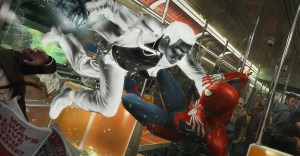
Spider-Man and Scorpion in their classic comic style.While the Scorpion is also featured in both of the Insomniac games, he is similarly an underdeveloped character there as well. However, he is a big part of an important moment in Marvel’s Spider-Man 2 when Kraven dispatches him with ease, demonstrating the hunter’s skills and savvy, setting him up as a formidable opponent for the wall-crawler to have to deal with.
Jameson also has appeared in the Holland movies too, with J.K. Simmons reprising the role after portraying the character in the original Tobey Maguire trilogy. But Simmons’ portrayal of the raging news editor in No Way Home is a far cry from his iconic interpretation of the character in the movies from the early 2000s, acting as little more than the face of an anti-Spider-Man campaign. He has little impact in the story, even if his tirades against Spider-Man do partly motivate Peter’s decision to wipe everyone’s memory of him as the wall-crawler.
Holland and Zendaya provide excellent, well-rounded portrayals of Peter and MJ, but they’re the only Spider-Man characters in this quadrilogy of movies that I can really say that about. Marisa Tomei was an inspired choice for Aunt May, but in this iteration, the existence of Uncle Ben and his tragic death--which canonically only occurs because of a selfish decision made by Peter--is completely ignored or maybe didn’t even happen. The removal of Uncle Ben takes a tantalizing aspect of the young hero's development and his relationship with his aunt completely off the table.
Jacob Batalon’s Ned is a fun character, but has incredibly limited development compared to the likes of Harry Osborn, the traditional choice for Peter’s best friend and whose father also happens to be Spider-Man’s greatest foe. And speaking of foes, while the villains in the Holland movies have been mostly great, they are either--in the case of Mysterio--dead, or stuck in another universe. That includes Homecoming’s Vulture, who was inexplicably transported into the world of Morbius as a way to try and connect Sony’s disastrous non-Spider-Man Spider-Man movies to the Hollandverse.
The Vulture as depicted in Spider-Man: Homecoming.For the most part, every other character of consequence that has appeared in the Holland Spider-Man movies–Tony Stark, Happy Hogan, Nick Fury, Doctor Strange–has been an imported MCU character, and no matter how well those crossovers are pulled off in Brand New Day, half of the film’s cast falls into that bucket.
In comparison, the Insomniac Spider-Man games develop a wealth of Spidey-first characters; Miles Morales, his mother Rio, Harry and Norman Osborn, Otto Octavius, Martin Li, Yuri Watanabe, Felica Hardy, Kraven the Hunter, Wilson Fisk--I could go on. And while a game has a lot more breathing room to develop characters, I would hazard to say that, for all their own faults, both the Maguire and Andrew Garfield cinematic outings at least attempted to grow Peter Parker’s inner and outer circles. When the Holland movies have the opportunity to do that, a slot that could be filled by one of Spider-Man’s own characters is instead given to an extended Marvel family member.
I’m not expecting a two-to-three-hour movie to be able to deftly juggle as large an ensemble as the Insomniac games do over their dozen plus hour campaigns. However, the effort those titles put into fleshing out Spider-Man’s world pays off in dividends for all of its characters, while also laying fertile ground for future installments to grow from. Each of the Holland movies is narrowly focused on building up Peter as a character, and plugging in other MCU heroes where it makes sense at the behest of that goal. Tom Holland’s Spider-Man might live in a friendly neighborhood, but it’s a disappointingly small one that, after four movies, should be wall crawling with a litany of the comic run’s most iconic characters.