Lee Cronin’s The Mummy Review: A Vicious Reimagining of Horror
Lee Cronin’s The Mummy hits theaters on April 17 as one of the most visceral and unpredictable horror experiences of the year. For better or worse, this film stands out as a sad, funny, messy, and undeniably mean horror flick that defies traditional studio expectations. It is rare to see such a vicious oddity released as a major spring tentpole by Warner Bros., yet the decision to place Lee Cronin’s name above the title proves his unique vision has finally found its home. While the 133-minute runtime occasionally stretches, the director's signature visual verve ensures that this latest entry in his filmography remains specific to his dark fixations and deeply unsettling.
A Family Fractured by Ancient Evil
The narrative follows an American family whose young daughter is kidnapped in Egypt, only to later emerge from a sarcophagus with terrifying consequences. The story begins with heavy themes before transitioning into horror-comedy stylings, creating a tonal shift that defines the film’s middle section. If you can wade through the saggy parts, the payoff involves a unique blend of psychological dread and supernatural terror that feels distinct from its predecessors.
The Mummy has no connection to the Boris Karloff originals, the Brendan Fraser swashbucklers, or the short-lived Tom Cruise-led Dark Universe. In fact, it functions less as a traditional m movie and more as an Exorcist clone for the modern era, appealing specifically to those amused by little girls blurting curse words. Cronin continues his exploration of the family unit being warped and bastardized, a theme he has perfected across three films including Evil Dead Rise and The Hole in the Ground.
The Anatomy of Trauma and Horror
The film opens with an Egyptian family enjoying Arabic hip hop before the mother, played by Hayat Kamille, shuts them down with a steely glare that signals impending doom. Beneath their farmhouse floorboards lies a dark tomb from which harsh knocking sounds emanate, leading to an exciting title drop that rivals Cronin’s previous works. The protagonists are introduced as Charlie Cannon (Jack Reynor), his mischievous son Sebastián (Dean Allen Williams), and his conscientious daughter Katie (Emily Mitchell). They plan to move back to the U.S., but fate intervenes when Katie is repeatedly bribed with candy by a mysterious woman—the same mother from the prologue.
When Charlie discovers empty wrappers in Katie’s bedroom, she has already been whisked away in broad daylight. A local missing-persons detective, Dalia Zaki (May Calamawy), drives to find her, but the kidnapping is covered by a sandstorm that provides perfect cover for the abductors. Eight years pass before the U.S. embassy calls with shocking news: Katie is alive.
The Return of Katie Cannon
Katie’s return is marked by a terrifying physical transformation that leaves her parents and brother in shock:
- She is found bound and severely malnourished inside an ancient coffin transported on a crashing plane.
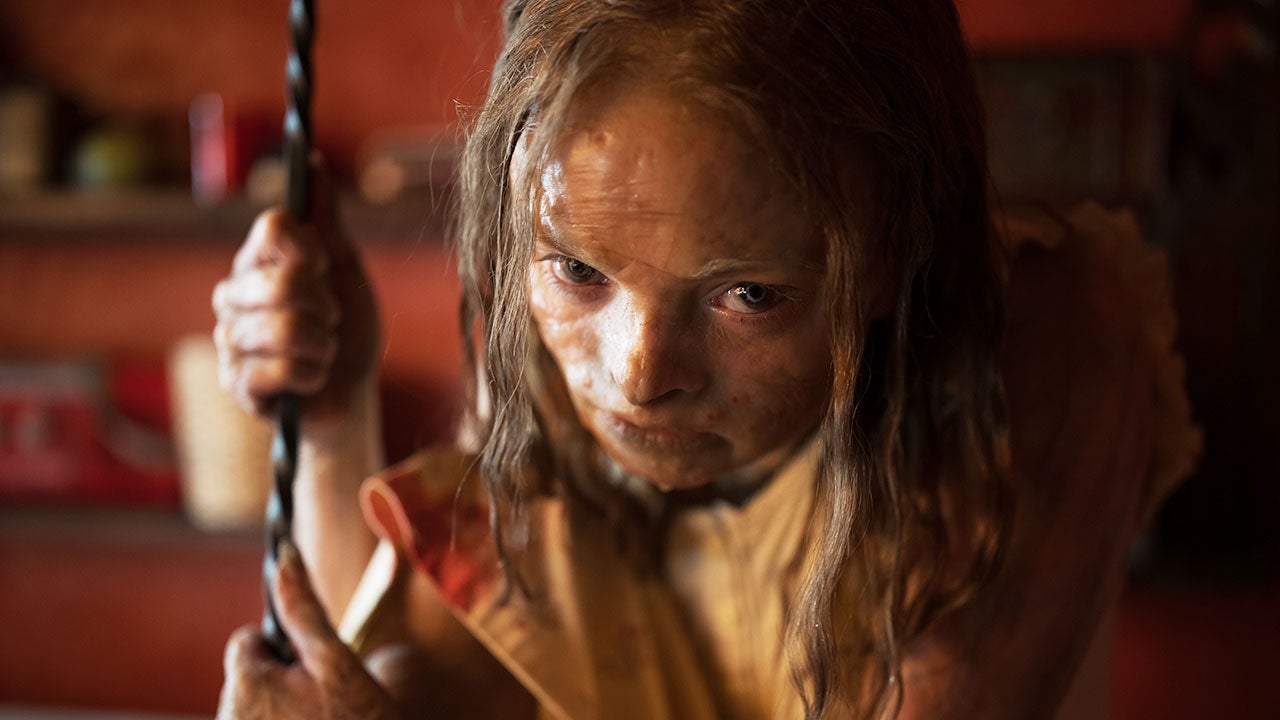
- Played by Natalie Grace, she does not speak, with limbs contorted and skin described as rubbery.
- Her face appears oddly asymmetrical, and her sudden movements are jolting and intimidating to those around her.
While Sebastián keeps his distance, Katie’s new younger sister Maud (Billie Roy) approaches with curiosity. The family dynamic shifts dramatically as things start going bump in the night, often independently of Katie, who seems to prefer dark, quiet corners despite being in a wheelchair. The film suggests that robbing the family unit of its familiar connections is the basis for Cronin’s latest nightmare.
Unspoken Traumas and Supernatural Ambiguity
As Zaki investigates the case in Cairo—where about a third of the film is conducted in Arabic—Charlie and Larissa become the emotional focus of the story. The movie subtly begins to suggest the kinds of traumas Katie may have undergone, gesturing toward possibilities like sexual trauma without ever fully speaking out loud. Words like "grooming" and "human trafficking" are raised as potential explanations, even though a supernatural culprit might be the true cause.
This lack of clarity drives the plot forward in a way that feels strangely authentic to real-life horror. Charlie investigates desperately, hoping answers will make things easier, while Larissa pretends everything is back to normal. Katie remains unable to communicate verbally, yet her eyes betray a quiet desperation to be understood. It is an oddly refreshing take on "elevated" horror where trauma is more than just a metaphor hovering in the distance; it is the visceral core of the narrative.