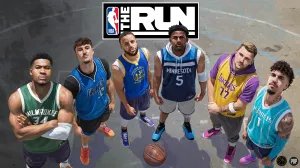
NBA The Run is much more fun than I expected. Built as a revival of the arcade take on basketball games seen in titles such as NBA Jam and, more specifically, NBA Street, I thought I knew what I was getting into and yet it really surprised me.
This is partly because of how the team at Play By Play Studios, built from some former EA Sports developers, ensured that defense is as powerful as offense. Playing against Wemby was a pain because his alien-like frame allowed him to consistently block my shots. The game is flashy, but not just on offense, and I expect that will be key to its chances of finding an audience.
But NBA The Run does something else that's arguably as important, especially since it's an NBA game in an era dominated by NBA 2K. Of course, 2K is a purer simulation of the sport, but for players looking to play co-op basketball with their friends, there's only so much time in the day. Thankfully, NBA The Run dodges the biggest pothole that NBA 2K sadly and intentionally drives into year after year: a broken in-game economy.
Whereas NBA 2K is a game that not only promotes, but nearly demands, players spend extra money to make their avatar more skilled as soon as they hit the game's social City mode, NBA The Run blocks out all of that mess. It's a 3v3 co-op game with a single price tag ($30 or $40 for the game's base and special editions, respectively), and that's it. In-game cosmetics are just cosmetic. There's no way to pay your way to victory, no way to swipe your credit card and enhance your player. As much as I love NBA 2K, that just has not been the case for a while now, and it's a point I try to hammer home every September when I review the latest game, even as so much else in that series is laudable and often extremely fun.
In this way, NBA The Run will debut with a key leg up over the competition. Its roster is full of current stars, like Anthony Edwards, Steph Curry, and the Celtics' pair of Js, Jayson Tatum and Jaylen Brown. For some players, you'll even find rookie versions, like an early Cavs edition of LeBron James.
https://www.youtube.com/watch?v=DvgJugUaKWQWisely borrowing from Fall Guys' quick tournament structure, the titular run refers to the tournaments in which you play several short games. Its survive-and-advance framework means that every time you play, you'll face off against other teams progressing through the tourney, too. If you win four games in a row, you'll claim a trophy (a la the Fall Guys crown), and the game tracks how many you've earned over time--even allowing you to show off your total count with an emote in pre- and post-game screens.
This tournament structure works well thanks to how quickly the games are played. Wins feel earned, but losses don't sting too much. Within a moment, you can be right back in a new round. The destination is the point, but thanks to core gameplay that looks and feels great, the journey is worth the inevitable shortcomings that any team will face at times. But all of that is lifted up by NBA The Run's refusal to get bogged down by microtransaction min-maxing, unlike the game's foremost rival.
NBA The Run's price tag also seems to help it avoid using such tactics. The developers explained to me that, when they were first starting out on this game four years ago, Karthik Bala, the CEO of Velen Studios (the team behind Knockout City), offered them strong advice: Avoid free-to-play because "the graveyard is way too big." Maybe a free version of this game falls for those same microtransaction pitfalls, as the team may have felt pressured to increase player spending by any means. Thankfully, in this universe, the studio avoids us ever finding out.
After playing NBA The Run, I certainly wouldn't say I'm done with NBA 2K. But because it's far more wallet-friendly and far less time-intensive, all on top of just being fun to play, I'll definitely be making time for NBA The Run in my rotation.
NBA The Run arrives on Steam, Xbox Series X|S, and PlayStation 5 on June 9.