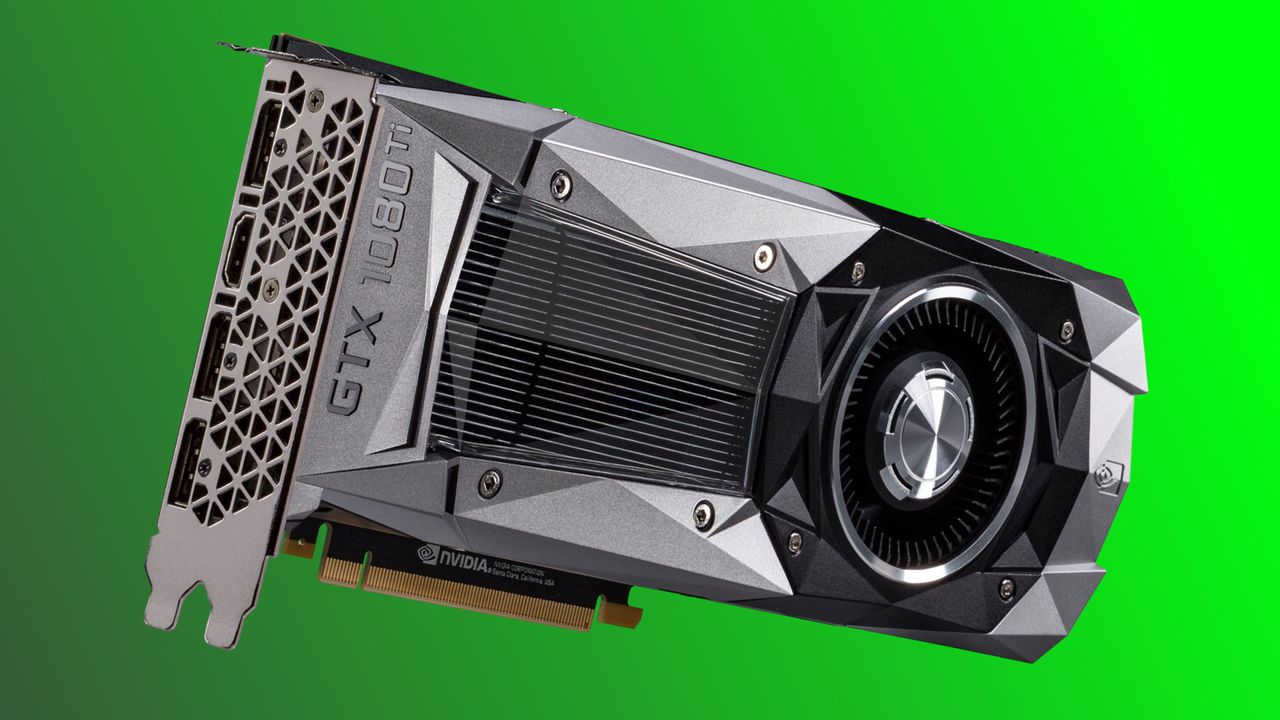
We live in some odd times when the CEO of a tech company can be seen working crowds, signing autographs, and generally giving off film star vibes, but that seems to be norm when it comes to Nvidia's Jensen Huang whenever he's in Taiwan. But it was during one such moment at Computex that he said something that would resonate with any PC gamer: declaring that the GTX 1080 Ti was a bit special.
The brief interaction was shared by MilGrauNews on X, where somebody (apparently the OP's girlfriend) handed Jensen an original GeForce GTX 1080 Ti for signing. "Oh, one of my favourites," he enthusiastically responded. "Oh, my god. This is one of the best. This changed everything."
A mina conseguiu um autógrafo do Jensen Huang, fundador e CEO da NVIDIA, na sua placa GTX 1080 TI Founders Edition.Será que agora ela vale uma grana num leilão? pic.twitter.com/yiv91vj0V4June 2, 2026
For once, Nvidia's CEO has said something that I wholeheartedly agree with, as the GTX 1080 Ti was outstanding for its time—and for many more years to come. To understand why, we need to go back to May 2016, when Nvidia launched its Pascal GPU architecture. The initial line-up of graphics cards sporting these chips topped out with the GeForce GTX 1080, but then three months later, the Titan X Pascal made an appearance.
That graphics card used a slightly cut-down GP102 GPU, with 3,584 shaders and 12 GB of GDDR5X. It was mighty powerful, but also outrageously expensive at $1,199, though certainly not the most costly that Team Green had released at that point (the $2,299 Titan Z from 2014 takes that award).
But in March 2017, Nvidia did something very special; something that it's never done since and will probably never do again. It launched the GeForce GTX 1080 Ti, a GP102-powered graphics card that also had 3,584 shaders and just one GB of GDDR5X less than the Titan X Pascal.
What made the launch special was the price, just $699. Since it used faster VRAM chips than those on the Titan card, it actually had more memory bandwidth, so you were effectively getting an equally, or slightly more, capable graphics card for 42% less money.
This or the 1080 Ti? Silly question... (Image credit: Nvidia)Nvidia would eventually go on to release the Titan Xp, in April 2017, that used a full-spec GP102 GPU, with 3,840 shaders for the same price as the first Pascal Titan. But, with the 1080 Ti being so good and so much better value, relatively few people were interested in it. I must admit that I was one such person and bought an Xp, but that was the last time I ever forked out for a range-topping Nvidia graphics card.
In many ways, Pascal marked the end of an era for Nvidia, because the GPU's successor (Turing) was the first to sport Tensor cores and ray tracing units, kick-starting the whole RTX shebang. Something else that the RTX 20-series cards pushed off the line was a noticeable hike in prices. The RTX 2080 Ti and RTX Titan, both released in 2018, were $999 and $2,499, respectively, and these days, all Nvidia models that use the biggest GPU in a given series are silly money.
I'm not suggesting that the GeForce GTX 1080 Ti was cheap, because that's still a big slab of money to hand over for a GPU even now. But what you got for all thatcash was, and still is to some extent, extremely good.
$700 doesn't even get you an RTX 5070 Ti these days (Image credit: Future)Huang is absolutely right in saying that "it changed everything" because it marked a turning point when Nvidia realised that if PC gamers were happy to spend $699 on a graphics card, they would probably be just as happy to spend a bit more. And then more… and more. Until we're at the point where $699 will only get you a GeForce RTX 5070, although the RAMpocalyse is the biggest factor behind that.
The GeForce GTX 1080 Ti was indeed one of the best graphics cards Nvidia has ever made, but I suspect we will never see its like again.