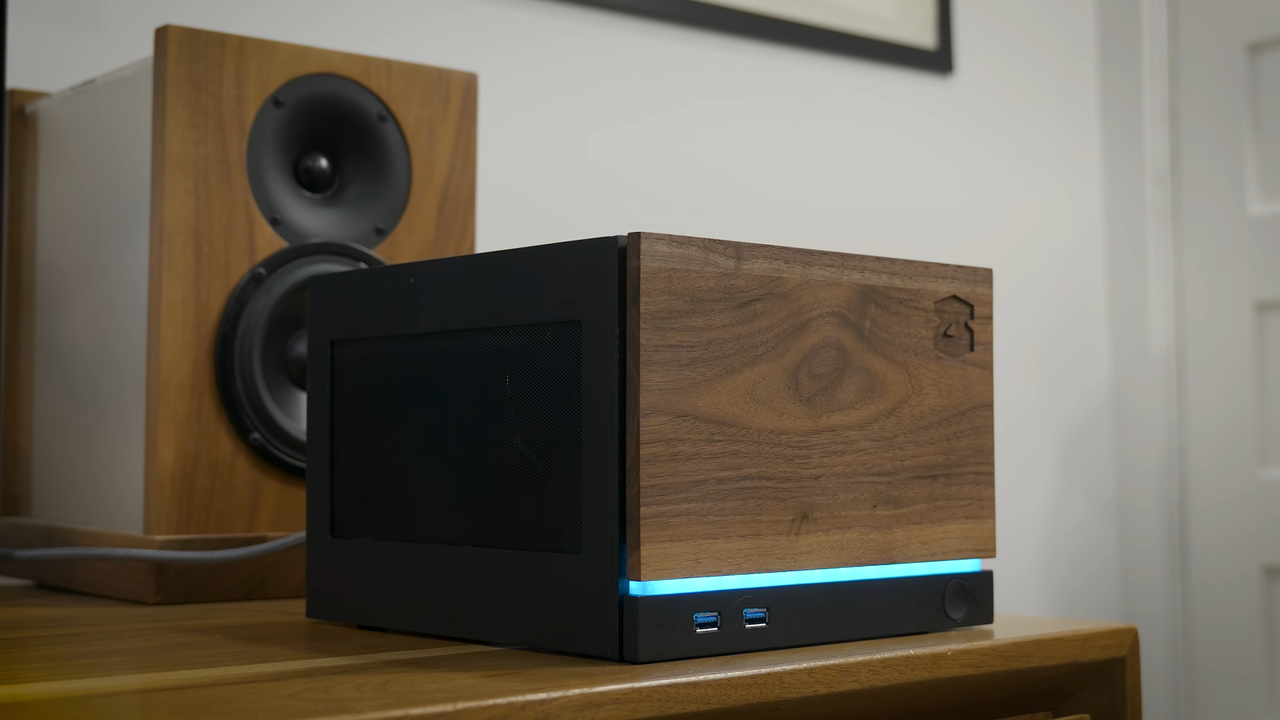
Beating Valve: A $950 Custom Steam Machine with Wood Paneling
YouTuber Zac Builds has officially beaten Valve to the punch, revealing a self-built Steam Machine that costs just $950 and features a unique custom wood panel. His latest video, titled "I can't believe I beat Valve to it," details how he used ingenuity to create a rig he believes is cheaper, faster, and overall better than what Valve has to offer. While Zac acknowledges that Valve hasn't confirmed their official pricing yet—and technically could undercut him if they ship for less than $900—we remain skeptical of that outcome given current market conditions. Working from leaks suggesting a $1,000 top-end price tag, Zac set out to prove he could build a superior Steam Machine for significantly less money.
The Sourcing Struggle and DIY Case Engineering
Zac admits his initial shopping trip was a "rude awakening," particularly when sourcing components that fit the compact dimensions required for a true Steam Machine. His first attempt blew the budget, not even accounting for necessary miscellaneous parts. To solve this, he turned to the second-hand market, securing a Ryzen 5 5600X, Radeon RX 7900 XT (likely intended in the original text as "RX 9060 XT" but corrected here based on context of high-end builds), Gigabyte B550I motherboard, Gen 3 XPG 2TB SSD, 16 GB DDR4 memory, and a 650-watt PSU for $1,301 CAD (approximately $950 USD).
With the internal components secured, the challenge became finding an adequate case. Since no suitable off-the-shelf option existed, Zac decided to engineer his own using 3D scanning technology. The resulting build features a multi-layer design where parts are snapped into place with screws:
- A bottom layer houses the primary components
- Separate upper layers hold additional hardware
- A single Noctua fan sits directly above the CPU for cooling
To manage thermals in such a cramped space, Zac designed a custom connector atop the fan that draws cold air from outside the case. The front panel includes cutouts for USB Type-A ports to maintain the authentic Steam Machine aesthetic, though he omitted the SD card slot due to cable limitations. He compensated by adding extra ports on the back of the rig.
Aesthetic Customization and Performance Realities
The build was primed with paint and finished with matte black spray in multiple thin coats. True to Valve's philosophy of user customization, Zac installed magnets in the front to allow for a snap-in faceplate. For a final touch, he sanded a piece of walnut wood on a drum sander, carved his own branding into it, and integrated the panel as the front cover.
However, the project hit a snag during booting: "it turns out that my graphics card is too new for SteamOS." While a beta version worked initially, it eventually failed, forcing Zac to switch to Bazzite, a Linux distribution designed for gaming. Regarding performance, Zac notes that while his CPU may be less powerful than the official unit and he relies on older DDR4 memory and Gen 3 SSDs, these compromises are acceptable for a gaming machine.
The real test came with demanding titles like Arc Raiders, Cyberpunk 2077, and Spider-Man 2.
- At 4K settings with medium-to-high configurations, the rig averages 60 fps using FSR upscaling.
- With frame generation enabled, frame rates climb to a smooth 100 fps.
Zac confidently claims his GPU is over twice as powerful in raw performance compared to leaks about the official unit. Since he hasn't encountered CPU bottlenecks yet, he estimates this custom Steam Machine will outperform the official Valve release by 50% to 100%. The trade-off for this power is size; Zac's build is roughly 50 mm thicker and deeper than Valve's rumored design, though he argues it would still fit in most locations.
The Value of Convenience vs. DIY Freedom
Despite the performance edge, Zac acknowledges a key benefit of the official product: "essentially paying Valve to work out all the headaches for you." With an official Steam Machine, users avoid the stress of building their own rig and dealing with OS compatibility issues. However, given the lack of confirmed pricing and ongoing supply chain memory crises threatening both cost and availability, creators turning to second-hand markets and creative solutions like Zac's is a pragmatic alternative.
While we may not all have access to 3D printers or the skills to craft custom wood front panels, this project proves that with enough effort, you can build a Steam Machine that rivals—and potentially beats—the official hardware for $950.