How Do You Follow The Perfect Platformer? N+ Devs Think They Have The Answer
Mario will forever be the preeminent face of the platformer genre, but for as much as I've loved the series, there's no doubt about what one platformer I'd pick to be stuck with on a desert island: N++. The definitive 2015 version of the long-running N series was a true accomplishment; it's staggering both in terms of the quality and depth of its platforming action, and the sheer scope of the game itself, featuring thousands of hand-crafted levels, plus a level creator.
When I first heard that a new N game was in development, I was genuinely confused as to how Metanet Software could do anything more with it. Indeed, developers Mare Sheppard and Raigan Burns are also of the opinion that they can't really improve on what they've already done in that space, and they also find themselves "kind of bored with the basic format of single-player platformers." And so the answer to what's next is quite simple: multiplayer.
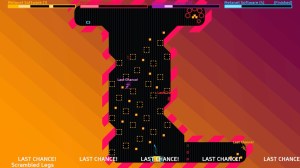
Multiplayer is not new to the series, but in more fully embracing it with the curiously named N+ Infinity Times Two, it's allowed Metanet to go "perpendicular" in continuing to expand on N. N++'s best-in-class platforming appears to be intact here, based on a presentation and hands-off demonstration attended by GameSpot. The same can be said for N++'s distinct minimalistic visual style, which Burns says leverages a "cutting-edge vector-rendering system that has the equivalent of 256x anti-aliasing, which is a bit crazy" and was originally built for N++. This is what Metanet says allows for the "incredibly subtle" character movement that makes the N games feel so good.
Despite those elements carrying over here, the change to multiplayer is sure to be a controversial one, given that N has first and foremost been all about single-player platforming, dating back to the series' origins as a Flash game in 2004. My initial reaction was one of slight disappointment as someone who prefers solo games to multiplayer ones, though my feelings changed as the presentation continued. For one, that's because there will be a "full" single-player campaign, although the exact scope of it was not immediately clear. But more importantly, the new multiplayer modes look like a lot of fun.
That probably won't come as a surprise given the quality of what Metanet has put out over the years; its history as a small developer that remained fixated on perfecting N over the course of so many years does not suggest it was forced by investors to chase trends and jump on the online-multiplayer or live-service bandwagon. But what I did find surprising were some of the inspirations for Infinity Times Two, which included more expected games like TowerFall but also Rocket League, Super Smash Bros., and Quake 3.
The New Multiplayer Modes in N+ Infinity Times Two
In terms of those multiplayer modes, which support 2-4 players (with the ability to train solo), there is a mix of co-op and competitive, with some modes being new to the franchise, while others Metanet claims are new to gaming entirely. Co-op will be detailed at a later time, but we did get a glimpse of a few competitive modes.
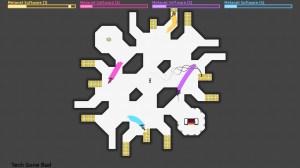
- Racing involves navigating to the exit as quickly as possible, which is straightforward enough and was compared to 2D Fall Guys, but with the added wrinkle that you can get a rocket launcher to ruin your opponents' day.
- Team Tag has a team of ninjas accumulating score by staying alive, while hunters try to explode those ninjas by making contact with them.
- Other modes include Co-Op, One-Up, and Trials.
There are "5+" modes promised, and more have been prototyped and could eventually see the light of day. Metanet plans to add new levels and other content post-launch, and possibly new modes, though Burns made two things clear: They won't add modes just to increase a number and risk watering down the overall experience, and they don't want to nickel-and-dime fans.
An update cadence on par with something like Rocket League is not the goal (nor does it seem possible, given Metanet's size), and both Burns and Sheppard don't enjoy the feeling in other games that they are "in a factory farm being milked for money." Burns deemed indie games to not be about money, but instead to make "the best possible experience." Beyond what Metanet builds itself, a level editor (with cross-platform sharing) offers the potential for "effectively infinite content."
Balancing Casual and Competitive Play
Metanet also believes Infinity Times Two's three-button control scheme lends it to being very casual- and party-friendly; it should be relatively easy for anyone to pick up and play. But given this is all built on N++'s platforming—known for its high skill ceiling thanks to the momentum-based movement, wall-jumping, and fall damage—Metanet also thinks there is tournament-level, highly competitive play possible.
Multiplayer was available in N++, but by crafting the core experience around multiplayer, it has seemingly unlocked entirely new ways to play, as well as new ways to design levels. "There's an entire world of new possibilities once you change the core conversation from the single-player context of a level designer and a player conversing to a multiplayer context where it's players conversing together and the level design becomes more of a conversation starter, rather than the focus," Burns explains.
Asked about surprises they discovered in focusing on multiplayer, Sheppard says, "Multiplayer modes have made us super excited about level design again because there is so much more possibility and so much more to do with the levels, because the whole concept of them is different. Thinking of them as a place for conversations between players and a lot of dynamic things to take place, thinking of them as a background for that, is a very different way to design levels. Each multiplayer mode has such different requirements that the things we need to think about when creating spaces [are] completely new and revolutionary for us."