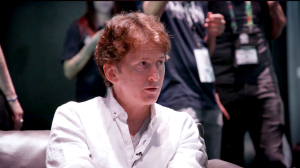
The phrase "you can't beat someone at their own game" has never been more true, in my experience, than for Dave Guskin.
I've had the opportunity to cover Riftbound: The League of Legends Card Game since its inception, first traveling to Riot Games's office last year before its October debut to get an early look, and then covering each expansion since. Every time I've spoken to lead designer Dave Guskin, it's been over a few games of whichever set is next on the schedule. Every time, he's wiped the floor with me.
Last month, I returned to Riot Games to sit down once again with Guskin, this time for Vendetta, Riftbound's fourth set, to talk about new mechanics, the "rivals dueling" theme, and more. Once again, the conversation happened over Riftbound matches. Once again, I left without a victory.
One-sided as it may be, the theme of "dueling rivals" has never felt more prescient. I'll get you one of these times, Dave, but for now, here's what he had to say about Vendetta.
New mechanicsAs we sit down and begin to play, the first new mechanic that sticks out to me is Empower. A card with Empower has access to an additional effect whenever they're Empowered, but once that effect is activated, or the unit leaves the field of play, they become disempowered.
Zed from the Showdown deck highlights the Empower mechanic, as his Legend card becomes empowered whenever a player banishes a card they own. Once empowered, you can exhaust Zed to disempower him, then discard a card to draw a card. It's a great way to gain access to more cards in a pinch, especially if you have cards you can throw away in the moment.
Another new mechanic that is soon to rear its ugly head at my expense is Flow, which can best be explained as a parallel to the Flashback mechanic from Magic: The Gathering. After playing a card with Flow, you can play it again from your trash for the Flow cost, then banish it from the game. Shen's signature spell, Shadow Dash, is a prime example of how powerful Flow cards can be.
Making a competitive splashWhen I asked Guskin which new character, in his opinion, would make the biggest splash in the competitive scene upon release, his response was someone who uses both mechanics at once. "I think Kennen is really strong," Guskin said. "It's a pretty open purple/yellow deck that lets you maybe try a bunch of things that you can't do necessarily right now. That's the one I got my eye on the most."
As we play, I ask Guskin if, because of the "duel" nature of Vendetta, one deck becoming more prominent in the meta might influence the other deck in the "duel" to rise up with it. "I think the decks have more of a thematic or mechanical kind of connection, where one deck is about holding and that deck's about conquering," he said. "But, if Zed is really strong, it doesn't necessarily mean Shen will also be strong.
That said, he would like to see if one of the duels highlighted in Vendetta ends up playing out in the real world. "I do think that there are a lot of strong decks in Vendetta," he said, "I think it will shake up the meta, and if we get a featured match at a big tournament between Shenn and Zed, I think that would be awesome."
The first anniversaryRiftbound is already approaching its first birthday, and the team is in the planning stages for a potential celebration. "There are plans of plans, we've talked about a few different things."
"I think there's different layers at which an anniversary matters," Guskin says. "There's kind of the internal excitement and celebration that we've made it another year. There's the player facing, looking back at all the sets that came out this year, and maybe planning a product or experience around that. Then there's the premier-level competitions that celebrate a year's worth of tournaments."
Internally, the team also recognizes two "first anniversaries," as the game launched in China before it made its way to the rest of the world. While plans are being fleshed out, "we have nothing to share quite yet."
What players are sayingOn the subject of player-facing elements, I asked Guskin about two recurring topics discussed among the players at my local game store. The first involves the Comprehensive Rules Guide, and how frequently Riot plans to update it with changes, updates, etc. Guskin says the team is aware that updates are needed, but the solution is more complicated than it seems.
"It's tricky … the short answer is 'yes we will make changes,' but the more complex answer is we are always striving to kind of correct mistakes that we make, and players are really good at identifying," Guskin says. "We want to kind of make things more intuitive, simpler, and more elegant when possible. But, we're also cognizant of too much change, especially for a physical TCG where players expect changes every set when new cards come out. The goal is to keep changes a bit less frequent but more substantial."
The second involves card artwork, which is mostly taken from internal League of Legends art created over the game's history. There are a few instances of unique commissioned artwork, especially on the Overnumbered variants, but eventually the team will run out of official art; will more art be commissioned?
"Yes, 100%. We have already commissioned a bunch of new art, and not just for the overnumbers," Guskin said. "Some of it is actually in Vendetta, and as we progress forward into the future, we're going to have more original Riftbound art; we'll probably use Legends of Runeterra, League of Legends, and Wild Rift art less frequently, only where it makes the most sense. I am pretty excited about it because we have a stellar creative team, and they're just kind of getting off the ground in terms of concept pushes and world building for Runeterra. There is some really cool stuff coming down the path."
The next set, Riftbound Vendetta launches July 31 in big-box retailers and local game stores, and the first anniversary of Riftbound in the US is October 31. Perhaps in year two, I can finally get that win against Dave Guskin at his own game.