The Evolution of Bipedal Locomotion
The distinction between biological endurance and mechanical persistence evaporated on the asphalt of Beijing this past weekend, marking a definitive pivot in the global race for humanoid robotics. For years, the industry has chased the "holy grail" of bipedal locomotion, treating the half-marathon as a grueling proving ground for stability and battery efficiency. On April 19, 2026, that pursuit culminated in a spectacle that blurs the line between athletic competition and technological dominance.
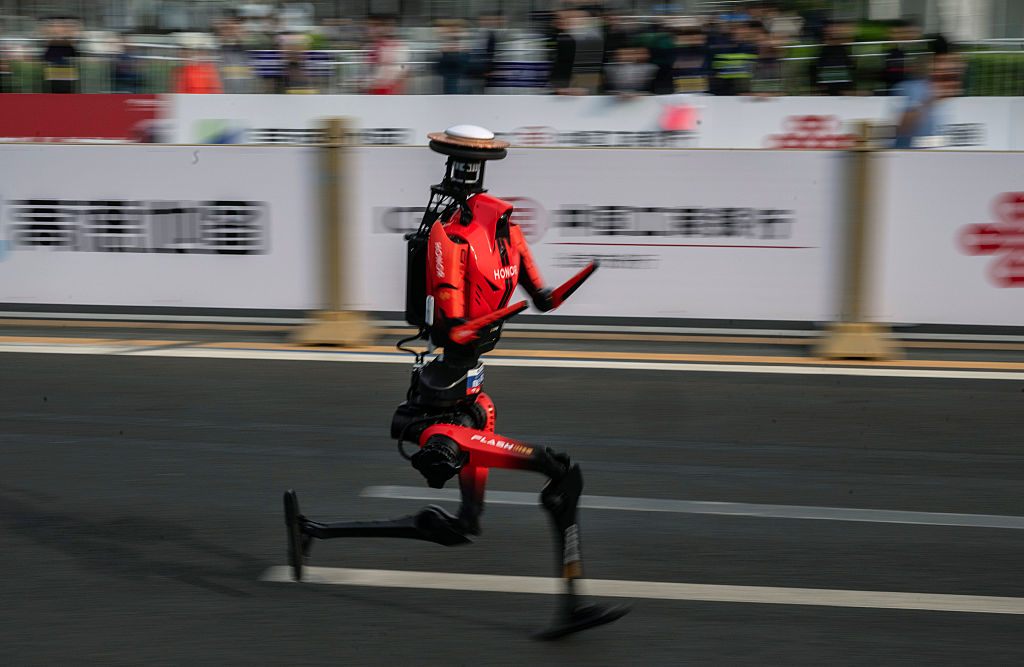
Robots beat human records at Beijing half-marathon when the Honor Lightning completed the grueling 21-kilometer course in 50 minutes and 26 seconds. This achievement shattered the previous world record set by a competitor robot by nearly two and a half hours and decimated the human benchmark, signaling a new era in robotic engineering.
The Lightning Strike and the Autonomous Win
The victor was the Honor Lightning humanoid, operated by a team calling themselves "Qi Tian Da Sheng" (The Great Sage). This machine did not merely finish the race; it did so while navigating the course entirely autonomously. This autonomous capability was a significant hurdle that eliminated the need for remote piloting, proving the viability of self-governed navigation in complex environments.
The engineering behind this feat is substantial. The robot features elongated legs measuring approximately 37 inches to maximize stride length. These legs are paired with a sophisticated liquid-cooling system designed to prevent the thermal throttling that often plagues high-performance robotics during intense exertion.
The contrast between the autonomous winner and the broader field was stark. While the Honor Lightning clocked 50:26, a remotely controlled Honor unit actually crossed the finish line first with a raw time of 48 minutes and 19 seconds. However, that remote-controlled unit crashed into a barrier 100 meters from the end. This incident served as a reminder of the fragility that still haunts robotic navigation without human intervention.
Under the event's weighted scoring rules, which penalized remote control by a 1.2 coefficient, the autonomous Honor Lightning was rightly crowned champion.
Robots Beat Human Records at Beijing Half-Marathon: The Data
Comparing the output of a machine to that of a human elite runner invites inevitable skepticism, often summarized by the internet adage that a car can outrun a cheetah without violating physics. Yet, the numbers here demand serious scrutiny. The winning robot beat the men's half-marathon world record of 57 minutes and 20 seconds, set just weeks earlier in Lisbon by Jacob Kiplimo.
The machine maintained a pace that would exhaust even the most conditioned athlete. It achieved this with a consistency that biological muscles cannot replicate, doing so without the need for hydration or caloric intake.
The data highlights a massive chasm in performance improvements:
- Robot Time: 50 minutes, 26 seconds (Autonomous)
- Human Record: 57 minutes, 20 seconds (Jacob Kiplimo)
- Previous Robot Record: 2 hours, 40 minutes (Tiangong Ultra, 2025)
- Improvement: ~1 hour, 50 minutes in a single year
The robot's ability to sustain a sub-2:24 per kilometer pace for over 21 kilometers highlights a fundamental divergence in how energy is managed. While humans rely on glycogen stores and oxygen uptake, these machines rely on structural reliability and power density.
The Geopolitics of Silicon
The race in Beijing was more than a sporting event; it was a showcase of China's aggressive push into embodied AI and robotics manufacturing. Honor's dominance in this sector signals a broader trend where consumer electronics giants are pivoting to hardware dominance.
The country's "14th Five-Year Plan" explicitly targets robotics as a frontier technology. The goal is to lead the world in general-purpose humanoid robots, moving the industry from niche prototypes to industrial realities.
Major Chinese firms like Agibot, Unitree Robotics, and UBTech have already begun mass production. They are currently shipping thousands of units annually, proving that the sector is no longer theoretical. The Beijing event featured 105 teams, a tenfold increase from the inaugural race. This indicates that the race for robotic supremacy is no longer a question of "if" but "when."
The Horizon of Automation
The implications of the Beijing half-marathon extend far beyond the finish line. The technologies powering the Honor Lightning—advanced balance algorithms, liquid cooling, and high-torque actuators—are directly transferable to industrial settings.
If a robot can run 21 kilometers over rough pavement without stumbling, it can likely navigate a complex factory floor or a disaster zone with equal efficacy. As the gap between human and machine performance closes, the debate shifts from capability to integration.
The specter of displacement for human labor is real, but the immediate utility lies in the robots' ability to operate in environments hostile to biological life. The Beijing half-marathon was a victory lap for engineering, but it was also a starting gun for a new era of mechanized labor. The question is no longer whether robots can beat humans at a marathon, but what other human endeavors remain safe from their relentless pursuit of efficiency.