Last year, Flip 7 took the gaming world by storm with its simple but enthralling push-your-luck gameplay, appealing to both casual players and hobbyists alike. Much of that success stemmed from a straightforward probability formula: each card featured a number, and there were exactly that many copies of that number in the deck. This made it intuitive for players to gauge their chances of drawing specific cards.
In our Sea Scroll card game review, we see that this concept has been brilliantly inverted. Rather than trying to avoid duplicates, you are now actively hunting them. While it shares a mathematical DNA with its predecessor, the strategic depth feels entirely fresh.
What’s in the Box?
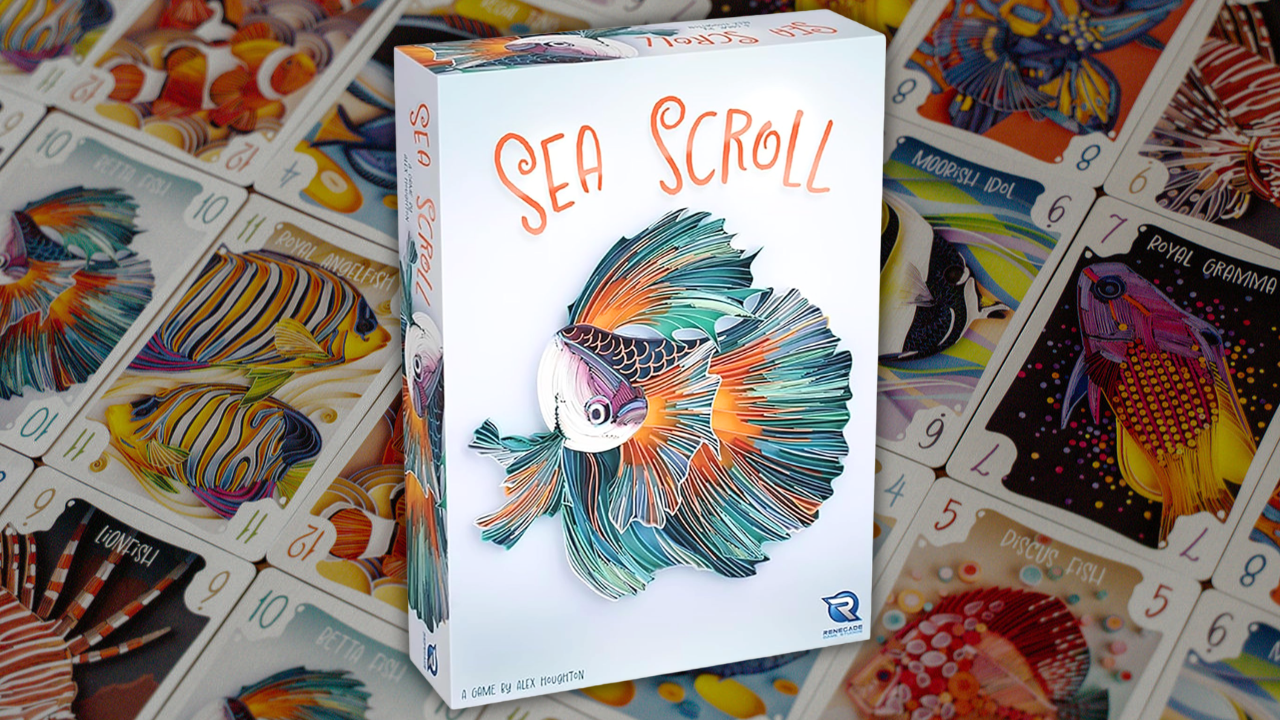
As is often the case with small-box card games, there isn't much besides a deck of cards. However, the packaging deserves credit; the box features beautiful foil detailing that makes the lettering pop and the fish scales shine.
The visual presentation is where this game truly excels:
- Unique Art Style: Artist Yulia Brodskaya uses a "quilling" technique to layer paper.
- Intricate Designs: The results look more like detailed paintings than standard card art.
- Thematic Depth: Each of the nine fish species has its own fascinating portrait to study between turns.
How Sea Scroll Plays
The core mechanic revolves around the deck's unique distribution: there are exactly as many of each fish type as the number printed on the card. For example, you might find twelve Clownfish in a deck, but only four Regal Tangs.
Before starting, players remove certain fish and random cards based on the player count. Once set up, players receive two cards, and four random cards are laid face-up in a row. On your turn, the process is fast:
- Draw: Take two random cards from the deck into your hand.
- Collect: You may choose one group of face-up fish to add to your collection. However, you can only do this three times per game.
- Discard: Place one card into the center row. If it matches a value already present, it stacks with that pile.
The tension in this Sea Scroll card game comes from the "vicious" scoring system revealed at the end. If you have the most of a specific fish type, you gain those points. But if you have at least one of a fish type and don't have the most, you lose those points instead. It is highly recommended that you double-check everyone understands this rule before play begins.
Strategy and Risk Management
While it lacks the raw, frantic excitement of Flip 7, Sea Scroll offers more calculated decision-making. The game becomes a psychological battleground where you must weigh several variables:
- Probability Tracking: You must track which fish have been discarded or collected to make educated guesses about the remaining deck.
- Point Bombs: Drawing high-value cards that you aren't currently collecting creates a dilemma—you must keep one, but they act as potential "bombs" that could ruin your score at the end.
- Bluffing: You can strategically take a face-up pile early to trick opponents into thinking you are dominating that species, potentially baiting them into discarding cards you actually want.
Ultimately, this is an excellent quick-playing game. While it might not have the weight to stay on your table for decades, there is an impressive amount of tactical depth simmering beneath its simple surface.