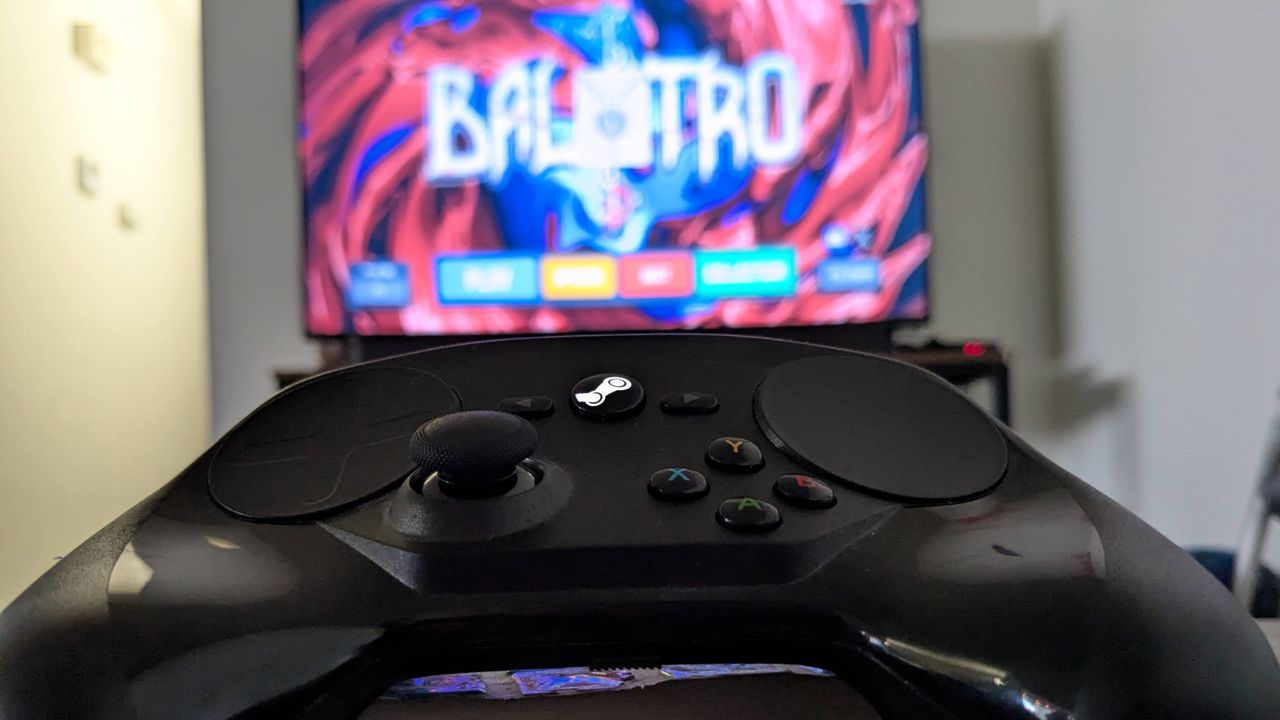
Seven years ago, I made a spontaneous purchase that sat forgotten in a box for nearly a decade. On November 26, 2019—just one day before Valve officially discontinued the hardware—I snagged an original Steam Controller for a mere $5. At a 90% discount, it was an impulse buy I couldn't resist, even if the shipping cost nearly doubled the price of the pad itself.
Now, after years of dust, this budget relic has resurfaced as my unexpected living room sidekick.
Rediscovering the Steam Controller
When I finally cracked open the box a few months ago, my expectations were admittedly low. The industry consensus on the original Steam Controller has long been that it is clunky and awkward. While there is truth to the criticism—the face buttons are small and the analog stick requires a firm press—the actual ergonomics are surprisingly comfortable.
The hardware shines specifically because of how I play games today. Since integrating a dock for my Steam Deck, my living room has effectively become a console setup. While an 8BitDo pad handles standard gaming well, it struggles with menu-driven indie titles like Balatro, Case of the Golden Idol, and Mewgenics.
The Steam Controller excels where traditional pads fail:
- Precision Touchpads: The dual thumbpads are spacious and highly accurate.
- Superior Mouse Experience: The trackpad interface feels even more fluid than the Steam Deck's onboard pads.
- Advanced Haptics: Using the left touchpad as an iPod-style scroll wheel is incredibly intuitive.
Why Steam Input Makes This Controller Essential
The real magic of this $5 find isn't just the hardware, but the software ecosystem supporting it. Despite being "dead" hardware, the Steam Input community has ensured that the controller remains a powerhouse for modern gaming.
No matter which title I load up, there is a high probability that a community-made configuration already exists. In a recent survey of 32 installed games, 81% had dedicated community layouts ready to go. This level of support was evident in my testing:
- Community Layouts: I found a Balatro configuration that actually outperformed the one I manually built for my Steam Deck.
- Gyro Integration: Even for players who aren't "gyro fans," the ability to use motion controls—such as activating gyro only while holding a trigger in Pragmata—adds a layer of immersion that traditional controllers lack.
- Long-term Support: Recent titles like Marathon already feature community-driven configurations, proving the longevity of the device's utility.
The Future of Niche Gaming Hardware
Valve originally marketed this as the only gamepad you would ever need for your living room. While that might be an overstatement, it has found a permanent niche as the perfect secondary device. As PC gaming moves more firmly into the lounge area, we need specialized tools for "mouse-heavy" scenarios—tools that don't require a literal mouse and keyboard on the coffee table.
This $5 experiment has proven three distinct points:
- Controllers are the most interesting hardware in the gaming industry.
- We have a genuine need for specialized gamepads designed for uncommon use cases.
- When a "weirdo" controller is available for the price of a coffee, it is an impulse purchase you won't regret.
The only downside? Valve really should have drilled a slot into the chassis to store the USB dongle. As long as I don't lose that tiny piece of plastic, this old legend is staying in my rotation.