That’s No Moon Knows Crossfire Is Going To Be Divisive, And It’s Ok With That
Make no mistake: Crossfire, the debut game from That’s No Moon, is a big deal. The carousel of reveals at Geoff Keighley's Summer Game Fest rarely pauses long enough to fully lay out the stakes behind each game and the ambitions of each developer, but for the Los Angeles-based team, the stakes are high and the ambitions are lofty.
That’s No Moon is made up of veterans from Infinity Ward, Naughty Dog, Bungie, and Sony Santa Monica, as well as new talent with fresh ideas and the fire to realize them. This is all funded by Smilegate, the South Korean giant behind the Crossfire franchise, which enjoys a player base of millions in Asia. But Crossfire is perhaps best known elsewhere for a swept-under-the-rug Xbox version of the first-person shooter, CrossfireX, that included single-player campaigns from Alan Wake and Control developer Remedy Entertainment.
Smilegate seems intent on realizing the global potential of Crossfire, and having That’s No Moon make its own Crossfire game is the South Korean company's latest attempt to plant its flag. While it might sound like a game is derived from business considerations rather than creative ones, That’s No Moon's Crossfire is still the exact project the developers have always wanted to make, they said, built on ideas the team has always had.
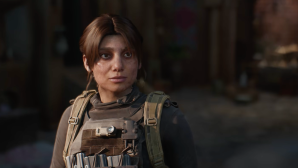
Those ideas, boiled down, are to create a narrative-driven game that delivers a grounded, military story with the prestige of movies such as The Hurt Locker. That’s No Moon’s Crossfire will focus on two characters with clashing life experiences, ideologies, and objectives, who are forced to overcome the odds by relying on each other. That’s No Moon’s take on Crossfire uses a third-person perspective, rather than the game's usual first-person approach, to reinforce those narrative objectives, eschewing the optimized-for-fun design of most modern shooters. The hope is that the grueling combat scenarios happening on screen will be mirrored by the emotions of the players.
That is a misty-eyed way of saying Crossfire is going to be difficult. The team describes its combat as having the kind of lethality ordinarily reserved for military sims and some extraction shooters, but in the framework of a game that its creators hope will have the broad appeal of something like a Battlefield and the narrative impact of The Last of Us.
"In film, you have these prestige movies that are military-themed or war-themed, things like Dunkirk and All Quiet on the Western Front," said chief creative director Taylor Kurosaki. "These films use the pressure of war to reveal a character's true nature. And in games, it's bifurcated. You have your military games, which are not taken super seriously, and then you have these prestige, narratively-driven games that usually are not in that setting.
"For us, we're combining two things that we really love: action-adventure [and] using the pressure of war [as a narrative tool]. So we do feel like this is something that is novel … We wonder why it is in film that you can have these prestige movies in the war genre, but yet in games, there's prestige and there's war, but they're never one and the same."
It's a good question. Although franchises like Call of Duty and Battlefield have certainly tried to tell more grounded stories, the Michael Bay-esque blockbuster action-movie nature of those games means they ultimately end up as entertaining power fantasies. That inevitably leads to stories that see world-changing events get sorted out by cool dudes with rad guns. When it comes to big-budget video games, these are the military experiences in the majority. I can only think of a handful that, pardon the pun, stick to their guns and try to leave players with an emotion other than adrenaline-fueled elation. The poster child for the kind of game That’s No Moon wants to make is undoubtedly Spec Ops: The Line, which is beloved for telling a story that delivered an emotional punch heavy enough to keep it in conversations 14 years after its release.
Although Kurosaki acknowledged Spec Ops occupies the same space that his team wants Crossfire to, they noted that they didn't specifically look to it for inspiration. Nevertheless, the similarities are there, most notably in the way both games aspire to intertwine the agency of gameplay and emotion of narrative to leave a lasting impression on the player. In Spec Ops, the player is asked to take a military action that, in most other games, is dished out as a reward for efficient killing, but is instead a pivot point that unveils the true horror of warfare.
That’s No Moon, however, doesn't seem to be aiming for one moment that pulls the rug out from under the player. Instead, it wants the player to truly feel the pressures of war and the way it can impact the people in it through a more realistic, brothers-in-arms journey.
"What Spec Ops has that our game has is that inherent pressure you get from war. But the thing that we have loved in what you would normally see in these action-adventure games is really more of a sense of heart and charm, comradery, a bond," said Kurosaki.
"We would never say, 'We're making a game that's unlike anything you've ever experienced ever before,' because usually when people try to be so different, we don't know what to make of it," Kurosaki said. "I love thrillers, but I don't want to just see a cookie-cutter thriller. I want to see a very highly executed thriller that's doing some new things. One that comes to mind is Zodiac, a really good version of a thriller that's playing in that familiar genre and doing some things differently.
"So for us, [we're] taking that war genre and this action-adventure and saying, 'Our soldiers don't have to be tough and gruff and all of this.' These are 'real' people who, from a character standpoint, might have something more in common with Planes, Trains, and Automobiles or Midnight Run or The Odd Couple than with, I don't know, Michael Bay or whatever. That's the heart space that we like to"