What do you do as a PC gamer who is looking for a good-value budget graphics card? In these times of ever spiking component pricing that's not an easy question to answer, especially when the current generation of GPUs haven't really moved the needle on in terms of performance at the bottom end of the market. But the RTX 5050 is probably the reluctant answer I would give to anyone aiming to buy the best budget graphics card right now.
Nvidia's RTX 5050 is the lowest-spec RTX Blackwell GPU in this generation, using a smaller GPU than the last-gen RTX 4060, but also higher clocks and more cache to make up the difference. It's nominally $50 cheaper than the older card launched at, and effectively performs at a similar level. Which I guess is progress of sorts.
But the reality is this remains a near $300 card right now, and if anyone out there was looking for an upgrade to their old RTX 4060 card, they're going to have to look a lot higher up the stack and spend a good deal more, because even the RTX 5060 can't always take a significant performance lead.
The similarly priced Intel Arc B580 does present an alternative, however, with a larger VRAM array and often higher gaming performance—sometimes hitting RTX 5060 levels. But it's not as reliable in that performance, with huge frame rate variance between games, and still regular driver issues at launch for new games. Though there is always the argument that if you spend more, you get more, and here if you can stretch to the $360 of the RX 9060 XT 8 GB card then that will deliver higher gaming performance, but in relative terms that feels like a stretch in this budget end of the hobby.
In a world where the RTX 5050 had released at $199, really bringing previous generation RTX 4060 GPU performance down to a lower tier, we would have been talking about something genuinely appealing. But the original pricing, comparative performance, and the subsequent price hikes, have made it a default budget pick, not a desirable one.
✅ You need a new, affordable graphics card right now: The RTX 5050 fulfils its brief as a budget GPU, and if you have a hard limit of around $300 or £250 this is the most reliable card at this level.
Don't buy if...❌ You have any card from the RTX 40-series: The RTX 5050 effectively trades blows with the bottom rung of the Ada architecture ladder, and lies around the price you might have paid for that card many years ago now.
Nvidia RTX 5050 features(Image credit: Future)RTX 5050
RTX 4060
RTX 5060
GPU
GB207-300
AD107-400
GB206-250
Lithography
TSMC 4N
TSMC 4N
TSMC 4N
Die size (mm²)
121
159
181
Transistors (B)
15.1
18.9
21.9
Shaders
2560
3072
3840
SM count
20
24
30
RT cores
20
24
30
L2 cache (MB)
32
24
32
Memory size (GB)
8
8
8
Memory type
GDDR6
GDDR6
GDDR7
Memory bus
128
128
128
Memory bandwidth (GB/s)
320
272
448
Boost clock (MHz)
2572
2460
2497
TDP (W)
130
115
145
MSRP (US$)
$249
$299
$299
It feels like a sad indictment of the state of PC graphics cards when you look at the specs of the RTX 5050's GPU in relation to both the RTX 4060—the weakest of the desktop GPUs in the Ada era—and the RTX 5060. On one hand you've got the tiny GB207 GPU able to match what is nominally the tier above from the last generation, but on the other it's only theoretically $50 lower priced and in reality about the same.
What we're left with is a bottom rung RTX Blackwell chip designed to perform at around the same level as the bottom rung of the Ada generation, but simply be a lot cheaper to manufacture. While barely passing those savings on to us PC gamers.
The GB207 is 24% smaller than the AD107, has 20% fewer transistors, and 17% fewer CUDA cores. But is relying on higher clockspeeds, more cache memory, and more power to make up for the deficit in GPU logic.
Though what Nvidia will say is that you are getting access to its DLSS 4 suite of upscaling features, which means the RTX 5050 gets access to Multi Frame Generation, which recently got boosted up to 6x. The issue here is that when you get down to this level of GPU, where arguably a little performance boost would be more than welcome, frame gen isn't the panacea you might hope it would be. You still need good baseline frame rates before you can enable frame gen without it being a laggy mess.
It will enable you to get to around 60 fps at 1440p in something like Cyberpunk 2077, and a single player title like that isn't so beholden to ultra-low input latency. So sticking frame gen on isn't that big of a hit in some games, especially after upscaling has boosted your frame rate to a more acceptable level.
Nvidia RTX 5050 performance(Image credit: Future)The gaming performance of the RTX 5050 is, essentially, fine. It would be great if we were talking about a ~$200 graphics card rather than a near $300 one, though. The original idea with the RTX 5050 was to create a low-end RTX Blackwell GPU that was cheaper than the RTX 4060 but delivered similar performance. That's generally been the hope going for generation-on-generation frame rate gains; the effective GPU tier down gets the same performance as the higher tier one from a previous generation.
The issue is that the RTX 5050 is, in reality, the same price and therefore the same effective GPU tier as the RTX 4060 was. That was the bottom rung of the Ada architecture, and this is the bottom rung of the RTX Blackwell generation, and both became essentially $300 GPUs in their lifetime.
But it's also not exactly equal. The newer GPU has less actual graphics logic inside it and sometimes that tells. The higher clock speed and cache of the RTX 5050 generally gives it performance parity with the RTX 4060, but there are definite times where the RTX 4060 has a not-insignificant lead.
And then Intel's Arc B580 wants to have its say, too. When it's good, Intel's 12 GB graphics card can really stick the boot into Nvidia's weakest RTX Blackwell card. Just look at the 1440p frame rates in our test suite. But then you can also see, in Black Myth Wukong and Homeworld 3, where it actually lags behind the RTX 5050.
Therein lies the problem for the Intel architecture; gaming inconsistencies. It's hard to get behind Intel's graphics cards for the general user because they aren't 100% reliable for the average PC gamer. There will always be games where it doesn't quite deliver, or has major performance or visual issues around launch, and maybe for a while after, too.
The RTX 5050, on the other hand, is absolutely rock solid in its performance. Nvidia holds 90%+ of the GPU market, and so PC devs will obviously target GeForce GPU performance as a key part of game optimisation. Intel GPUs? Less so.
The performance of the AMD RX 9060 XT 8 GB cards are more of a concern here, however. AMD's modern frame rates are also super consistent, with far less of the variance of old generations of its graphics architecture, and the RX 9060 XT is consistently out in front of both the RTX 5050 and RTX 5060. But it is also another $60 at least more expensive.
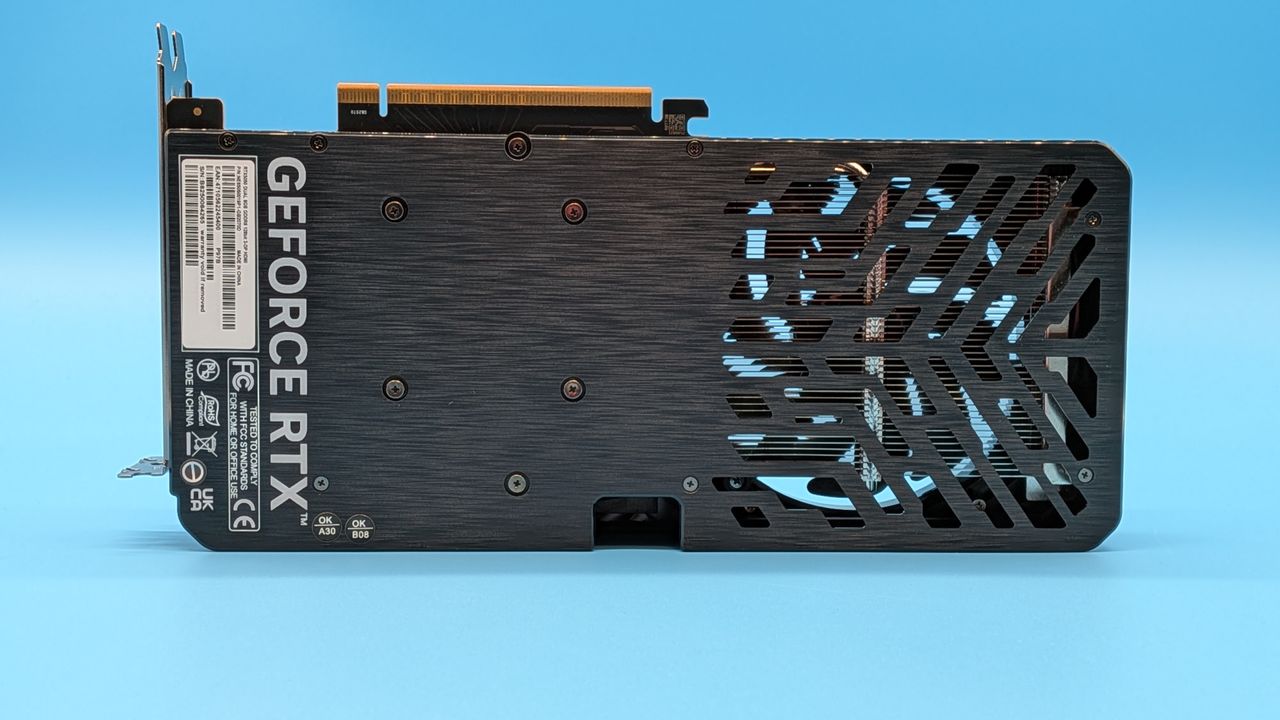
Nvidia RTX 5050 thermals(Image credit: Future)There is no Founders Edition shroud for the RTX 5050, which means you're having to rely on the cooling solutions of whichever vendor's card you end up with. Here, I'm testing a Palit Dual version of the RTX 5050, which is designed to be the cheapest, reference priced version of Nvidia's card.
The fans and the shroud—including the faux-brushed-metal-but-resolutely-very-plastic backplate—are all a bit cheap-feeling, but I am absolutely okay with that as they very much do the job. Compared to the MSI RTX 4060 we're comparing it to, the card remains pretty consistently cool, without the spiking peak temperature you can see with the RTX 4060.
But you can see the little GPU at the heart of the RTX 5050 is having to work hard to hit the necessary performance when you compare it to the positively chill RX 9060 XT. Those thermal figures show how effective the Asus cooler is and how cool the RDNA 4 chip runs.
Nvidia RTX 5050 sound(Image credit: Future)The dual-fan design of the Palit cooler, with the second fan being a blow-through design that is there to just push air over the heatsink extending off the back of the short PCB, means that not only is the card relatively cool, it's also quiet. I've been running it on an open test bench, which means I'm right next to the card, and even on extended runs, such as with Metro Exodus, the sound remains consistent and consistently quiet.
This isn't a card that's going to bother you with fan turbine noise during a gaming session.
It's also not a GPU that's going to bother you with excessive coil whine either, something that some other RTX Blackwell cards have suffered with, especially plumbed into our Seasonic PSU.
Nvidia RTX 5050 value(Image credit: Future)This is arguably the core of the issue for the RTX 5050: its value. But it's also not the easiest thing to actually get a bead on, considering we have to almost entirely rethink our notions of graphics card value in the light of the RAMpocalypse and AI being the only thing to spend silicon budgets on these days.
First, let me revisit the situation the RTX 5050 and its mini GB207 GPU were designed for: The idea was to have a bottom-end RTX Blackwell card that could deliver essentially the same performance as the RTX 4060, but for a lower price in terms of both MSRP and manufacturing.
That's a largely laudable endeavour on the part of Nvidia, except that even at the $249 MSRP it wasn't exactly a whole GPU tier below the RTX 4060, and not long before the RTX Blackwell generation launched you could buy an RTX 4060 for around the same price. So even in the expected market conditions, Nvidia was essentially bringing the RTX 5050 in at the same price and performance.
With the current memory pricing crisis and AI-generated bottlenecks, however, prices of GPUs have only really gone one way, and the RTX 5050 is now a $300-odd graphics card. And that completely kills the theoretical value proposition between it and the old RTX 4060. But, that is now purely a theoretical thing, as the RTX 4060 is no longer reliably on sale new, and even if it is, is priced higher than the RTX 5050.
In recent times, the RTX 5050 has hovered around the $260 mark, and that makes it a far better value card, especially against the current-gen competition. The Intel Arc B580 is resolutely stuck at $290, but I just don't find it a consistent enough GPU for reliable gaming performance, particularly for new games.
The real competition, and the one that gives me most pause in my recommendation for the RTX 5050 as the budget pick right now, is the AMD RX 9060 XT 8 GB. That's a $360 card that comfortably outshines both the RTX 5050 and the RTX 5060, but it does mean you have to spend another $60 - $70 on your purchase. For me, I think that's probably worth it if you can, but if you are stuck at a hard limit of $300 for your new GPU purchase, then I would say the RTX 5050 is the best budget graphics card you can buy today.
Nvidia RTX 5050 software(Image credit: Future)As a budget GPU, there's not a lot of software that comes with the RTX 5050. This Palit version offers a download of Thundermaster, its overclocking app, which is largely a poor man's MSI Afterburner, with mostly the same features but an underwhelming UI.
Outside of that, it's all about the Nvidia App. This is the main software offering from Nvidia that comes optionally bundled with its graphics drivers, and is where you can control various things from the DLSS override settings, and automatic game settings, to the overlay, overclocking, and in-game filters.
Nvidia's software has come on a long way and the app is genuinely a worthwhile piece of software to have installed alongside your GeForce GPU.