Unless you've been living on another planet, orbiting a star light years away, you won't have missed the fact that memory kits are painfully expensive right now. One of the world's biggest manufacturers of PCs has warned that the RAMpocalypse will continue for years, but so far, makers of DRAM kits have taken a somewhat binary approach in their responses to the crisis: do nothing or go extreme.
As reported by Computerbase, a forecast on the supply and prices of DRAM was presented by Lenovo at a high-performance computing event last week. It essentially told us something that we're already acutely aware of: Memory prices will remain extremely high for many years to come and may never drop back down to 2024 levels.
There's nothing that you and I can do about this, of course, but you'd perhaps expect the top manufacturers of memory kits to do something. We don't really need high-speed, low-latency sets of DRAM in our gaming PCs to enjoy decent frame rates, and anyone with an AMD Ryzen X3D chip can get away with surprisingly slow memory.
Yes, the 'sweet spot' for an AM5 socket chip is DDR5-6000 and anything with a CAS latency of 32 cycles or lower will feel really snappy and responsive. But slap a set of DDR5-5200 CL38 in there, and you won't actually notice unless the game is 100% memory-limited. There are some genuine scenarios where it will, but gaming isn't one of them.
So you'd think that to offer some relief in the current DRAM situation, memory kit makers would be doing their best to churn out slower sets that are more affordable than those currently on offer.
GeilTeam GroupHowever, a quick browse through recent newsroom posts shows that this isn't happening. If anything, DDR5 kit manufacturers are either keeping totally silent on the whole problem or going in the opposite direction, releasing ultra-fast sets that are so niche that hardly anyone would be buying them, even if the RAMpocalypse didn't exist.
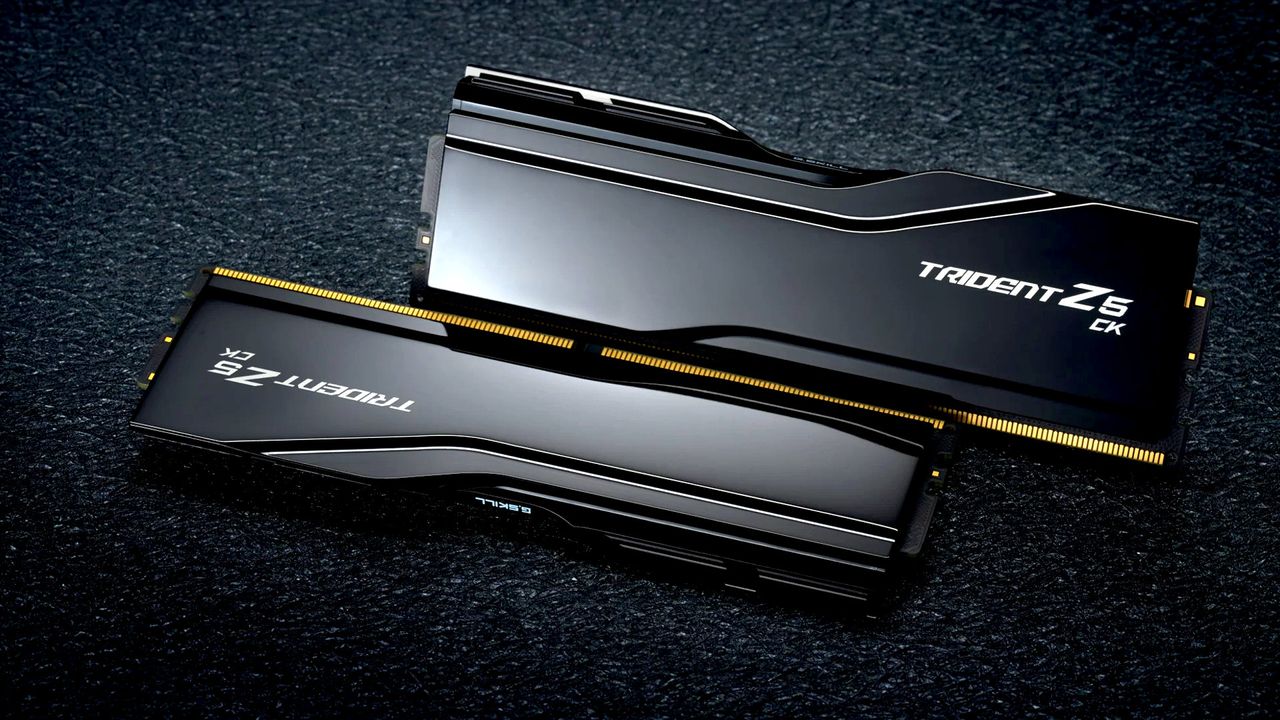
You want examples? How about G.Skill's DDR5-9200 CL72 kit, or the DDR5-8000 CL64 set from Geil. Even Team Group, a brand that normally offers some great products in the mainstream PC market, announced a DDR5-8000 CL54 set. Kingston and Lexar, on the other hand, have stayed quiet on the whole memory front.
The really fast DRAM kits are CUDIMM ones, i.e. they use a small chip on the memory PCB to boost the clock signal, so they will only work in an Intel LGA 1851 socket motherboard. Even then, not every Arrow Lake processor will be happy to run its memory controller at ludicrous speed, though the latest 200K Plus chips stand the best chance, as they natively support DDR5-7200.
Unless you're pairing a Core Ultra 7 270K Plus with an RTX 5090 and game at 1080p, you won't notice much difference in performance, though. That's because memory bandwidth isn't a limiting factor in a game's frame rate, or at least, not unless the CPU and GPU are so fast that they just blitz through the workloads.
Intel's 270K Plus can take really fast DRAM but it doesn't make much of a difference in games. (Image credit: Future)G.Skill says that its memory technologies evolve to "support PC gaming, content creation, AI workloads, and professional computing applications", but I can count the number of scenarios where having an Intel desktop PC with DDR5-9200 is going to be crucially faster than one with DDR5-6400, for example, on a single hand.
To be fair to all of the aforementioned memory makers, they're in a position where they're going to be damned if they do release ultra-fast, ultra-expensive kits, and damned if they don't. In the case of the latter, memory is the primary market for G.Skill and Geil, so they have to be seen to be doing something to keep the business in the news and interest ticking along.
But I suspect that this time next year, when the grim realities of the RAMpocalypse have ripped through the PC industry like a tornado in the plains of Texas, the market will be so desperate for affordable memory that kit makers will have no choice but to field slower, cheaper options.
If they don't, this sector of the industry will almost certainly be saying goodbye to a raft of names that have been synonymous with PC gaming for a very long time.