Okay, Maybe I Could Be Convinced AI Monitors Aren't All Bad
At Computex this year, it was no surprise that MSI would be showcasing AI-powered monitors. After all, AI has dominated the conversation at the event for the past few years. But the idea of a "world's first agentic AI monitor" wasn’t exactly on my radar as a must-see at the Taiwan tradeshow. Still, I found myself at MSI’s HQ in Taipei, exploring a range of new products, including the MEG X—a $1599 monitor that claims to be the first of its kind.
A New Era of Monitor Technology
The MEG X is more than just a high-end 34-inch ultrawide QD-OLED display. It boasts a 5th-gen QD-OLED panel with a Penta Tandem structure, which improves light efficiency by up to 30%. Other features include RGB Stripe technology to reduce color fringing, DarkArmor Film for deeper blacks and better scratch resistance, and a built-in AI processor that powers features like AI Super Resolution, AI Gauge, and AI Scene.
The monitor’s standout feature, however, is its AI-powered settings adjustment system. Users can ask the monitor to change settings through a voice command, eliminating the need to navigate through complex OSD menus. This is a significant step forward, especially for gamers and professionals who spend a lot of time adjusting display settings.
The Dragon Interface
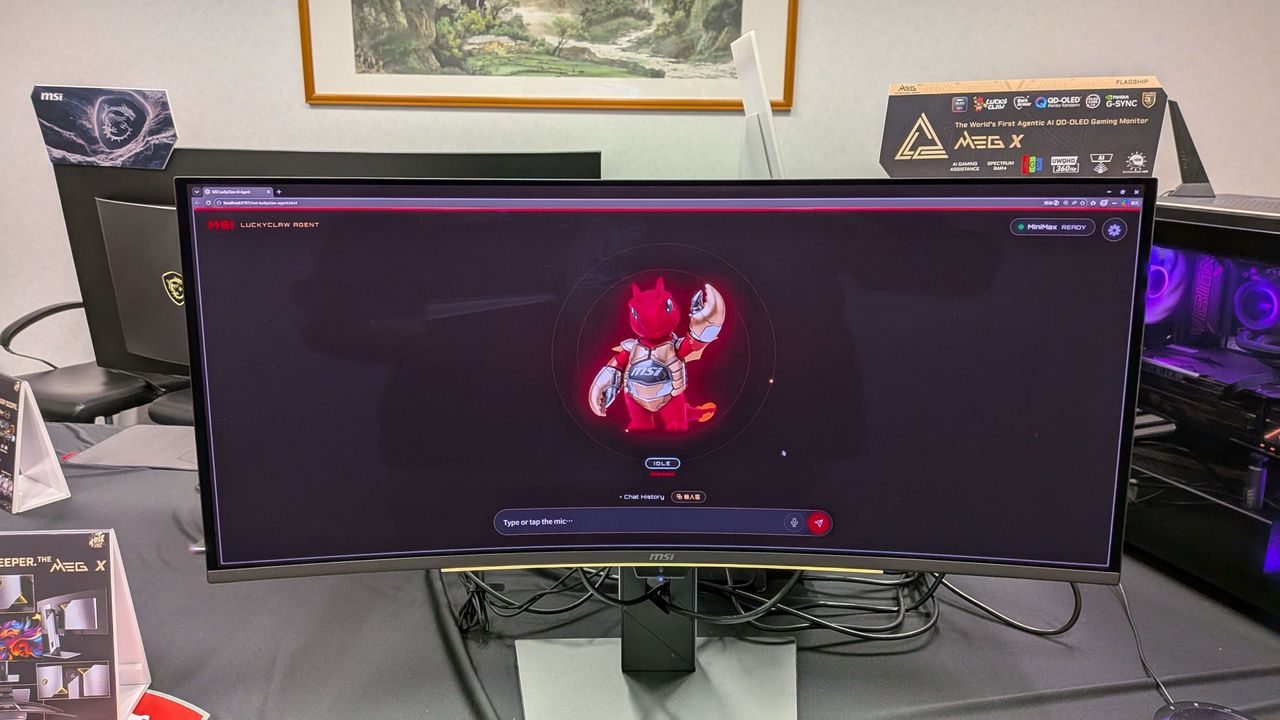
MSI’s LuckyClaw feature allows users to interact with a cartoon dragon with crab claws, which can be controlled to adjust brightness or enable on-screen crosshair features. While the dragon’s personality might be a bit much for some, the underlying technology is impressive. The system uses a micro-controller that allows settings to be adjusted from within Windows, rather than through the traditional OSD.
Unfortunately, this specific feature wasn’t available for demo during my visit. However, I did get a glimpse of the OpenClaw interface on the MSI MPG 341CQR QD-OLED X36, a monitor that uses the same Samsung 5th Gen Penta Tandem panel. It’s a solid display in its own right, but the AI features on the MEG X are what truly set it apart.
AI Features: Useful or Not?
While the AI-powered settings adjustment is a definite plus, other AI features on the MEG X don’t seem as impressive. AI Super Resolution, for instance, doesn’t match the performance of FSR or DLSS as it only runs on the monitor’s scaler. There’s also a feature that upscales the scope area in the center of the screen, which might be useful for certain applications but could be considered cheating in gaming.
Additionally, the monitor includes a light bar that indicates the left or right channel for music, but again, this might not be ideal for gamers. These features, while innovative, don’t quite reach the level of usefulness that the AI settings adjustment does.
Final Thoughts
Despite the questionable AI features, the MEG X’s ability to adjust settings through voice commands is a game-changer. If the interface wasn’t so obnoxious—like the dragon with the toddler-like personality—I might actually consider AI monitors as a viable option. It’s a step in the right direction for monitor technology, and one that could potentially change the way we interact with our displays.