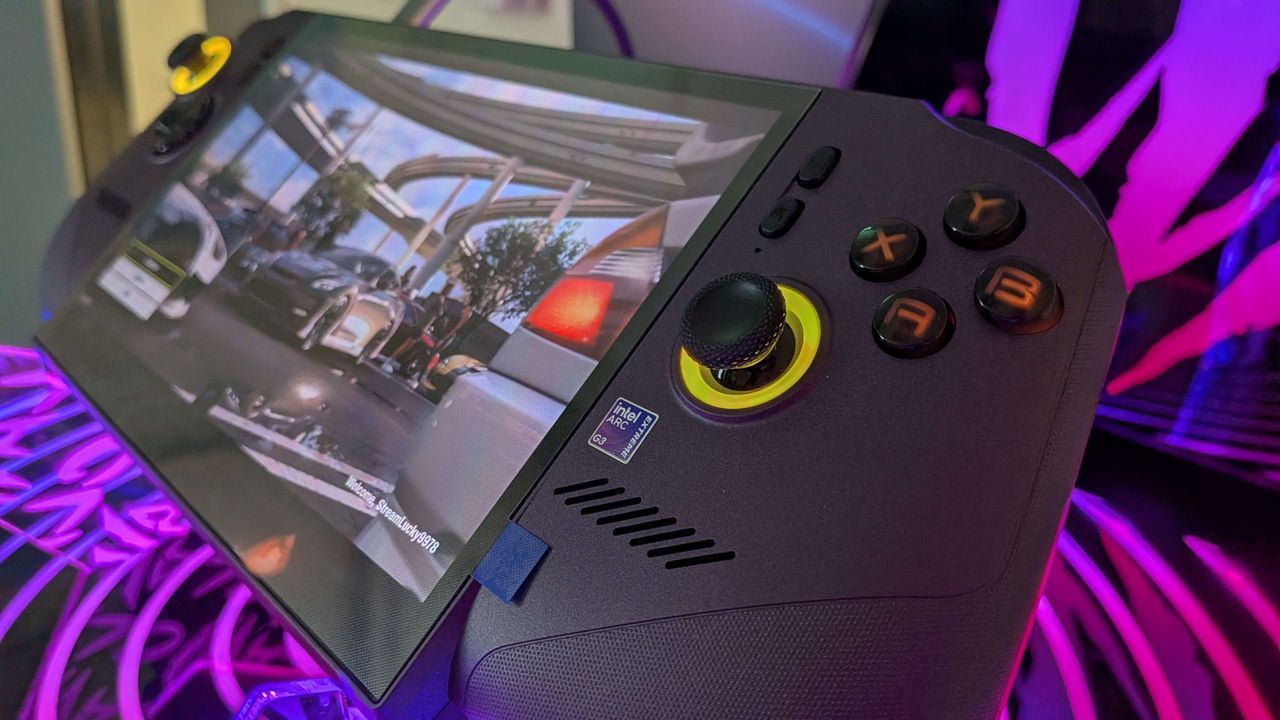
The device in my hands feels like the standard all new handheld gaming PCs will be judged by
From my time playing around with the new Panther Lake-powered MSI Claw 8 EX AI+, I've found some seriously extreme things about this handheld gaming PC. Mostly that's a good thing, but it being 2026—and the fact I'm talking about a new gaming handheld mere days after the Steam Deck price hike—you can probably already guess what the not-so-good extreme thing is. It's the price. We've been told today at a pre-Computex hands-on event with the Claw that we're looking at $1500. So long as MSI can maintain production costs and keep it at that price point. Which is maybe a tiny bit concerning.
It is worth re-iterating that the Steam Deck has just had a hefty price hike itself, and has still somehow sold out of its entire stock for North America. Not that I'm making excuses for that eye-watering price, but if Valve's ageing handheld—and a far weaker setup at that—is going to set you back around $1,000, maybe we shouldn't be surprised that a system that looks to be the benchmark by which all other handheld gaming PCs are rated is going to cost a chunk more.
Now I've got that one negative out of the way, let's get onto the more positive stuff—and there's a lot of it.
MSI Claw 8 EX AI+ specs
The MSI Claw 8 EX AI+ is using the top chip in the new G3 range of dedicated handheld Intel chips, the G3 Extreme. That means you're getting the full 14-core processing array, along with the 12 Xe core Arc B390 iGPU. While there is a more affordable 10 Xe core version in the straight G3 chip, MSI is not looking at using that just yet.
I asked the question and was told: "So far we're starting with the G3 Extreme and we're going to be sticking with this one in our first wave."
Those 14 cores break down into just a single pair of Cougar Cove Performance cores, with eight Darmont Efficient cores, and a further four low power E-cores capable of operating on their own while leaving the rest of the more power-hungry cores turned off.
What's under the hood
Along with that, you're getting 32 GB of LPDDR5x-8533 and a 1 TB SSD. That SSD is of the standard 2280 variety, which means users have a greater number of options to choose from if they wish to upgrade the storage down the line. Though it bears saying that, owing to the limitations of the chassis, you're only able to use single-sided SSDs in there.
In terms of the I/O, there's a pair of Thunderbolt 4 ports on the top, with a MicroSD card reader, fingerprint reading power button, and a 3.5 mm audio jack. You're also getting new "HD haptic" linear resonant actuator (LRA) modules to deliver a new, more accurate, quieter, and lower powered vibration motor in the handles.
There are some things that notably haven't changed from the previous version of the MSI Claw, namely the screen, the Hall effect triggers and sticks, and the 80 Whr battery. So, you're still getting a 1200p IPS-level panel, with a peak luminance of 500 nits and support for VRR, from 48 Hz to 120 Hz.
Future of handheld gaming
MSI is also sticking with Windows, too. It's obviously going to have the Xbox mode of the Xbox Ally X, with MSI creating a lightweight quick settings screen that mimics what Asus has done with its Armoury Crate software. So, it will be a more tailored handheld experience, but SteamOS it is not.
Though MSI has tested SteamOS after Intel recommended giving the Claw a whirl with alternative operating systems, I'm told "with SteamOS, there are still technical barriers." With my own experience of trying Valve's Linux OS out on various non-Asus, non-Lenovo, non-Valve handhelds, I would have to agree. MSI has tested other Linux operating systems in the labs, but when I ask if they're working okay, I'm told they're "workable, but just for engineers."
MSI is also testing out TMR sticks in the labs, but the results of those experiments have come too late to get into this version of the Claw at least.
Even though it is using the same big ol' battery, the new Claw is a little lighter than the old one, coming in at 785 g versus 795 g for the old version. Which actually surprised me. Having picked it up and played around with it, it feels so much lighter than that in the hand. It's well balanced, and the flared grips, closer to that of the ROG Xbox Ally X and the Xbox Controller it's based on, make it feel far more comfortable than the previous device when you're actually holding it.
Battery life and performance
"I promise you battery life that should be more impressive than the current..."