Apple Rubberstamps Open Source Driver for Nvidia GPUs on Macs
Apple rubberstamping an open source driver marks a pivotal moment for Mac users who have longed to integrate Nvidia GPUs into their setups. For years, the transition from macOS's support of standard graphics APIs to proprietary solutions severed the link between Apple Silicon and Team Green's ecosystem. However, that era of exclusion is officially ending thanks to a newly approved open-source solution developed by tiny corp. This breakthrough allows users to finally utilize CUDA capabilities on Mac hardware, restoring access to a powerful ecosystem previously blocked for years.
The TinyGPU Breakthrough: Installation Made Simple
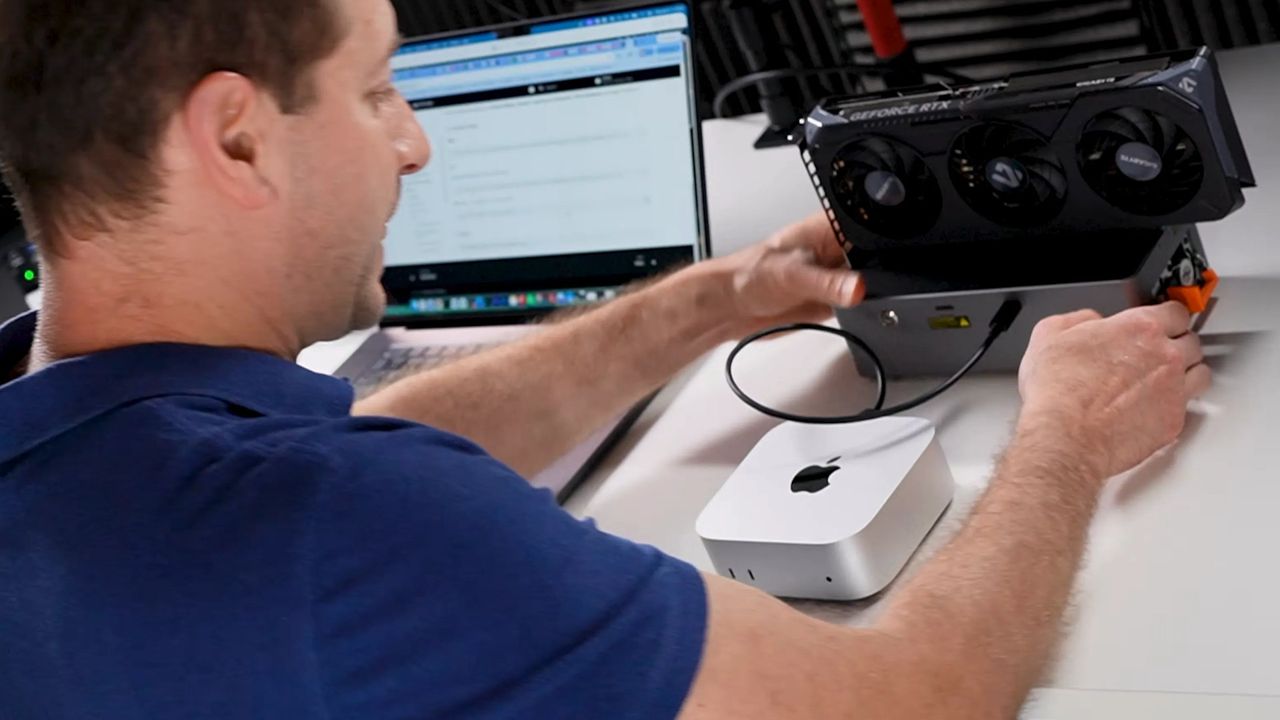
The catalyst for this change is an application called TinyGPU, created by the developer duo known as tiny corp. Coding and tech YouTuber Alex Ziskind demonstrated the potential of this software in a recent video, successfully connecting a GeForce RTX 50-series graphics card to a Mac mini via an eGPU dock over a USB4 cable. The process is remarkably straightforward, requiring no complex homebrew modifications or "shenanigans."
Apple has fully approved this driver for both AMD and Nvidia, ensuring a seamless experience:
- Connect your Thunderbolt or USB4 eGPU to the Mac with proper power delivery.
- Install the TinyGPU app and the accompanying open-source driver.
- Set up your compiler environment.
As noted in the official announcement, the installation is so streamlined that even a basic AI assistant could handle it. This level of integration means users can now access CUDA acceleration without wrestling with kernel extensions or system vulnerabilities.
Performance Reality Check: AI Focus vs. Gaming Hopes
While the technical achievement is undeniable, prospective users should temper expectations regarding high-performance gaming. The development team at tiny corp has explicitly focused their efforts on AI workloads rather than traditional graphics rendering for games. In Ziskind's tests using an RTX 5090, the card did process significantly more tokens per second than the Mac's internal M4 Pro chip.
However, the software stack is not yet optimizing the full potential of the Blackwell GPU. Several key performance insights from the testing phase include:
- The RTX 50-series cards outperformed the M4 Pro in token generation speeds.
- A significant portion of the Blackwell architecture's capabilities remains untapped by current drivers.
- Real-world gaming scenarios are not currently supported despite the open-source nature of the project.
Future Horizons for Mac Gaming and AI
Despite the current limitations, the open-source status of tiny corp's GPU runtimes on GitHub suggests a promising future for broader compatibility. The community may eventually bridge the gap to enable full gaming support on macOS, though this will likely be a formidable challenge given the architectural differences between Apple Silicon and standard PC GPUs.
For now, owners of AMD RDNA 3, Nvidia Ampere, or newer graphics cards can immediately begin experimenting with AI tasks on their Macs. This development represents a significant step toward unifying the ecosystem, even if playing the latest titles on an external RTX card remains a goal for later down the road.