The End of the Standalone AI Podcast Era
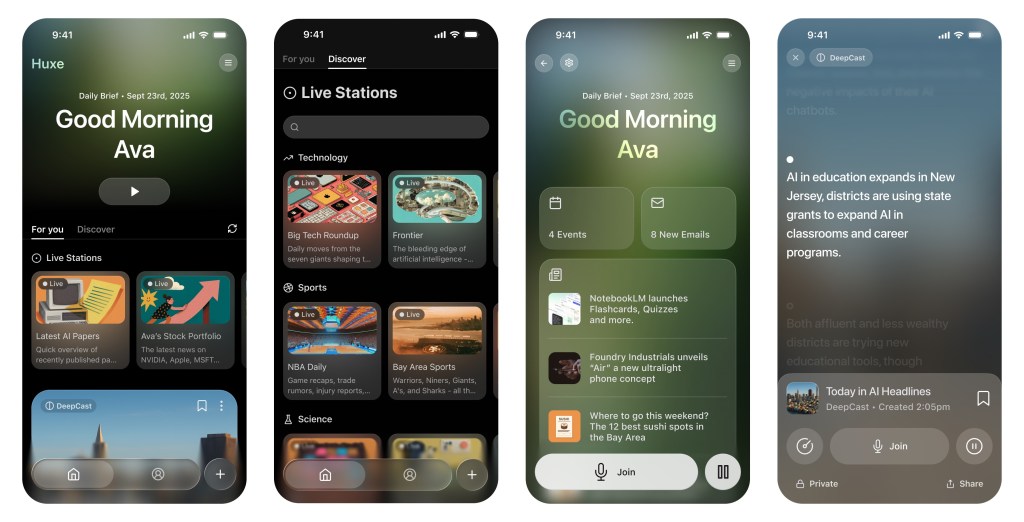
The shutdown of Huxe, an application that allowed users to input a topic and instantly generate a personalized podcast, serves as a stark indicator of how quickly specialized AI tools are being absorbed by tech giants. Founded by former Google NotebookLM developers, Huxe entered a market where its core innovation had already been rendered obsolete by the very infrastructure it relied on.
This closure is not merely the failure of a single product but a symptom of a maturing industry. The graveyard of AI startups is rarely paved with bad code; it is usually paved with feature parity. Huxe’s demise highlights a recurring pattern where startups pioneer the interface, only to see their value proposition evaporate when incumbents integrate similar technology into existing ecosystems.
The Commoditization of Personal Audio
Huxe was launched in late 2024 by Raiza Martin, Jason Spielman, and Stephen Hughes, all former Google employees. The team secured $4.6 million in funding from notable investors including Conviction, Genius Ventures, Figma CEO Dylan Field, and Google Research’s chief scientist Jeff Dean. Despite this impressive backing and the pedigree of its founders, the app could not survive the rapid acceleration of big tech’s AI capabilities.
The timing of Huxe’s collapse is particularly biting. Just one day before the shutdown announcement, Spotify released its own personal podcast feature. This feature performs the exact same function as Huxe: it generates audio content based on user prompts and interests.
This parallel is not coincidental. It highlights several key realities of the current market:
- Rapid Obsolescence: Core products of startups are turning into commoditized features.
- High Barriers to Entry: As AI models improve, the uniqueness of any single app’s core function diminishes.
- Economic Unsustainability: The cost of development cannot be recouped when the feature becomes free or bundled elsewhere.
Huxe’s creators saw the potential for an AI-native podcast player, but they failed to build a moat against companies like Spotify, Adobe, Amazon, ElevenLabs, and Meta. Even Google itself has released separate features to create podcasts based on a user’s Discover feed. When core products turn into standard features, the barrier to entry for new competitors becomes nearly insurmountable.
The Structural Trap for AI Startups
The shutdown of Huxe underscores a fundamental challenge for AI-native startups: the difficulty of maintaining a unique value proposition in a rapidly converging market. As AI models improve, they become better at converting one format to another—text to audio, audio to video. This capability reduces the uniqueness of any single app’s core function.
For Huxe, the issue was not just competition but the nature of its service. Generating a podcast about a topic is a powerful tool, but it is becoming a standard feature across multiple platforms. This commoditization makes it difficult for a standalone startup to scale to millions of users who are willing to pay for the service.
The broader implications are significant. Other startups, such as Oboe, founded by former Spotify executives, and Sun, part of an a16z speedrun cohort, are attempting to build audiences for audio-focused learning. However, they face the same structural headwinds. If the technology for generating high-quality audio content becomes universally accessible and integrated into major platforms, the niche for standalone audio AI apps shrinks dramatically.
The End of the "App" Era for AI Tools?
Huxe’s demise suggests a shift in how AI tools will be consumed. Rather than downloading dedicated applications for specific tasks, users may increasingly rely on integrated features within larger platforms. This trend favors companies with massive user bases and deep pockets, allowing them to distribute the cost of AI development across millions of subscriptions.
For founders and investors, the lesson is clear: innovation alone is no longer enough. To survive, AI startups must either:
- Build a community or network effect that cannot be easily replicated by tech giants.
- Pivot to enterprise solutions where customization and data privacy are paramount.
The era of the simple, standalone AI app is closing, replaced by a landscape where AI is a layer within larger, more complex systems. The winners will be those who can leverage scale, integration, and user trust, not just those who can build the best prompt-to-podcast engine. For former NotebookLM developers and their peers, the next chapter will likely involve building in the shadows of the giants, or finding entirely new frontiers where feature parity has not yet been achieved.