BYD's Fastest-Charging Car in the World Is Astonishing—in Good and Bad Ways
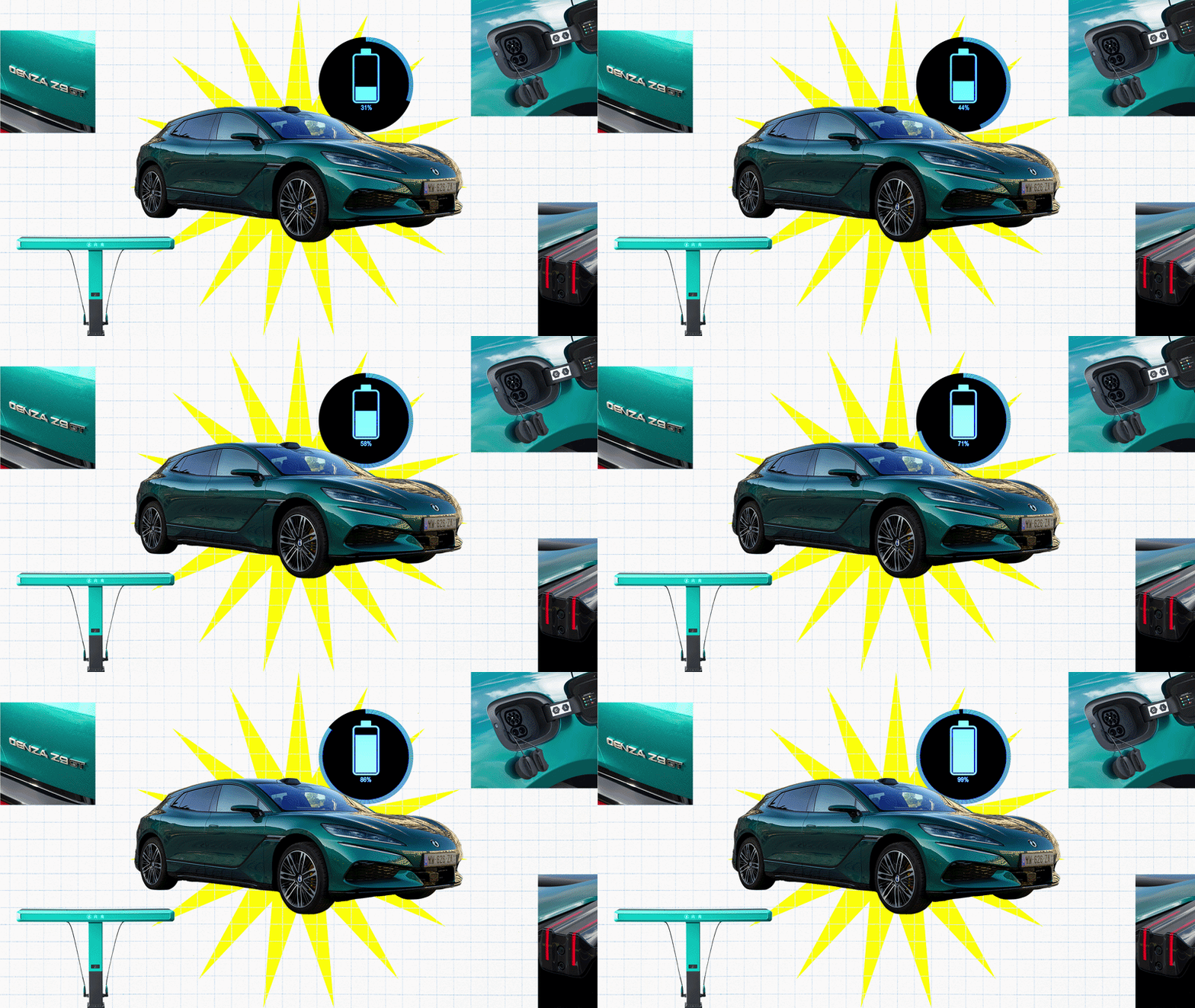
BYD has fundamentally broken the physics of electric vehicle charging, yet BYD's fastest-charging car in the world is now facing an uphill battle against its own premium pricing strategy. The Denza Z9 GT does not merely challenge the status quo; it renders the current definition of "fast charging" obsolete by completing a 10% to full charge in just over nine minutes. This performance is not a theoretical benchmark measured under ideal laboratory conditions but a verified reality witnessed on the test track, where internal resistance and heat generation have been tamed through radical engineering. While this technological leap offers a genuine solution to range anxiety, the vehicle's positioning as a €115,000 European flagship suggests a brand that has lost its way, attempting to buy entry into the luxury segment rather than earning it through value.
The Flash Charging Revolution Redefines EV Infrastructure
The core innovation behind the Denza Z9 GT is not merely speed but the management of energy flow at unprecedented levels without destroying the battery cells. Traditional lithium-ion batteries struggle when subjected to high current inputs because the resistance within the cell generates heat, which degrades the chemistry and forces charging speeds to taper off for safety. BYD's engineers have circumvented this limitation with the Blade Battery 2.0, a system utilizing cathodes with a multi-sized particle structure that acts like packing different-sized rocks into a container to maximize density and ion flow. This architectural shift effectively cuts internal resistance and heat generation in half, allowing the battery to accept massive power surges without degradation.
The implications for infrastructure are staggering. While current Tesla Superchargers top out around 325 kilowatts, BYD's new Flash chargers are capable of pushing 1.5 megawatts—equivalent to 1,500 kilowatts—directly into the pack. This capability transforms the charging experience from a chore that requires planning meals and rest breaks into a stop comparable to refueling a gasoline vehicle. The rollout plans indicate an aggressive expansion, with BYD targeting 6,000 new locations globally outside of China, including 600 sites in the UK alone. Once operational at full capacity, these stations promise to deliver a 10% to 70% charge in five minutes and a full charge in nine, rendering the "range anxiety" argument obsolete for early adopters.
Key technical breakthroughs driving this speed include:
- Blade Battery 2.0: Features a unique multi-sized particle structure that reduces internal resistance by 50%.
- Flash Charging Tech: Capable of delivering up to 1.5 megawatts, significantly outperforming current industry leaders.
- Thermal Management: Advanced cooling and self-repair mechanisms maintain cell integrity during high-speed cycles.
- LFP Chemistry: Retains the safety and cost benefits of lithium iron phosphate while achieving speed previously reserved for nickel-rich cells.
The Premium Pricing Paradox Undermines Value Proposition
Despite the technological marvel under the hood, the market strategy surrounding the Denza Z9 GT reveals a jarring disconnect between product value and consumer perception. BYD has historically built its global reputation on offering feature-rich vehicles at prices that undercut German incumbents like BMW and Mercedes-Benz by significant margins. The Z9 GT shatters this narrative with a European sticker price of €115,000 (approximately $134,000), which is roughly double the cost in Australia (£55,000) and triple the price in China (£45,000). This pricing discrepancy suggests that BYD believes it can extract a premium solely based on brand elevation rather than market value, a move that industry veterans view as a dangerous miscalculation.
Trust at the six-figure level is built over decades through consistent quality, heritage, and resale value, not through aggressive marketing or a single "wow" feature like a 2.7-second zero-to-60 time. The automotive market has already shown little mercy to new entrants that attempt to force their way into the luxury bracket; Porsche Taycans, for instance, are currently suffering from severe residual value losses, dropping up to half their worth in just one year. BYD executives claim the Z9 GT's "wow factor" will insulate it from such devaluation, yet there is little evidence that a Chinese brand can bypass the historical bias against non-traditional luxury automakers.
The vehicle itself offers a mixed bag of performance and practicality that struggles to justify the price tag on its own merits. While the 1,140 bhp output delivers hair-raising acceleration and the rear-wheel steering allows for crab-walking and tight U-turns, the driving dynamics feel disconnected from the car's weight. At nearly three tons, the Z9 GT feels heavier than it should, with heavy steering inputs and a ride quality that is described as "soft" rather than precise. The interior attempts to elevate the experience with Devialet audio systems and massaging seats for rear passengers, but these amenities alone do not bridge the gap between a high-tech appliance and a genuine luxury contender.
A Bold Gamble on Brand Value
The introduction of the Z9 GT represents a pivotal moment where BYD must choose between reinforcing its identity as a value leader or risking reputation to chase the premium demographic. The charging technology is undeniably world-class, potentially setting the benchmark for the next decade of electric mobility. However, the willingness to charge European customers more than double the global average suggests a brand that has forgotten the fundamentals of value proposition.
If BYD can deliver on its promise of rapid infrastructure expansion and prove that the Z9 GT is not just a fast car but an emotionally satisfying driving machine, it might eventually win over skeptical buyers. Until then, the strategy feels like a calculated risk that could backfire if the market decides that paying Porsche prices for a brand without the same heritage is simply too high a cost to bear.