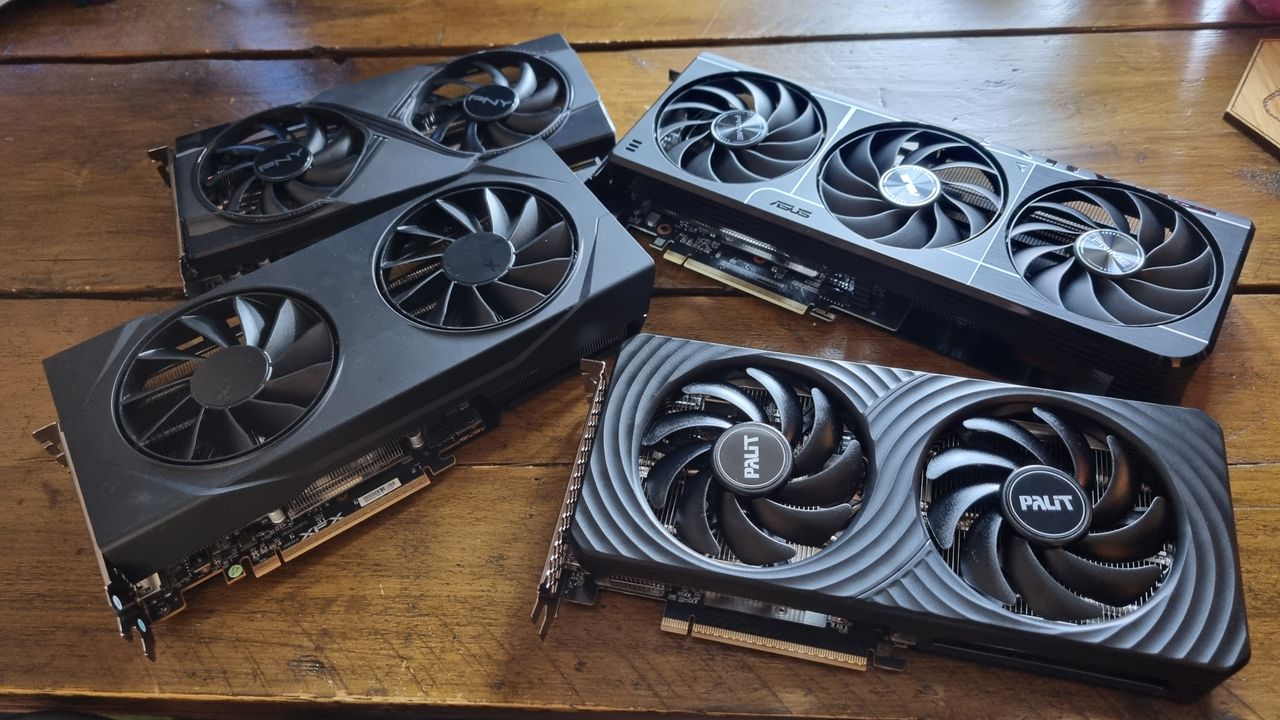
I've spent the past few weeks testing the pants off of several graphics cards—such is the life of a hardware writer. Alongside my VRAM capacity testing, I have reviewed the RTX 5060 Ti 8 GB and the RX 9060 XT 8 GB, finding that both deliver reasonable average gaming performance, though the Nvidia card definitely wins the day. Because the 16 GB versions are clearly faster overall, I had to ask: can overclocking 8 GB AMD and Nvidia graphics cards even the playing field?
To find out, I tweaked the twangers out of my 8 GB samples and ran them through our GPU benchmarking suite. I then compared that data against both the stock and overclocked performance of the RTX 5060 Ti 16 GB and RX 9060 XT 16 GB. The results are interesting: while overclocking 8 GB AMD and Nvidia graphics cards can often match their more expensive 16 GB variants in certain benchmarks, there are times when there is simply no replacement for VRAM.
My overclocking methodology
I kept the process simple to avoid chasing tiny percentage gains or fighting stability issues. I increased the core clock and memory speeds, running demanding benchmarks repeatedly until the GPUs crashed, then backed them down to a stable state. For most cards, I kept power levels at stock to ensure a fair comparison.
Here are the specific tweaks applied during my testing:
- RTX 5060 Ti 8 GB (Palit Dual): Limited to +350 MHz core and +5 overhead memory due to stock BIOS power limits.
- RX 9060 XT 8 GB (Asus Prime): Utilized a -100 mV undervolt to achieve a stable +300 MHz core and +200 MHz memory clock.
- RX 9060 XT 8 GB (Standard): Achieved a +300 MHz core and +300 MHz memory overclock at stock power levels.
- RTX 5060 Ti 16 GB (Palit Infinity 3): Provided data for comparison, showing that a +400 MHz core overclock alone offers significant gains.
All tested cards remained within safe temperature limits during these tests, though you should always monitor your thermals if attempting this yourself.
Can overclocking 8 GB AMD and Nvidia graphics cards bridge the gap?
When looking at performance at 1080p, all of our 8 GB samples showed average frame rate improvements over their stock counterparts. While these gains are often modest, there were notable exceptions. For instance, in The Talos Principle 2, the otherwise unimpressive RX 9060 XT 8 GB gained a full 10 frames, soaring from the bottom of my results to the very top.
However, do not take these results as a guarantee of what you will achieve with your own hardware. This is merely a demonstration of what basic techniques for overclocking 8 GB AMD and Nvidia graphics cards can potentially do. In some titles, the lack of VRAM remains an insurmountable hurdle that clock speeds alone cannot fix.
Black Myth Wukong (1080p High) Performance Data
| GPU Model | Avg FPS | 1% Low FPS | | :--- | :--- | :--- | | RX 9060 XT 8 GB Asus Prime | 71 | 58 | | RX 9060 XT 8 GB (OC: +300/+200/-100mV) | 75 | 67 | | RTX 5060 Ti 8 GB Palit Dual | 74 | 62 | | RTX 5060 Ti 8 GB (OC: +350/+500) | 80 | 69 |