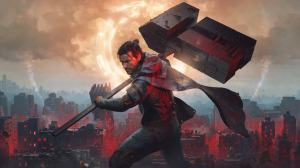
Control Resonant Reshapes the Narrative with Themes of Trauma and Redemption
If you watch the latest Control Resonant gameplay footage, you'll see a game that takes the fascinating supernatural world of Control and melds it with the exhilarating and fast-paced melee combat of a character-action game. It's new territory for Remedy Entertainment, a studio that has primarily made games where protagonists shoot guns, but that genre experience wasn't evident in what I played. The combat felt satisfying and weighty, and the dynamic between unique weapons and powers created a thrilling gameplay loop.
What you probably won't get a good grasp of, however, is that the man crushing monsters with a hammer, telekinetically launching a barrage of rocks, and delivering bone-shattering flame punches is the victim of years of mental torture, captivity, and, in many ways, abuse. In dispatching The Hiss, Dylan Faden is undoubtedly superhuman, but in facing the world outside The Oldest House, he is a fragile man robbed of normality, uneasy in his newfound freedom, and in search of redemption.
That shift towards themes of loneliness and pain was always the plan, according to director Mikael Kasurinen. Control was envisioned as a story of two siblings on two extremely different roads through life. While Jesse Faden connects with the supernatural on her own terms, going on to find her way to The Oldest House and become Director of The Federal Bureau of Control, Dylan Faden was stolen away, imprisoned, and forced to use his powers by scientists trying to forge him into a candidate for the role of Director.
Dylan is not the typical hero in the way that Jesse was. His backstory is the quintessential setup for a villain, and that is what makes him such a fascinating character in Control Resonant. Through Jesse, we got to see how a mostly ordinary person deals with the extraordinary. But through Dylan, Remedy also wants to explore the ordinary through the eyes of someone extraordinary.
This is presented as a focal point from the outset, when Dylan wakes to find that The Oldest House has been overrun and he needs to deal with the weirdness that awaits. He battles his way out with ease but hesitates before stepping out onto the streets of Manhattan. Dylan Faden hasn't seen daylight in many years, so to him, it is much stranger than a fridge you can't look away from or a floppy disc that gives you the ability to fly.
"That idea of discovering what his humanity is was really appealing to me because Jesse was strong and then had to figure out her purpose," explained Sean Durrie, the actor for Dylan. "He thought he had a purpose but needs to find his strength. And so that journey of becoming someone who was trying to atone for his past to become helpful, to become a hero in a way, was a thrilling kind of thing to tackle."
Kasurinen added: "I think it makes him more interesting because he's not that typical confident hero who knows exactly what to do and how to do it and just starts doing it. He hesitates. There's a lot of things coming at him. He's trying to figure out what's the right part for him and he is facing these different situations. What he does know is he wants to help. That's his core belief. But then how to navigate that strange situation they've been thrown into is what defines them. And I like that about Dylan. He's not your typical hero.
"Jesse comes from this world. She's like us, she steps into the paranatural strange reality and learns about it together with the player. We never really saw New York in the first game. We leave it behind right away; it's behind the glass wall. You can never go to that place in the first game.
"In this game we go towards [it], we step onto those streets and [embrace] Dylan being an outsider [to Manhattan], like Jesse was an outsider to the Oldest House. What's normal to us is strange to him and we use that a lot, how Dylan approaches certain situations. He might be totally unafraid of certain things that are horrific to us, but then when he finds a detail that is somewhat interesting to him. He can be mesmerized by that and excited about that while others are like, 'Well, that's graffiti, man. They're all over the place.'"
The atypical, outsider nature of Dylan is very disarming when you remember that, in the first game, he is characterized as a dangerous weapon that needs to be contained--a nuclear bomb in a box. As players, we learn that there were incidents where Dylan lost control of himself and killed others. But when we meet him in Resonant, he is meek, unsure, and almost childlike, which presents some interesting challenges from both a narrative and gameplay perspective.
"I do think there's strength in the idea that you have this sense of connection to a character who might have uncertainty about their purpose in life," said Kasurinen. "But Dylan is still, at the end of the day, unafraid of facing these things and ready to deal with them. That's something that you can immediately connect with. The worst nightmare for him is that he would become a monster that is a danger to others, but as long as he can help, you see that [better] side of him right away. I think you can project that power fantasy through that lens, right? Like, 'I'm going to help. I'm going to deal with these different threats,"
"From a performer's perspective, I did a lot of research into how humans respond to trauma and how that manifests as they get older too," explained Duffie. "What I learned is that it can revert you to younger ages even as you get older.
"It was really important for me not to dwell in it within the character because you don't want to wallow in it so to speak, but that's where that innocence comes from, because he was a victim of very awful treatment that colors the rest of his life. But now we are getting through that and so as he progresses and faces his demons, how does that change him?"
One of the more interesting meta-layers that is created by having Dylan take the starring role comes from the relationship that players have with Jess