The Soaring Cost of PC Gaming Memory: Is Speed Really Necessary?
PC gaming has always been an expensive hobby, even if you stick to entry-level hardware. Consequently, the majority of enthusiasts only upgrade their systems piecemeal, swapping out one component every so often or waiting many years for a new rig. However, if you were hoping to build a new gaming PC or update your CPU and motherboard this year, the shocking cost of DRAM kits right now is making the process considerably challenging. Back in July 2025, you could pick up a 32 GB kit of DDR5-6000 with a CAS latency of 30 cycles for under $90 during sales. Today, that same set costs $480 at Amazon, and if you want RGB lighting or brands like Corsair and G.Skill, the price rises even further. While cheaper options exist, such as a PUSkill kit for $370, it runs at just 4,800 MT/s with high latency, raising the question: do you really need fast memory for PC gaming?
The DRAM Test Setup and Methodology
To answer whether slower RAM impacts performance, I utilized a high-end test rig to ensure no bottlenecks masked the results. The setup included an AMD Ryzen 9 9900X paired with an Asus ROG Strix LC III 360 AIO cooler and an Nvidia GeForce RTX 5090 FE graphics card. Storage was handled by a 2 TB Samsung 990 Evo Plus SSD, powered by a Thermaltake ToughPower PF3 1050 W PSU and housed in a Thermal Grizzly Der8enchtable chassis.
- CPU: AMD Ryzen 9 9900X
- GPU: Nvidia GeForce RTX 5090 FE
- Motherboard Cooling: Asus ROG Strix LC III 360 AIO cooler
- Storage: 2 TB Samsung 990 Evo Plus SSD
- Display: Acer XB280KH monitor
- OS: Windows 11 25H2
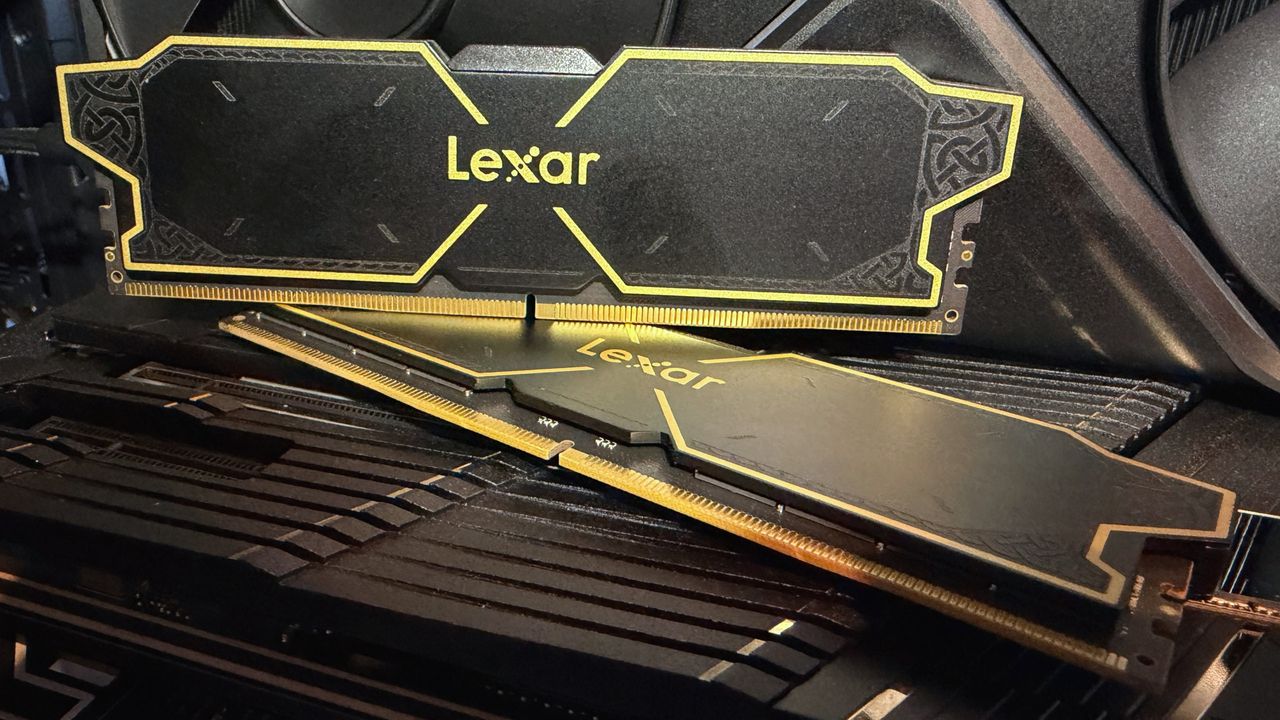
For the memory comparison, I used a set of Lexar Thor OC DDR5-6000 CL32. Without enabling EXPO in the motherboard BIOS, this kit defaults to running at 4800 MT/s with a CAS latency of 40 cycles. While not the absolute slowest DDR5 RAM available, it represents the kind of "cheap" memory currently flooding the market. I selected seven games: three where I expected no performance difference and four where I suspected slower DRAM would cause issues.
To ensure accuracy, each game saw five minutes of live gameplay (no built-in benchmarks) recorded via Nvidia's Frameview for average and 1% low frame rates at 1080p, 1440p, and 4K. Graphics quality was set to maximum, with ray tracing enabled in all supported titles except one. Crucially, I did not use DLSS upscaling or frame generation, as these technologies would artificially push constraints onto the CPU and prevent the hardware from being loaded evenly during testing.
Benchmark Results: Speed vs. Gaming Performance
When comparing the Lexar Thor OC DDR5-6000 CL32 against the slower DDR5-4800 CL40, the results were surprisingly uniform for titles that are not DRAM-sensitive. The 4,800 MT/s kit has 20% less bandwidth and a CAS latency 56% higher (16.7 ns vs 10.7 ns) than its faster counterpart, yet real-world gaming scenarios showed negligible differences in many cases.
Cyberpunk 2077 and Stalker 2: Negligible Impact
In demanding titles like Cyberpunk 2077 running at Ultra with Ray Tracing enabled, the slower memory set actually outperformed the faster kit slightly in average FPS. The RTX 5090 handled the workload regardless of whether the CPU had access to high-bandwidth RAM or not.
-
Cyberpunk 2077 (RT Ultra) at 1080p:
- DDR5-6000 CL32: 112 Avg FPS, 67 1% Low FPS
- DDR5-4800 CL40: 114 Avg FPS, 71 1% Low FPS
-
Black Myth: Wukong (Cinematic) at 1080p:
- DDR5-6000 CL32: 99 Avg FPS, 77 1% Low FPS
- DDR5-4800 CL40: 99 Avg FPS, 79 1% Low FPS
Similarly, in S.T.A.L.K.E.R. 2 and other tested titles, the frame rates remained virtually identical between the two kits. The GPU was often the limiting factor rather than memory bandwidth, meaning that for pure gaming performance, paying a premium for DDR5-6000 or faster may not yield tangible benefits in 2025.
Conclusion: Save Your Money on Memory Speeds
The data confirms that do you really need fast memory for PC gaming? The answer is generally no, especially if your primary use case is playing modern AAA titles at high resolutions. With the current market inflation driving DDR5 prices from under $90 to nearly $500 for the same capacity, opting for slower kits like DDR5-4800 CL38 or CL40 is a financially sound decision. While enthusiasts might argue for speed in productivity workloads or specific simulation games, the average gamer will see no real-world advantage that justifies the cost increase. In an era where memory costs have skyrocketed, prioritizing a better GPU or CPU often yields far superior gaming performance than chasing the latest DRAM speeds.