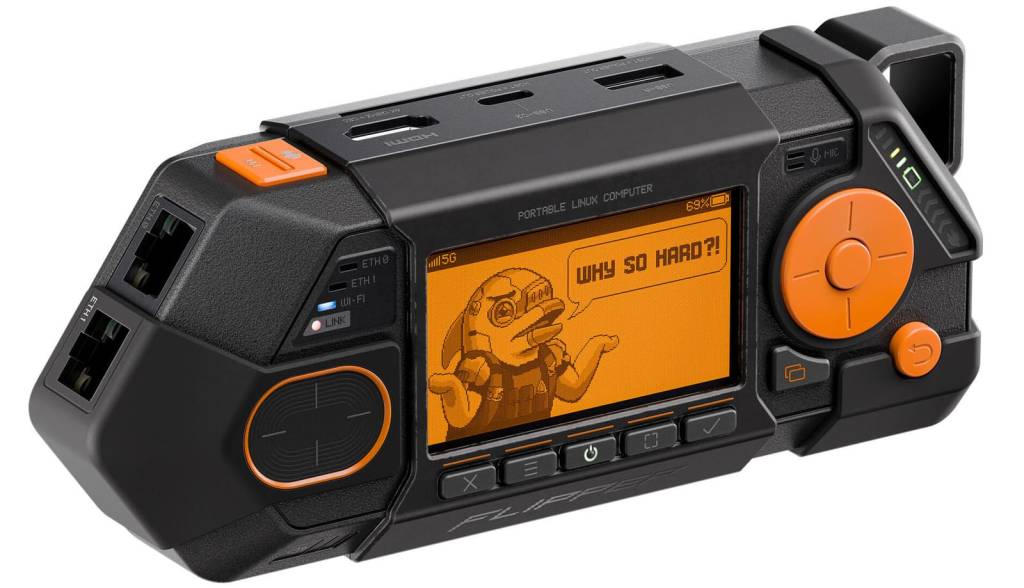
A New Era of Embedded Networking: The Flipper One
What defines a modern pocket computer: specialized radio sniffing capability or raw, multi-gigabit compute backbone? Flipper Devices’ introduction of the Flipper One challenges the established notion that powerful embedded tools must sacrifice deep networking versatility for dedicated hardware functionality. This device signals a significant pivot, moving beyond the impressive but niche capabilities of its predecessor, the Flipper Zero, to become a genuinely Swiss Army knife for advanced connectivity and localized computation.
The Flipper Zero excelled at radio connectivity, mastering RFID, NFC, and sub-1GHz frequencies. However, the Flipper One is not a successor in the traditional sense; it is a distinct evolution designed for the Linux-powered networking landscape. It targets hackers, researchers, and tinkerers who require more than just signal interception—they need a robust platform for active network manipulation and edge computing.
Architecting Compute Power: The Dual-Chip Philosophy
The architecture of the Flipper One speaks volumes about its intended use case: one that demands both high-throughput data processing and reliable low-level control. The decision to employ dual processors is not merely an exercise in redundancy; it is a deliberate separation of concerns between heavy lifting and persistent operation.
The primary brain features the eight-core RK3576 chip, designed for the demanding computational tasks inherent in modern embedded computing. This processor boasts Mali-G52 GPU support and a dedicated NPU (Neural Processing Unit) for on-device AI inferencing. It is this core that handles the bleeding edge of networking protocols and complex software stacks running an open Linux environment.
Contrasting this high-power compute unit is the second processor: the two-core RP2350 microcontroller. This component acts as the device’s nervous system, managing critical peripherals like the display, buttons, and power regulation. Crucially, this separation ensures that basic user interaction—the ability to view status indicators or input simple commands—remains functional even if the main Linux kernel crashes or is powered down for maintenance.
Unprecedented Connectivity for Tinkering
Where the Flipper Zero excels in its radio spectrum capture, the Flipper One dominates the wired and wireless networking landscape. The connectivity suite is built for integration into larger infrastructure projects, not just standalone sniffing missions. This includes redundant pathways such as two ports of Gigabit Ethernet, a specialized 5 Gbps USB Ethernet option, and modern Wi-Fi 6E support across multiple bands.
The concept’s true breadth, however, lies in its modularity via the M.2 port. This standardized expansion slot transforms the device from a mere gadget into a potential network hub or edge computing node. Potential additions underscore its architectural flexibility:
- 5G Modems: Integrating cellular connectivity for remote deployment in isolated environments.
- SDR Modules: Expanding spectrum reach far beyond the built-in radios for advanced signal analysis.
- NVMe/SATA SSDs: Providing persistent, high-speed local storage capacity for large datasets.
- AI Accelerators: Allowing the device to run increasingly complex machine learning models offline.
This hardware foundation enables the Flipper One to function as a versatile router, VPN gateway, or bridge. It can even serve as a Linux desktop via HDMI 2.1, supporting 4K@120Hz output. This allows users to run local AI models without any internet connection, ensuring privacy and operational independence in sensitive environments.
Software Evolution: Beyond the Operating System Shell
The operational vision for Flipper One hinges on software maturation, particularly the development of Flipper OS. The team recognizes that simply running a mainline Linux distribution, while powerful, lacks user-friendly workflow management for iterative hacking or prototyping. The planned Flipper OS aims to solve this by allowing users to manage distinct "profiles" containing curated package sets and configurations without resorting to physically re-flashing the underlying storage medium.
Furthermore, the inclusion of hardware controls like the FlipCTL interface suggests a deep commitment to physical interaction design. This enables sophisticated control over external displays using tactile input, bridging the gap between command-line efficiency and graphical user convenience.
While the device is still in development, with kernel support and LLM training remaining ongoing projects, the trajectory is clear. Flipper One is not just a tool; it is a platform for the next generation of network security and embedded computing, offering a level of control and flexibility that previous generations could not match.