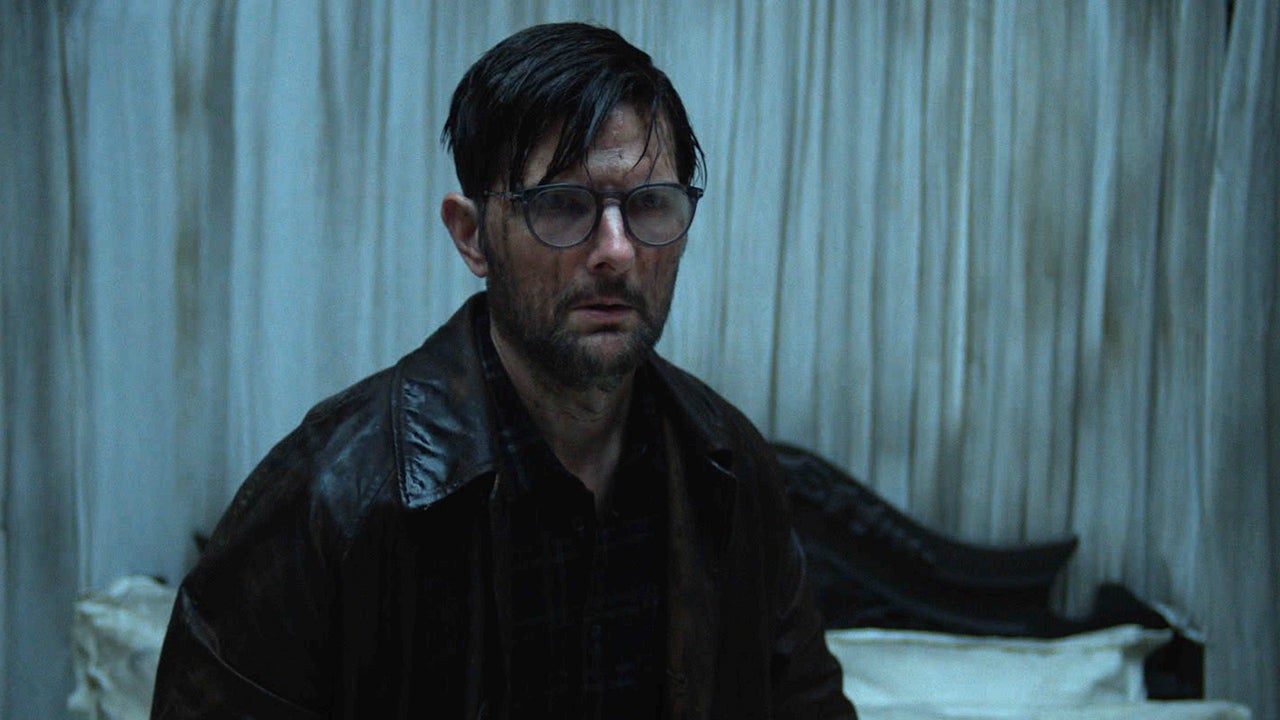
Hokum hits theaters on May 1.
Damian McCarthy’s Hokum throws a lot at the wall to see what sticks; unfortunately, little of it does. This movie is part Irish folklore, part murder mystery, part Stephen King riff (by way of a troubled writer at a haunted hotel), and a few other things thrown in for good measure. All of these come wrapped in a distant, haphazard aesthetic approach that robs the film of its tension and scares, resulting in too much and too little all at once.
McCarthy generally knows how to build tension, if his 2024 Irish supernatural revenge thriller Oddity is anything to go by. However, Hokum falls victim to stylistic over-familiarity from the moment it begins. Its opening images, removed from time, feature a desperate conquistador and his young ward wandering through the desert in search of water and treasure. They are soon revealed to be part of the writings of secluded American author Ohm Bauman (Adam Scott), who types away at his desk in the darkness. He spots a human shape on the stairwell in the distance, and then much closer to his table, but points his desk lamp at it, so it disappears. It’s a fun little flourish à la David F. Sandberg’s Lights Out, but this tug-of-war between light and dark is neither thematically nor narratively relevant from that point on; it’s just a trick McCarthy employs from time to time, so it loses tension with each successive appearance.
Soon after, Bauman makes the decision to travel to a tiny Irish hotel in a secluded forest in order to scatter his parents’ ashes. They’ve been dead for some time, and he hopes to honor them by returning to the site of their honeymoon. His emotional hardships have followed him there in the form of a figure resembling his mother, whose death he believes he had a hand in. This makes for a potent emotional setup, but would you believe that Bauman’s festering guilt, and this specter from his past, don’t actually have anything to do with the rest of the film?
The hotel staff quickly become key supporting characters, though Bauman’s rankled responses to their polite inquiries make him an enormous asshole. He’s more than just curmudgeonly; he’s downright detestable, to the point of burning the hand of an enthusiastic bellboy who claims to be a fan of his work. There’s complex, and there’s cartoonishly sinister, and Bauman so often crosses over into the latter that it’s hard to care about him as a human being. Before long, the hotel’s bartender, Fiona (Florence Ordesh) – one of the few people to show Bauman kindness – disappears, urging him to investigate the loose ends left by the local police as the hotel closes for the season. Oh, and there’s also a stranger in the woods who speaks of witches and magic mushrooms, a creepy groundskeeper who executes wild goats, and a manager who claims the hotel’s honeymoon suite is haunted and therefore keeps it shuttered.
Again, none of these things have any bearing on Bauman’s character, who enters the story with enough of his own troubles to fill an entire feature. Instead of building on this foundation, McCarthy overcomplicates his plot by introducing unrelated ghostly visions and supernatural elements vaguely tied together, until Bauman ends up in a kind of escape room scenario.
This isn’t inherently unworkable as a premise, but the film’s assembly is often too limp and scattered to adequately transform it into something breathtaking. Cuts between Bauman’s close-ups and POV shots of dark hallways are often confusing in their geography, which doesn’t bode well for a film of such contained physical surroundings, where escaping from one room to the next is so vital to the film’s plot. Memories from Bauman’s past start to manifest in the form of creepy cartoon characters come to life – one in particular is frequently present throughout the marketing – but this, like so many other ideas in Hokum, is but a temporary swerve.
McCarthy overcomplicates his plot by introducing unrelated ghostly visions and supernatural elements vaguely tied together.Scott, for his part, has always been a reasonably good dramatic actor despite his many comedic roles, but he’s saddled here with a mechanical saga wherein Bauman’s personal demons are only relevant in theory, and have little bearing on how things play out. He becomes, in the process, a non-presence who you would swap out with a table lamp for pretty much the same result.
As the plot lurches forward – often via conveniences brought on by the clockwork arrival and departure of secondary and tertiary characters at the hotel – it does so without a hint of emotional momentum, ultimately revealing its spookiest elements by straying further and further from its starting point. Neither Bauman’s past nor his work end up meaningfully reflected in (or impacted by) the hotel’s mysterious, witchy tale, which nonetheless becomes increasingly central to the semi-related mystery at hand. Each element feels plucked from an entirely different film, ultimately culminating in a revenge feature with pressing themes of misogynistic violence that McCarthy never really broaches.