Exoskeletons have long hovered on the periphery of consumer technology, transitioning from bulky medical necessities to experimental gadgets seen at tech showcases. While early iterations often felt more like cumbersome restraints than helpful tools, the industry is witnessing a pivot toward wearable robotics that actually integrate with human intent. The sheer volume of companies entering this space suggests we are moving past the proof-of-concept stage and into an era where motorized assistance becomes a standard accessory for specialized movement.
The primary hurdle for previous models has rarely been raw power, but rather the "uncanny valley" of kinetic timing. When assistance arrives a fraction of a second too early or too late, the user feels less like an augmented human and more like a puppet being jerked by invisible strings. Our Hypershell X Ultra S review finds that Hypershell aims to solve this fundamental friction through a software-driven approach designed to bridge the gap between machine torque and biological rhythm.
The HyperIntuition Breakthrough
The flagship X Ultra S represents a significant departure from the rule-based logic of its predecessors. Instead of simply detecting movement and applying a set amount of force, the device utilizes a new AI-based control system dubbed HyperIntuition. This algorithm processes continuous movement data to adjust torque in real time, attempting to mirror the irregular nature of human gait—the sudden stops, shifts in stride, and adaptations to uneven terrain that traditional systems historically struggled to interpret.
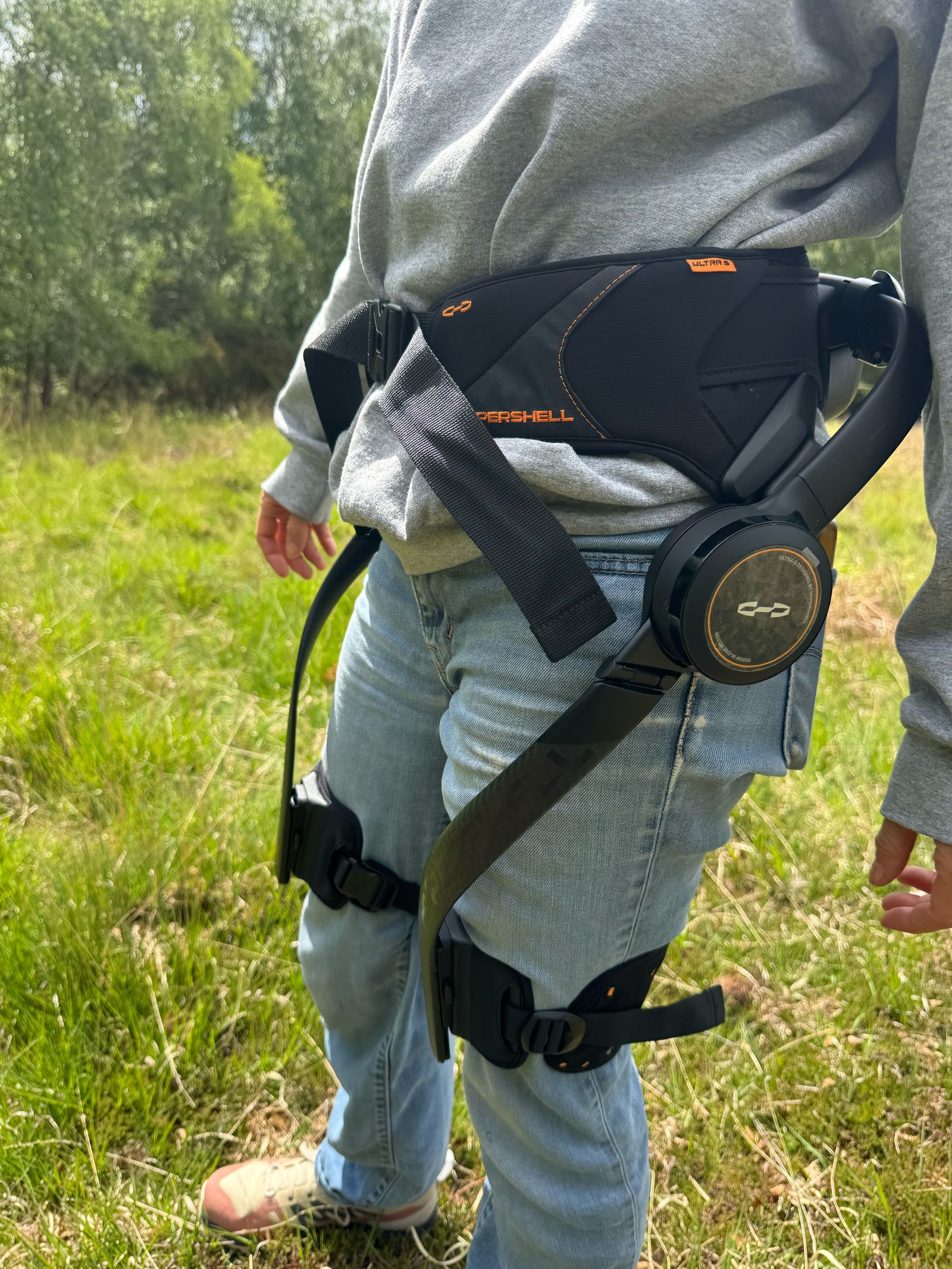
Hardware refinements accompany this software leap. The X Ultra S is constructed from a combination of carbon fiber and titanium alloy, bringing its total weight down to 5.5 pounds. While this is an impressive feat of engineering, the physical presence of the device cannot be understated; even at this lighter weight, the sensation of wearing a mechanical apparatus remains constant.
Key Technical Specifications
- Motor Output: Up to 1,000 watts and 22 Newton-meters of torque.
- Assistance Modes: 12 distinct modes covering stairs, gravel, dunes, and snow.
- Speed Ceiling: A maximum assisted pace of 15.5 miles per hour.
- Synchronization: A claimed human-machine synchronization rate of 97.5 percent.
The shift from reactive power to predictive assistance is the most notable change in this model. In testing, the system demonstrated a newfound ability to back off immediately when movement ceased, preventing that "robotic" jerkiness common in earlier models. When transitioning from flat ground to an incline, the Hypershell X Ultra S scales its support upward as the user's stride changes, providing a sense of propulsion rather than just forced movement.
Practical Limitations and Power Management
Despite the sophisticated software, the reality of wearing an exoskeleton involves several ergonomic compromises. The physical footprint of the device interferes with standard gear; front pant pockets become effectively useless, and the placement of the battery can create awkward mounting points for backpacks. Proper fitting is also paramount, as any misalignment between the motors and the hips can lead to discomfort or inefficient power delivery.
The most significant bottleneck remains battery longevity. While Hypershell claims a range of approximately 18 miles, this figure assumes the user is actively carrying and swapping spare batteries. Real-world application shows that high-intensity modes drain the cells rapidly:
- At 75 percent Eco assistance, a near-full battery may only provide roughly 4.2 miles of travel.
- High-power or "Hyper" modes can drop that range to under 2 miles.
This limitation dictates the device's utility; it is less a tool for cross-country exploration and more a specialized instrument for specific, high-effort segments of a journey. While there is an integrated cycling mode, its utility is somewhat hampered by the physical structure of the carbon-fiber rods, which make mounting or dismounting a bicycle a cumbersome process. Running in the device also feels "overcooked," as the mechanical assistance tends to fight against the natural fluidity of a high-speed stride.
Verdict: A Specialized Tool for Nuanced Terrain
The Hypershell X Ultra S is not a universal solution for human movement, but it is arguably the most refined attempt at consumer-grade augmentation to date. It successfully moves the needle from a "machine that moves you" to a "machine that assists you." By prioritizing timing and synchronization over sheer brute force, Hypershell has addressed the psychological barrier of wearing an exoskeleton.
While its high price point and niche applications may deter the casual walker, its value becomes undeniable when facing steep inclines or taxing environments. It is a specialized piece of kit—one that requires careful power management and a willingness to adjust one's gear accordingly. As sensor technology and AI continue to evolve, this device stands as a sophisticated blueprint for what the future of wearable robotics should look like: intuitive, responsive, and increasingly invisible.