Bluesky Is (Sorta) Down: A Decentralized Network Under Siege
It’s not just you — Bluesky is (sorta) down as the decentralized social network buckles under a concentrated digital assault this Thursday. What began as sporadic glitches around 2:42 a.m. ET has evolved into a persistent service degradation, leaving users staring at "Rate Limit Exceeded" errors while core features like the Discover feed and user profiles fail to load. Despite the underlying AT Protocol functioning for independent instances, the platform's official infrastructure is fracturing under strain, creating a stark paradox where the architecture designed to distribute power cannot withstand a coordinated attack.
The Architecture of Fragility Under Fire
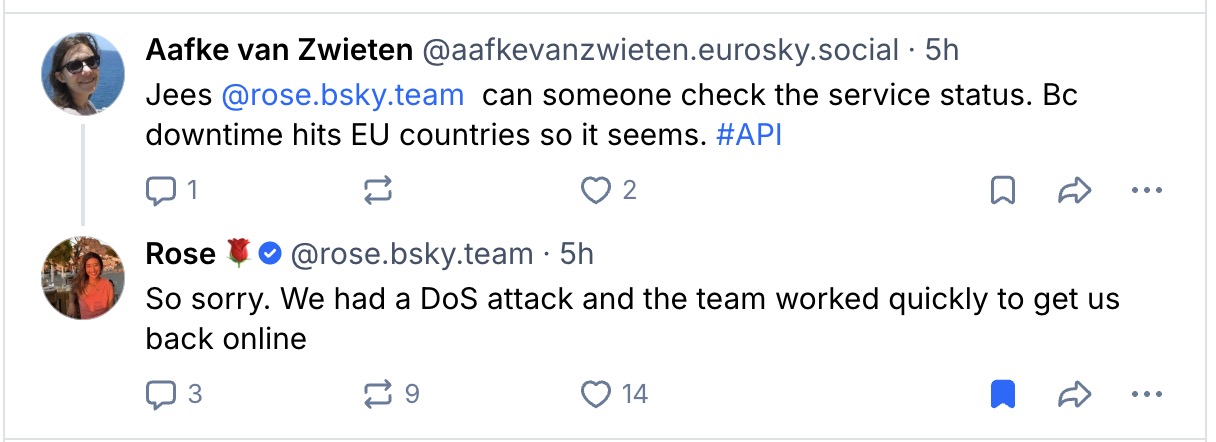
The nature of this outage points to targeted pressure on Bluesky's centralized nodes rather than a failure of the AT Protocol itself. Users attempting to refresh feeds or navigate communities are met with cryptic server messages indicating that traffic has outstripped available capacity. COO Rose Wang has identified a denial-of-service attack as the likely culprit, where bad actors flood entry points to choke the system.
This assault exploits the tension between the platform's decentralized philosophy and its current reliance on centralized servers for identity and discovery:
- The Discover feed frequently returns errors, forcing users into an indefinite wait or requiring repeated retries.
- Personal home feeds load sporadically, creating a fragmented reality where some content appears while other parts remain inaccessible.
- Direct navigation to user profiles results in hard failures that refuse to clear with constant refreshing.
- Error messages explicitly cite high traffic and rate limiting, signaling a saturation of API endpoints rather than a total crash.
Protocol engineer Bryan Newbold acknowledged the severity early Thursday, offering a blunt assessment: "oof, our services are getting pretty hard tonight." This candid admission underscores the vulnerability of a platform in transition; while the vision is to distribute authority across thousands of independent servers, discovery mechanisms and identity verification still rely on central points of failure. When those hubs are hammered by a coordinated attack, the user experience fractures regardless of how robust the underlying code might be.
The Decentralization Paradox in Practice
Bluesky's current struggle highlights a critical distinction between the theoretical resilience of a protocol and the operational reality of its implementation. Other communities running their own infrastructure on the AT Protocol appear to be functioning normally, suggesting the problem lies specifically with Bluesky's primary services rather than the network as a whole. Independent servers hosted by third-party providers continue serving content for configured users, proving that the protocol is not the bottleneck.
However, the average user navigating the official application or relying on the main discovery feed is left stranded when the central coordination layer fails. This dichotomy exposes the growing pains of a platform attempting to scale while migrating its trust model. The "sorta down" nature of the outage—where parts work intermittently while others are completely blocked—is characteristic of a system hitting hard limits on bandwidth or processing capacity.
Unlike traditional networks where a single point of failure brings everything offline instantly, Bluesky's situation is more granular, creating a chaotic experience where functionality depends entirely on which server instance a request is routed to at any given millisecond. Without an official timeline for resolution beyond the status page, users are left in limbo while speculation about long-term stability grows.
The Road Ahead for Decentralized Social Media
The resilience of Bluesky in this outage will determine whether its decentralized model can be a viable alternative to giants like X or Meta-owned platforms. If the platform recovers and implements more robust distribution mechanisms for discovery and identity, it may emerge stronger from the incident. However, if central nodes remain single points of failure susceptible to attacks, the promise of decentralization could become mere marketing rather than functional reality.
For now, the user experience is defined by latency and error messages, but the underlying technology remains intact for those willing to navigate the complex landscape of independent instances. As Bluesky navigates this instability, the industry watches closely to see how they balance a seamless user experience with the structural demands of their open protocol. The coming weeks will reveal whether the network can absorb these shocks or if they represent the limits of its current growth trajectory.