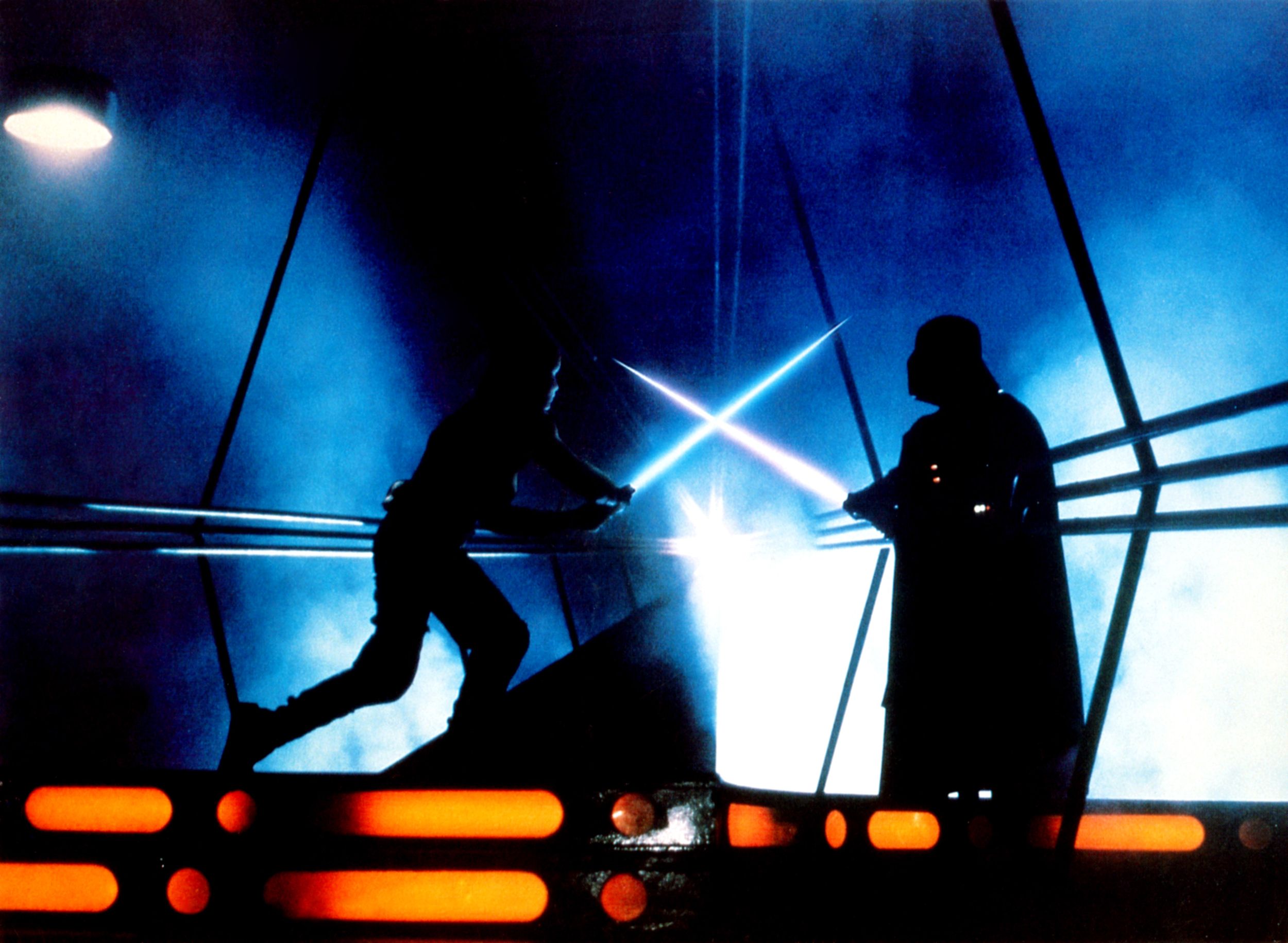
If the tip of a lightsaber blade possesses no mass, why does the weapon swing with the unmistakable momentum of a physical blade? While the name suggests a weapon composed entirely of electromagnetic radiation, the physics of cinematic combat tells a much different story. The behavior of these iconic weapons contradicts the very definition of "light" as we understand it in modern physics.
Beyond Electromagnetic Radiation
The term "laser sword" is a common misnomer used by characters throughout the saga, but the science simply does not support it. A laser consists of photons—massless particles of light. If a lightsaber were truly a beam of pure electromagnetic radiation, the fundamental mechanics of a duel would be impossible to execute.
There are several physical reasons why a purely massless beam fails as a weapon:
- Lack of Collision: Laser beams pass through one another without resistance; they cannot "clashing" or parrying in the way swords do.
- Visual Inconsistency: Without a medium like smoke or dust to scatter the light, a laser beam is invisible from the side, making the iconic glowing blades impossible to see during a fight.
- Zero Inertia: A massless object would require no effort to accelerate or stop, resulting in movements that would appear unnaturally fast and weightless.
To achieve the heavy, rhythmic strikes seen in the films, the blade must possess some form of physical substance that interacts with the environment.
The Mechanics of Angular Motion
Understanding the weight of a lightsaber requires a move away from linear motion and toward angular motion. When a combatant swings a weapon, they are managing torque ($\tau$)—the rotational force applied to the hilt. This movement is governed by the moment of inertia ($I$), which represents an object's resistance to changes in its rotation.
The moment of inertia is not solely dependent on total mass, but also on how that mass is distributed relative to the pivot point (the hilt). If a blade were massless, rotating the hilt would be as effortless as spinning a laser pointer. However, Jedi and Sith alike exhibit visible struggle when accelerating and decelerating their swings. This resistance suggests that the energy field of the blade carries enough "stuff"—protons, neutrons, or perhaps stabilized plasma—to create significant rotational inertia.
Locating the Center of Mass
The most definitive evidence for a massive blade can be found by analyzing the center of mass during high-velocity movements. In Return of the Jedi, a pivotal moment occurs when Darth Vader hurls his lightsaber at Luke Skywalker. By observing the weapon's rotation in flight, the truth becomes clear.
If the blade were comprised only of light, the weapon would rotate around the center of the hilt, as there would be no weight to pull the balance point forward. Instead, the saber rotates around a point shifted significantly toward the tip. This shift proves that mass is distributed along the length of the blade, pulling the center of gravity away from the handle. The physical behavior of the weapon in flight confirms that the "light" being manipulated has measurable density.
The debate over the nomenclature of the lightsaber may be settled by these laws of motion, even if the underlying technology remains a mystery. Whether the blade is a contained plasma field or a stream of high-energy particles, it is clearly not mere light. The weight of the blade is exactly what gives the duel its stakes, transforming a simple beam of energy into a weapon of tangible, physical consequence.