Meta is doubling down on its strategy for social fragmentation with the quiet launch of Forum, a new standalone app designed to mimic the structure of Reddit. Positioned as a dedicated space for "deeper discussions," this latest tactical move in Meta’s campaign to dominate user attention spans effectively wraps a Reddit-like interface in Facebook’s existing social graph.
This is not an innovation born from sudden user demand, but a structural pivot driven by Meta’s internal belief that AI-driven efficiency allows it to multiply its digital real estate without proportional cost. By creating specialized hubs for specific types of interaction, Meta aims to capture niche communities while keeping users firmly within its proprietary ecosystem.
A Specialized Hub for Facebook Groups
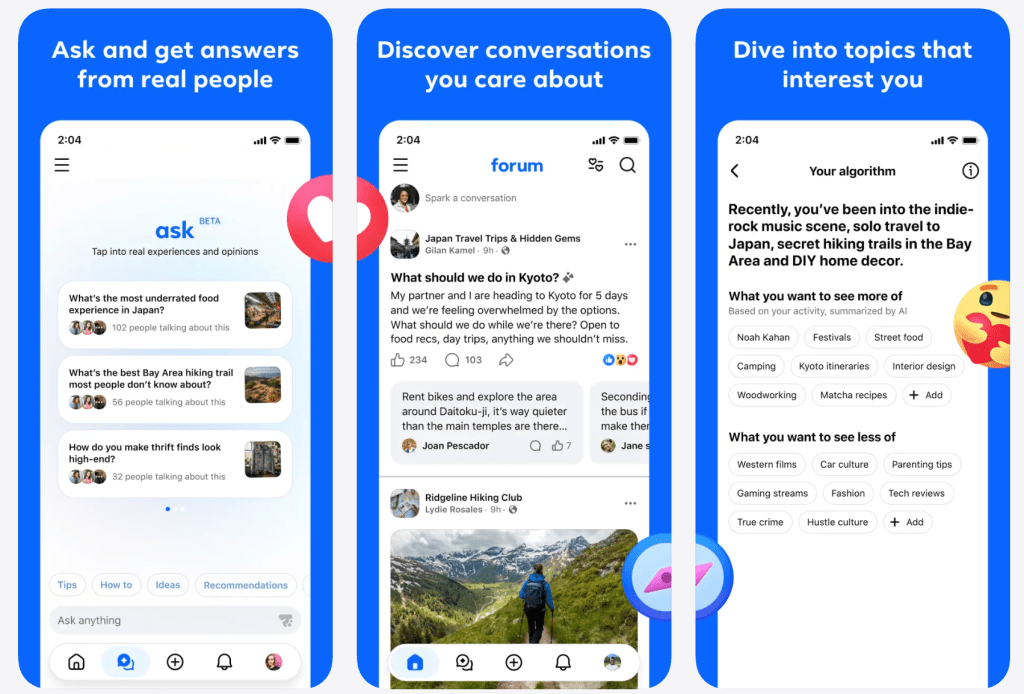
The application, first identified by social media consultant Matt Navarra, functions primarily as a specialized hub for Facebook Groups. Upon signing in with existing credentials, users are greeted with feeds centered on group conversations rather than the algorithmic chaos of the main Facebook timeline.
The app promises a cleaner, more substantive experience through several key features:
- Threaded Discussions: Users can engage in conversations that feel more structured than the typical social media scroll.
- Nickname Posting: To encourage community identity, users can post using a nickname rather than their real name.
- AI-Powered "Ask" Tab: This feature compiles answers from across different groups, leveraging Meta’s data infrastructure to provide curated insights.
- Admin Assistance: Built-in tools help group moderators manage content more efficiently.
However, the underlying architecture ensures that nothing truly leaves the Meta ecosystem. Content shared on Forum remains visible in the user’s primary Facebook groups, creating a seamless but inescapable loop of engagement. This design choice highlights Meta’s goal: to offer the feel of a new platform while harvesting data from its existing massive user base.
The AI-Driven Push for App Multiplication
The existence of Forum is directly tied to a broader corporate directive issued by CEO Mark Zuckerberg. According to reports from the Wall Street Journal, Zuckerberg has challenged his team, specifically Chief Product Officer Chris Cox, to consider building dozens of new applications. The rationale is that AI-driven efficiencies have lowered the barrier to development, allowing Meta to replicate successful features from other platforms without bearing the full historical cost of building them from scratch.
This approach mirrors the rollout of Instants, a separate app launched last month that enables disappearing photo sharing with Instagram friends. This is a clear derivative of Snapchat and BeReal’s core mechanics. The pattern is becoming unmistakable:
- Meta identifies a successful niche or feature in the broader tech landscape.
- It strips the feature of its unique brand identity.
- It repackages the mechanics as a standalone Meta product.
The logic behind this "build 50 new apps" mentality is twofold. First, it allows Meta to capture users who might otherwise abandon the main Facebook app in favor of a specialized community platform. Second, it leverages Meta’s massive data infrastructure to optimize these new apps, giving them an unfair advantage in moderation and content distribution. These AI features are not just conveniences; they are data-harvesting mechanisms designed to deepen user dependency on Meta’s proprietary tools.
A History of Failed Standalone Experiments
Meta is no stranger to the pitfalls of standalone social apps. In 2014, the company launched a dedicated Groups app with the intent of making cross-group content sharing easier. That effort was shuttered in 2017, largely because users preferred the convenience of the all-in-one Facebook experience. The failure of that previous iteration suggests a user base that is resistant to fragmentation, at least when it comes from the same parent company.
Forum attempts to circumvent this resistance by framing itself not as a separate social network, but as a specialized tool for those who already use Facebook Groups. By positioning the app as a "dedicated space built for deeper discussions," Meta is acknowledging a fatigue with the main platform’s noise. The promise is to let users "pick up where they left off" in conversations, offering a curated feed that prioritizes community interaction over trending virality.
However, the distinction between Forum and its competitors is blurring. As Reddit faces its own challenges with API changes and algorithmic shifts, Meta is well-positioned to capture the overflow. But capturing users is different from retaining them. The history of Meta’s app portfolio—ranging from the defunct Groups app to the recent Meta Edits, a copy of ByteDance’s CapCut—suggests a pattern of replication rather than creation.
The Fragmentation Gamble
The launch of Forum raises critical questions about the future of social media infrastructure. If Meta continues to split its services into dozens of specialized apps, the user experience will become increasingly fragmented. Users will find themselves managing:
- Multiple logins for a single corporate entity.
- Multiple notification centers to monitor different facets of their social life.
- Multiple data profiles that track behavior across various interfaces.
The benefits for Meta are clear: more touchpoints for data collection, more opportunities for ad insertion, and a diversified portfolio that mitigates risk if one platform faces regulatory scrutiny. The costs, however, fall on the user. The promise of "deeper discussions" in Forum is undermined by the fundamental reality that the platform is designed to extract value, not to foster genuine community.
As Meta scales this strategy, the industry must watch closely. The move to build dozens of new apps is not just a product update; it is a declaration of war on the concept of a unified, user-owned digital identity. Whether this fragmentation will ultimately strengthen Meta’s monopoly or erode user trust remains the central tension in the company’s future. For now, Forum is just another door into the same house, with slightly better lighting but the same invisible walls.