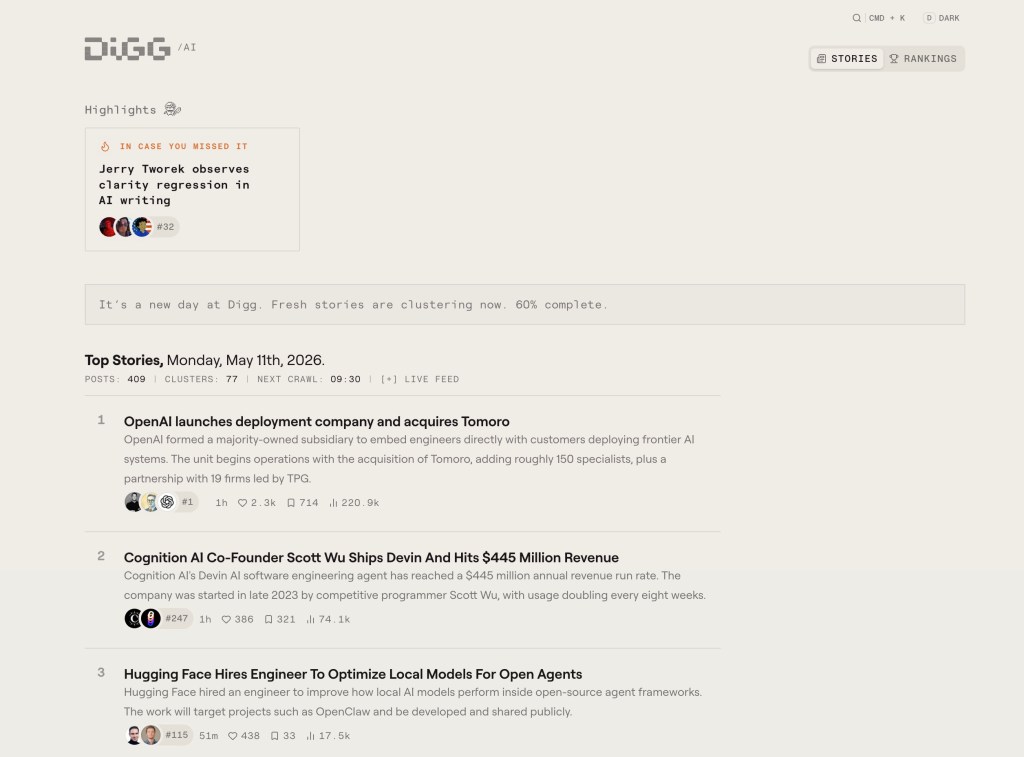
Digg Returns as an AI News Aggregator
The digital landscape is reshuffling once again as Digg reemerges, this time not as the social link-sharing platform that defined the early web, but as a specialized AI news aggregator. Kevin Rose’s renewed venture is aiming to recalibrate its identity after previous iterations faltered, pivoting toward a model that emphasizes real-time sentiment analysis and engagement tracking drawn from X (formerly Twitter). This strategic shift targets the fast-moving discourse surrounding artificial intelligence, attempting to capture value in a niche where traditional platforms are struggling to keep up.
A New Data-Driven Strategy
Digg’s pivot hinges on leveraging external engagement signals from X to surface trending topics, particularly within the AI sector. Rather than relying solely on its own internal metrics, the platform tracks data such as views, comments, and saves across curated feeds from the broader internet ecosystem. This approach allows Digg to identify stories gaining momentum in real time, sidestepping the reliance on traditional engagement data harvested internally by competitors.
The technical foundation of this transformation rests on three core pillars:
- Real-time sentiment analysis: By parsing conversation patterns on X, Digg aims to distinguish genuine influence from noise, filtering out the signal to find what truly matters.
- Dynamic metric aggregation: Engagement figures are pulled from multiple sources, offering a holistic view of public interest that goes beyond simple click counts.
- Focused topical depth: Initially concentrating on AI ensures specialized expertise in curating high-value content before expanding to other verticals.
Challenges Ahead
Despite ambitious technical goals, Digg faces significant hurdles in user adoption and content differentiation. Many news consumers already rely on X for breaking updates, raising critical questions about whether Digg can provide compelling reasons for users to switch platforms or even open a second tab.
Additionally, expanding beyond AI topics requires establishing credibility across new verticals—a challenge amplified by rapid shifts in digital ecosystems following corporate takeovers and algorithmic changes. The startup must also balance raw experimentalism with usability. Beta feedback highlights the site’s current “buggy” nature and incomplete feature set, emphasizing that iterative improvement is essential before long-term engagement can be assured.
Broader Industry Implications
Digg’s experiment reflects a growing trend toward AI-powered content curation, where platforms harness machine learning to interpret complex social dynamics rather than passively displaying headlines. This mirrors broader industry efforts to integrate natural language processing and predictive analytics into news delivery pipelines, moving away from static feeds toward intelligent interpretation.
However, sustainability depends on demonstrating tangible value beyond novelty. For Digg to succeed, it must show whether it can improve discoverability for publishers or provide genuinely enriched reader experiences. As AI reshapes information flows globally, ventures like Digg illustrate how legacy platforms adapt by embedding intelligence directly into their distribution mechanisms.
Conclusion
Success will ultimately hinge not only on technical sophistication but on delivering consistent relevance that justifies user commitment amidst an increasingly fragmented media environment. Key terms like engagement metrics, sentiment analysis, and content aggregation underscore the technical foundations supporting this transformation.
While early results remain preliminary, the venture signals a strategic shift toward smarter, more responsive news ecosystems capable of surfacing what truly matters in an age of information overload. The coming months will reveal whether Digg’s data-driven model can carve out a sustainable niche, offering stakeholders a critical case study in balancing ambition with practical constraints as AI continues to redefine how we access and interpret knowledge online.