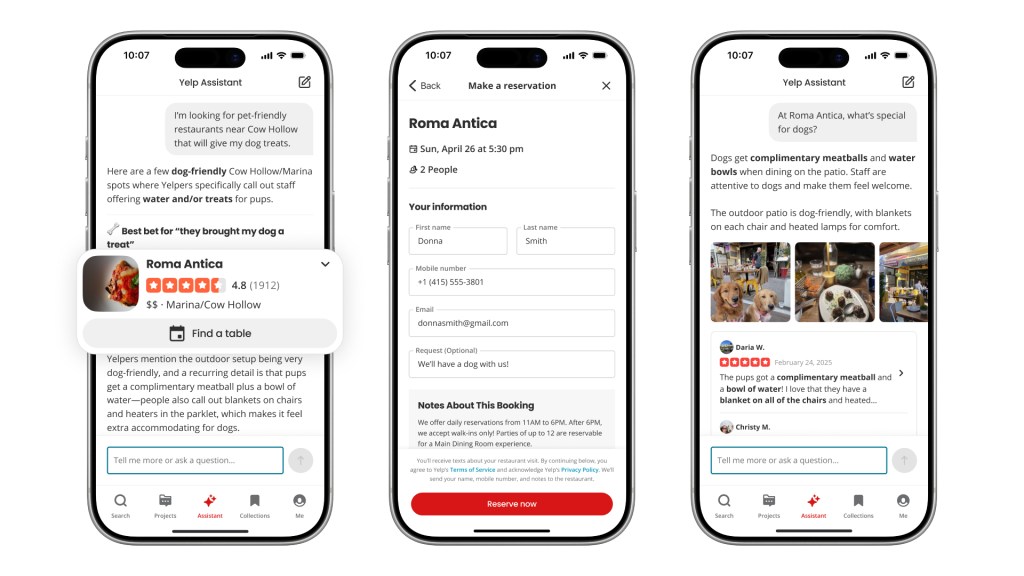
For years, the fundamental purpose of a review platform has been to facilitate decision-making through observation. However, Yelp’s updated AI assistant is attempting to collapse the distance between reading a critique and executing a transaction. This new direction suggests a pivot away from mere user retention toward an aggressive pursuit of utility, transforming the app from a passive information repository into an active transactional hub.
How Yelp’s updated AI assistant Drives Action
The core of this evolution lies in a significant shift in how users interact with the platform. While the company first introduced conversational AI capabilities in 2024 as a tool for navigating service queries, the latest iteration aims to handle both inquiry and fulfillment within a single continuous flow. This marks a transition from an "answers" platform to an "answers and action" platform.
The capabilities of Yelp’s updated AI assistant extend far beyond simple restaurant recommendations. Users can now initiate complex, multi-step planning sessions—such as finding dog-friendly hiking trails and then immediately ordering takeout for the return trip—without ever exiting the chat interface.
To ensure reliability, the technical foundation is designed to mitigate the "hallucination" risks common in large language models. The assistant's responses are grounded in specific business data, official websites, and verified user reviews to ensure accuracy. To facilitate higher frequency of use, Yelp has redesigned its mobile interface, placing the AI assistant in a prominent new tab at the center of the bottom navigation bar on both iOS and Android.
A Network of Integrations for Booking and Delivery
While the vision is one of seamless conversation, the current execution relies heavily on external partners to bridge the gap between asking and doing. At present, the assistant acts as an intelligent dispatcher rather than a fully autonomous agent capable of completing all financial transactions internally.
This ecosystem of integrations allows users to trigger specific actions through the chat window that lead to specialized third-party services:
- Food Delivery: Directing orders through DoorDash and Grubhub.
- Personal Services: Booking beauty and fitness appointments via Vagaro.
- Healthcare: Coordinating medical consultations through ZocDoc.
- Automotive: Arranging vehicle maintenance via Repairpal.
- Scheduling: Utilizing Calendly for various business appointment bookings.
This reliance on redirection highlights a critical distinction in the current AI landscape: while Yelp is moving toward an agentic workflow, it has not yet achieved true autonomy. The user experience currently involves being handed off to another app or web page to finalize payments. However, company leadership has hinted that this "redirection" model may be a temporary bridge toward a future where the entire transaction lifecycle occurs within Yelp's own architecture.
Advanced Visual Tools for Users and Merchants
The update also extends into the realm of computer vision and media management. Recognizing that modern diners often rely on "food porn" to make decisions, Yelp has implemented a feature allowing users to scan physical menus and see real-world photos of dishes posted by previous customers. Furthermore, the platform is introducing natural language queries for media galleries, allowing users to search through a business's photo collection using descriptive prompts rather than rigid keywords.
For merchants, the integration of AI offers significant operational advantages. Yelp is rolling out an automated feature that uses AI-powered tagging and grouping for "before and after" photos. This reduces the manual labor required for service providers—such as house painters or hair stylists—to maintain an organized and professional digital storefront.
The Verdict: A High-Stakes Pivot
Yelp's move toward a transactional AI model is a calculated risk that challenges the traditional boundaries of the review industry. If successful, the platform will have bypassed the friction of the "search-and-click" era, providing a streamlined utility that competitors like Google Maps or TripAdvisor will find difficult to ignore.
The ultimate success of this initiative depends on whether Yelp can move beyond mere redirection and master end-to-end transaction management. The industry is watching to see if Yelp can evolve into a true digital concierge, or if the friction of jumping between disparate apps will ultimately break the conversational magic they are trying to create.