Is there any metric of human physical achievement that remains truly safe from the encroachment of autonomous systems? The recent news that a humanoid robot set a half-marathon record in China suggests that the gap between biological endurance and mechanical precision is closing far faster than many anticipated.
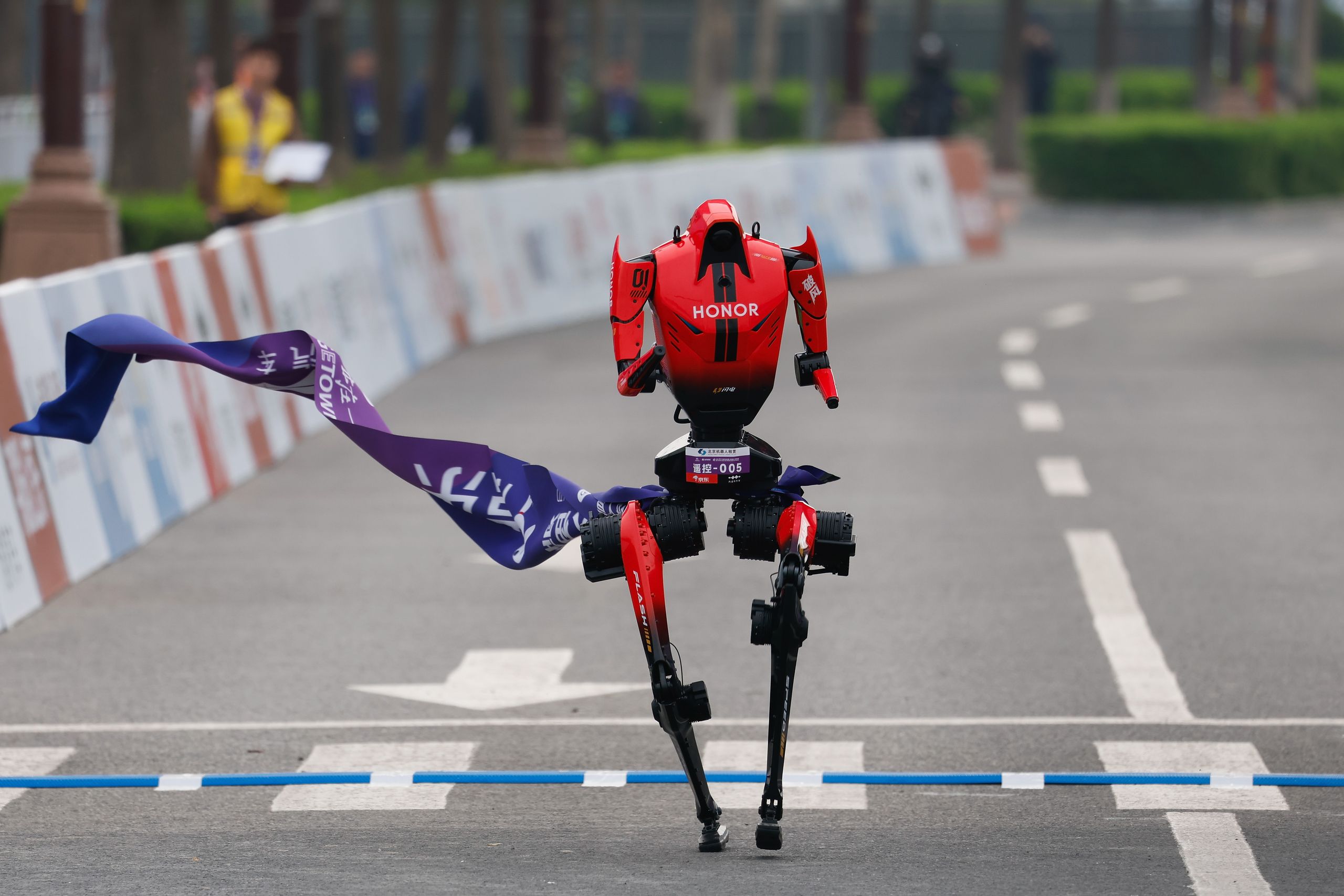
At the conclusion of the E-Town Humanoid Robot Half Marathon in Beijing, a robot developed by the Chinese technology firm Honor crossed the finish line with a time of 50 minutes and 26 seconds. This performance effectively shattered the existing human world record held by Olympic medalist Jacob Kiplimo by over seven minutes.
Rapid Advancements in Robotic Endurance
The leap in performance is staggering when compared to recent benchmarks. Just twelve months ago, the fastest participating robot struggled to complete the same distance in two and a half hours.
This sudden compression of performance metrics highlights a period of hyper-accelerated development in robotics engineering and AI-driven locomotion. It signals that the era of machines performing specialized physical tasks with superhuman efficiency is no longer just a theoretical concept.
Engineering the Humanoid Robot Half-Marathon Record
The Honor unit's success was not merely a matter of raw speed, but of highly specialized hardware integration designed to mimic—and then exceed—the capabilities of elite human athletes. To sustain such an intense pace over 13.1 miles, the machine utilized several key architectural advantages:
- Advanced balance systems to maintain stability during high-velocity strides and rapid direction changes.
- Extended limb geometry, featuring legs measuring nearly one meter in length to maximize stride efficiency.
- A specialized liquid cooling mechanism, adapted from smartphone thermal management technology, to prevent motor and processor overheating.
- Real-time AI algorithms that allow the robot to adjust its gait and adapt to terrain changes autonomously.
The Gap Between Remote Control and Autonomy
While the autonomous Honor unit delivered a record-breaking performance, the event also showcased a more directed form of precision. A secondary robot from the same manufacturer, operated via remote control, completed the course in a blistering 48 minutes and 19 seconds.
This distinction highlights a critical frontier in current research: the difficult transition from remotely piloted machines to truly independent agents capable of navigating unscripted environments without constant human oversight.
The Challenges of Real-World Navigation
Despite the headline-grabbing victory, the race was far from a seamless display of mechanical perfection. Among the 100 robots representing 76 different institutions, several technical failures were on display as machines veered off course or suffered total collapses.
This lack of reliability serves as a reminder that while computational intelligence can optimize for a predetermined straight line, it has yet to master the chaotic variables of the real world, such as unpredictable weather or complex social navigation.
A New Era of Technological Competition
The event itself was a massive undertaking, featuring 12,000 human runners alongside the robotic participants. While the two groups ran on separate courses to mitigate the risk of accidents, the contrast in performance was impossible to ignore.
The sheer scale of the competition underscores a broader strategic push by China to demonstrate global leadership in advanced robotics. This follows recent viral displays of robotic martial arts and high-precision movement that suggest a coordinated effort to showcase the maturity of domestic AI hardware.
The achievement in Beijing is more than a mere sporting anomaly; it is a calculated demonstration of technological dominance. There is an inherent distinction between seeing a car outrun a human and seeing a humanoid robot outperform us at our own biological specialty.
As machines begin to redefine physical limits, the industry must move beyond specialized speed and toward the nuanced, delicate movements that define human existence. For now, the record books have been rewritten, but the race for true autonomy is only just beginning.