The rapid acceleration of generative AI in drug discovery has created a paradoxical crisis. The industry is no longer struggling to find potential cures, but rather struggling to prove they actually exist. As AI-generated potential drugs flood the pipeline, we are witnessing an unprecedented expansion at the "top of the funnel."
However, this digital leap forward has exposed a massive physical bottleneck in the laboratory. While models like Google DeepMind’s AlphaFold have revolutionized protein structure prediction, the "bottom of the funnel"—the actual verification and characterization of molecules—remains stuck in a manual, labor-intensive era.
The Bottleneck: Why AI-generated potential drugs are hitting a wall
The sheer volume of candidates is currently overwhelming the traditional infrastructure of biopharma. When researchers use deep learning to design a molecule for a specific disease, they are left with a digital blueprint that requires rigorous physical testing. This process is essential before any candidate can enter clinical trials.
A critical part of this validation involves measuring the mass and charge of molecules through mass spectrometry. While this technique is vital for determining chemical composition, it is notoriously difficult to scale. The data produced by modern spectrometry is incredibly dense and requires significant human expertise to interpret accurately.
For many biotech firms, the cost of maintaining high-end equipment and employing specialized scientists is prohibitive. This gap between digital prediction and physical validation is exactly what 10x Science aims to close.
10x Science: Automating the verification of AI-generated potential drugs
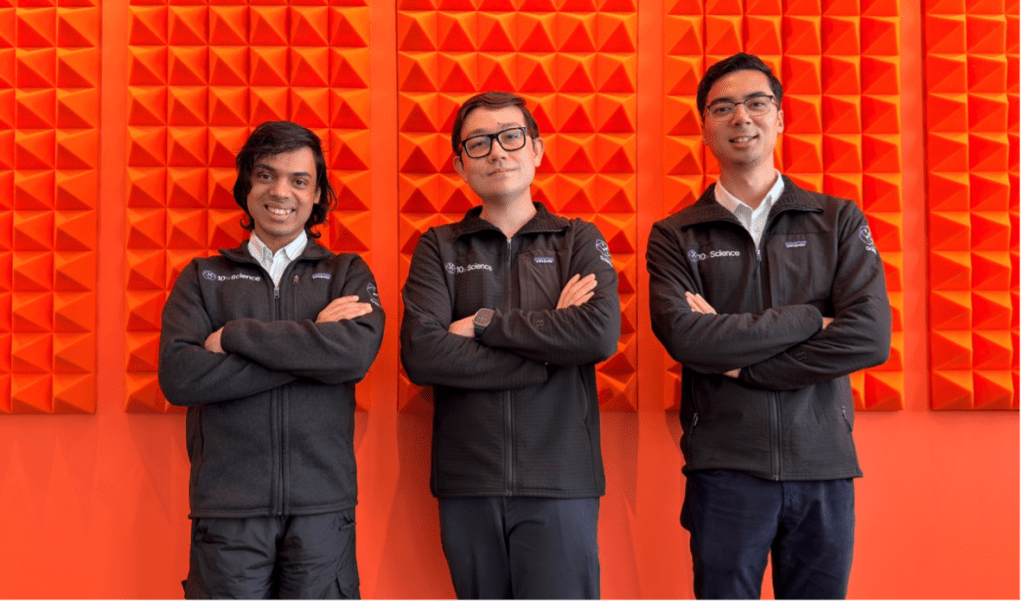
The startup recently announced a $5.8 million seed round led by Initialized Capital. 10x Science is positioning itself as the essential middle layer of the drug discovery pipeline. The company was founded in late 2025 by chemical biologist David Roberts, biologist Andrew Reiter, and computer scientist Vishnu Tejus.
The founders leverage their shared experience working in the Stanford laboratories of Nobel laureate Dr. Carolyn Bertozzi. Their mission is to transform mass spectrometry from a manual bottleneck into an automated, high-throughput verification engine.
Implementing Automated Molecular Intelligence
The 10x Science platform does not rely solely on "black-box" machine learning. Instead, it employs a hybrid architecture that combines deterministic algorithms rooted in fundamental chemistry with specialized AI agents. This approach ensures that the results are fully traceable—a non-negotiable requirement for pharmaceutical regulatory compliance.
The utility of this automated interpretation is already being tested at Rilas Technologies. There, scientists use the platform to accelerate the analysis of complex molecules through several key functions:
- Automated identification: The system identifies proteins by cross-referencing file metadata with online genomic databases.
- Data interpretation: AI agents navigate and interpret complex mass spectrometry datasets without requiring manual programming for every sequence.
- Scalable analysis: The platform allows smaller biotech firms to bypass massive internal investments in specialized hardware.
- Traceability: Algorithms rooted in biological principles provide explainable conclusions that can withstand regulatory scrutiny.
A Strategic Shift Toward Biotech Infrastructure
For investors, 10x Science represents a strategic play on the "picks and shovels" of the biotech revolution. Unlike traditional drug developers, whose success is tied to the high-risk outcome of a single molecule, 10x Science operates on a SaaS (Software as a Service) model. As long as the industry continues to generate new candidates via AI, the demand for automated verification will persist.
The company's long-term vision extends far beyond mere protein characterization. The founders intend to expand into a broader definition of molecular intelligence, integrating protein structures with complex cellular data.
This would create a unified digital layer that allows researchers to understand not just what a molecule looks like, but how it behaves within a living cell. As the deluge of biological candidates grows, the value of companies providing clarity amidst the noise will only increase.