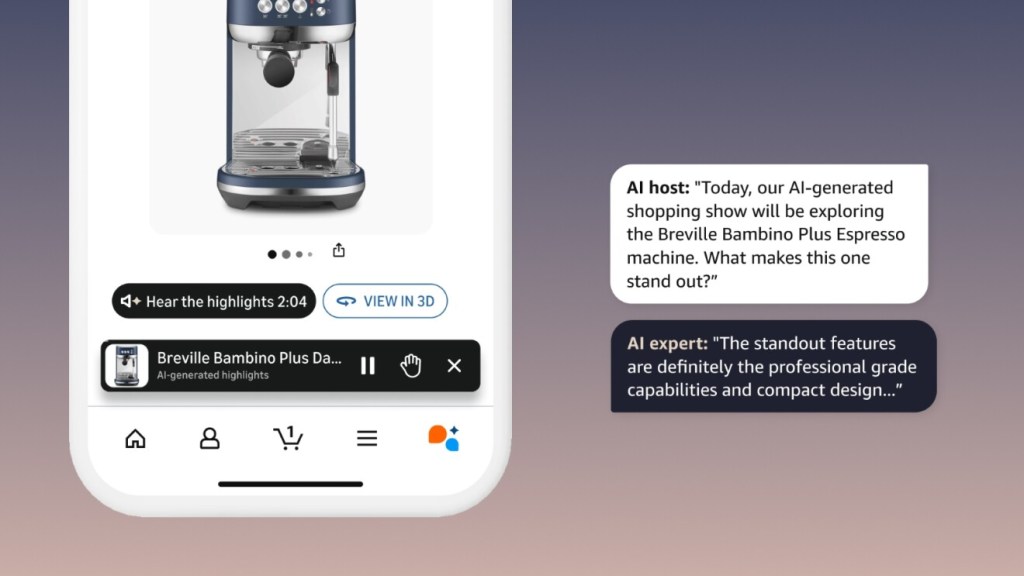
Amazon has officially transitioned its product pages from static text repositories into interactive, voice-enabled environments. As Amazon launches an AI-powered audio Q&A experience, the company is moving beyond simple chatbots toward real-time, conversational audio synthesis. This deployment marks a significant milestone in the integration of generative artificial'intelligence into the standard e-commerce workflow.
How Amazon launches an AI-powered audio Q&A experience to combat decision fatigue
The "Join the chat" feature, integrated within the Amazon Shopping app, allows users to engage with what the company terms "AI-powered shopping experts." Rather than forcing customers to manually parse through thousands of lines of user reviews and technical specifications, the system generates natural, discussion-style responses in real time.
By leveraging large language models (LLMs) capable of processing unstructured data, the feature can answer highly specific queries. For example, it can determine whether a particular fabric is prone to irritation or if a kitchen appliance is suitable for novice users by synthesizing insights directly from existing customer feedback.
The primary utility of this technology lies in its ability to reduce the cognitive load associated with modern digital shopping. In the current retail landscape, consumers often face "decision fatigue" caused by the sheer volume of data available on a single product page.
Moving toward ambient commerce via "Hear the highlights"
The new audio experience seeks to mitigate this fatigue through the "Hear the highlights" feature, which offers brief, automated audio overviews for millions of products. This transition from text-based browsing to an auditory interface suggests a move toward ambient commerce.
Because the audio playback is designed to continue even as users navigate other parts of the application, the shopping experience becomes less about active searching and more about passive, intelligent consumption. This creates a continuous loop of information where the AI acts as a persistent, knowledgeable intermediary between the massive Amazon catalog and individual consumer intent.
The architecture of an intelligent retail ecosystem
This audio-driven Q&A capability is not a standalone experiment but rather a new layer in a rapidly expanding stack of intelligent retail tools. Amazon is clearly building toward a unified, agentic ecosystem where every touchpoint is informed by predictive modeling and natural language processing.
The current infrastructure includes several critical components:
- Rufus: A dedicated generative AI assistant designed to facilitate deep product research and complex comparisons.
- Interests: An algorithmic tracking system that identifies and surfaces new products aligned with a user's demonstrated preferences.
- Help me decide: A recommendation engine that leverages historical browsing, search, and purchase data to provide personalized suggestions.
- Hear the highlights: The foundational audio layer that provides rapid, high-level summaries of product attributes.
The future of the digital storefront and the review economy
As these tools become more interconnected, the traditional product page begins to lose its identity as a static destination. Instead, it becomes a node in a larger, personalized conversation managed by autonomous agents. This shift moves the needle from a "search and find" paradigm to an "ask and receive" model.
The long-term implications for the e-commerce industry are profound. If Amazon can successfully bridge the gap between raw data and conversational clarity, it may fundamentally alter the review economy. When an AI synthesizes thousands of reviews into a single, authoritative audio statement, the individual voice of the reviewer is subsumed into a broader, algorithmic consensus.
While the current rollout is limited to specific products and the U.S. market, the technological foundation is set for a global-scale transformation. The industry must now grapple with whether this move toward voice-driven commerce will lead to higher conversion rates or simply introduce more algorithmic noise. One thing is certain: the era of the static product description is rapidly coming to an end as Amazon launches an AI-powered audio Q&A experience.