Achieving a 500-meter detection range while capturing high-fidelity color imagery marks a significant evolution in the hardware used for autonomous navigation. Ouster’s newly announced Rev8 lineup represents an attempt to consolidate the two most critical pillars of environmental sensing—lidar and cameras—into a single, unified data stream. By eliminating the need for complex software calibration between disparate hardware components, this technology targets a long-standing bottleneck in robotic vision: the difficulty of fusing independent sensors into a cohesive perception model.
Eliminating the Calibration Gap
For decades, the robotics industry has struggled with the immense computational overhead required to align separate camera and lidar data streams. Most current solutions involve "packaging" two distinct sensors into a single housing and attempting to synchronize their outputs through high-level reasoning and software-based fusion. This process is notoriously difficult, often resulting in significant latency and errors during the critical moments when a vehicle must interpret its surroundings.
Ouster’s architecture moves away from this traditional approach, opting instead for a digital lidar design. By utilizing custom-designed single photon avalanche diode (SPAD) detectors on a single chip, the company can capture both distance information and color imagery simultaneously. This method provides a pre-fused 3D colorized point cloud, significantly reducing the workload for perception engineering teams who no longer need to resolve discrepancies between a camera's pixels and a lidar's points. The ultimate objective of this hardware is to move beyond mere sensor fusion toward a single-sensor paradigm that could eventually render traditional cameras obsolete in autonomous environments.
Precision Performance and Scalable Hardware
The technical specifications of the Rev8 platform suggest a significant leap in environmental perception precision, designed to meet the demands of both high-speed transport and industrial automation. The technology boasts 48-bit color depth and an impressive 116 dB dynamic range, providing image data that competes directly with modern high-end camera sensors. To achieve this level of fidelity, Ouster collaborated with imaging experts like Fujifilm and the image science company DXOMARK to ensure the sensor meets the rigorous standards required for machine learning and object recognition.
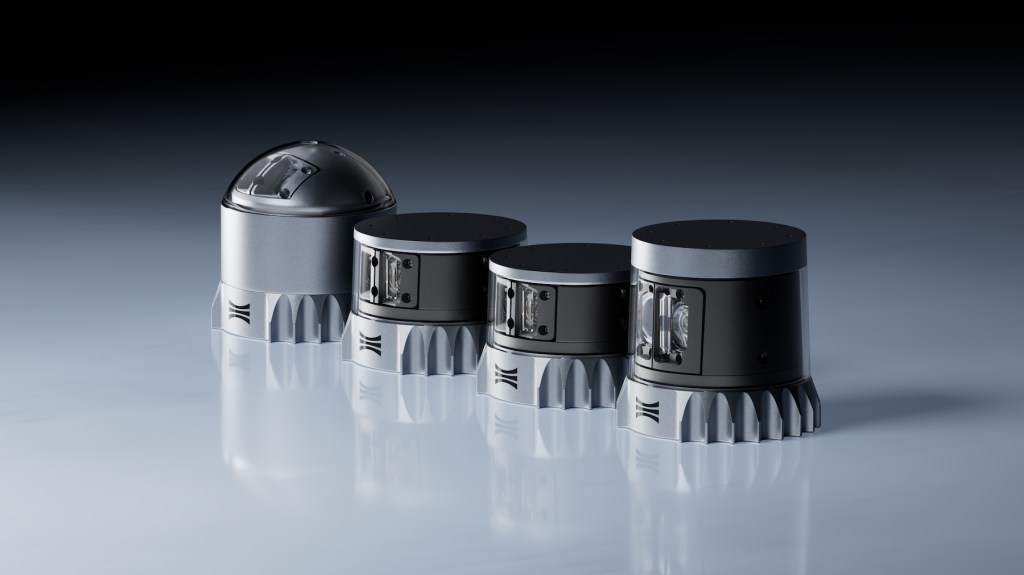
The lineup is designed to scale across various robotic applications, from massive logistics vehicles to small-scale drones:
- OS1 Max: A long-range specialist capable of detecting objects up to 500 meters in all directions.
- OS0 and OS1: Compact configurations for closer-range obstacle detection and navigation.
- OSDome: Specialized hardware tailored for omnidirectional or overhead sensing requirements.
The OS1 Max is particularly noteworthy due to its reduced footprint compared to previous long-range models. This makes it a primary candidate for the burgeoning sectors of high-speed autonomous trucking and robotaxi fleets, where sensor weight and aerodynamic drag are critical design constraints. As we see the market for sensors explode—driven by the deployment of robotaxis and the rise of humanoid robotics—the ability to pack more intelligence into a smaller footprint will become the industry's primary metric of success.
The Future of Autonomous Perception
The arrival of native color lidar occurs during a period of intense consolidation within the sensor market. As companies like Ouster absorb former competitors such as Velodyne and navigate the landscape left by Luminar’s recent restructuring, the industry's focus is shifting from raw range to data utility. While competitors such as China's Hesai are also racing toward color-integrated platforms, Ouster’s approach of embedding the technology directly at the chip level offers a distinct advantage in reducing both hardware footprint and computational latency.
If this transition to single-chip sensing matures as predicted, the distinction between "seeing" an object and "measuring" its distance may soon disappear entirely. For the robotics industry, the move toward pre-fused data streams represents more than just a hardware upgrade; it is a fundamental simplification of how machines interpret the physical world. The success of this technology will likely depend on whether perception engineers can fully leverage these unified streams to build safer, faster, and more efficient autonomous systems.