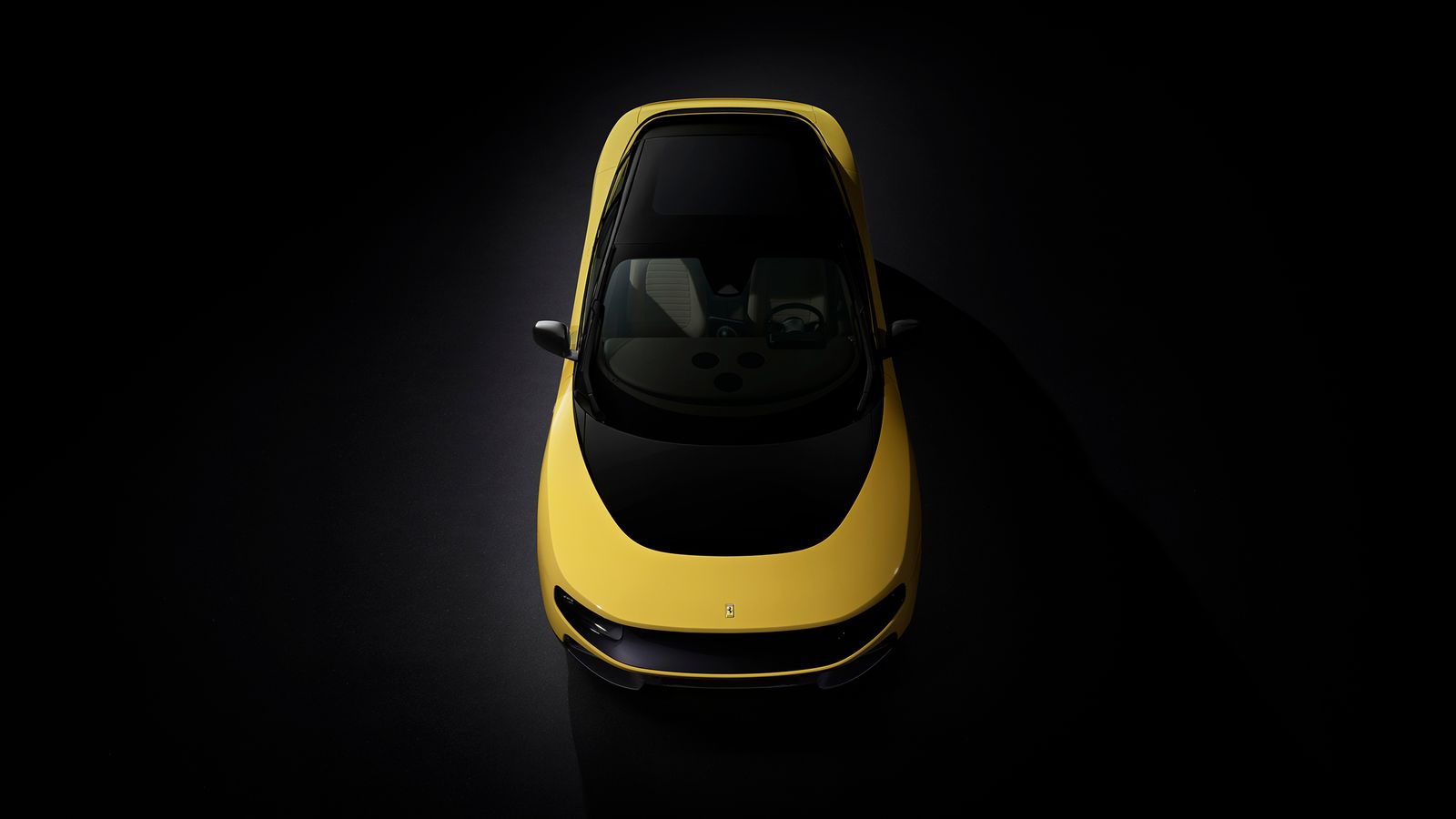
Ferrari’s first all-electric Luce subverts every expectation Maranello spent decades cultivating. At $650,000, the Ferrari Luce EV looks less like a track-ready weapon and more like a minimalist lounge on wheels. Instead of the aggressive, exhaust-bellowing hypercar enthusiasts anticipated, the silhouette arrives with clean, unbroken lines and an interior dominated by a single, tablet-like display that recalls Jony Ive’s signature design language more than Italian coachbuilding tradition. The silence inside is profound, trading mechanical symphony for digital calm. It is a deliberate departure, yet one that leaves a lingering sense of loss for what was left on the cutting room floor.
Designing Silence on Wheels
The exterior design abandons Ferrari’s traditional visual vocabulary for something far more deliberate. Sharp fender flares and exposed exhaust tips give way to flush door handles, aerodynamic efficiency, and a front fascia that prioritizes airflow over attitude. This aesthetic restraint reads as mature, yet it feels almost too subdued for a badge that historically demands attention. Where previous models shouted their performance credentials through carbon fiber vents and racing stripes, the Luce whispers its presence through surface tension and proportion. It is a masterclass in modern coachbuilding, but one that requires the observer to already know what they are looking at before appreciating it.
The Screen, The Silence, and The Price Tag
Inside, the cabin transforms into a sanctuary where analog gauges yield to a floating touchscreen. Critics have already pointed out that the display’s bezels resemble an off-the-shelf tablet rather than bespoke automotive hardware. The stripped-down interior layout prioritizes visual space over tactile richness, removing physical buttons in favor of haptic feedback and gesture controls. This marks a fundamental shift in how Maranello communicates performance to its drivers.
Key shifts define this new era:
- The absence of an internal combustion engine removes the auditory feedback loop that once defined driver-car communication
- Aerodynamic efficiency replaces aggressive styling as the primary design driver
- A premium is charged for exclusivity rather than mass-market utility
The trade-off is undeniably expensive: a $650,000 price tag attached to a driving experience defined by electric torque and near-silence. Enthusiasts who purchased Ferraris for the mechanical symphony now face a digital cockpit that rewards patience over instinct.
Why the Ferrari Luce EV Feels Like a Compromise Wrapped in Silk
Ferrari did not build the Ferrari Luce EV because global demand suddenly shifted toward four-wheel electric propulsion. Rather, it serves as a strategic checkbox, ensuring Maranello remains relevant while quietly demonstrating that traditional buyers remain skeptical of silent supercars. The model arrives at a premium, justifying its cost through limited production numbers and exclusive brand heritage rather than everyday practicality. It is the most controversial Ferrari in recent memory precisely because it asks loyalists to accept silence as a luxury feature.
The irony lies in how deliberately un-electric the driving experience feels; the steering calibration, weight distribution, and throttle mapping all mimic analog precision to soften the transition. Drivers will notice the familiar weight and responsiveness despite the lack of an exhaust note. This tension defines the entire ownership experience from day one.
The Ferrari Luce EV will likely sell out before it officially hits dealerships, proving that Ferrari’s halo effect remains unshakable even in an era of skeptical EV adoption. Yet its emotional impact hinges on whether buyers value exclusivity over heritage, or if they miss the mechanical soul that once defined the Prancing Horse. This tension defines the entire ownership experience from day one.
As Maranello prepares to expand its electrified lineup, the Luce stands as a fascinating bridge between eras—a silent statement piece that demands patience from purists and rewards them with understated elegance. It may not replace the roar, but it successfully earns its place at the table. The heartbreaking element is not that Ferrari compromised, but that they compromised just enough to make us wonder if the golden age of combustion is truly over.