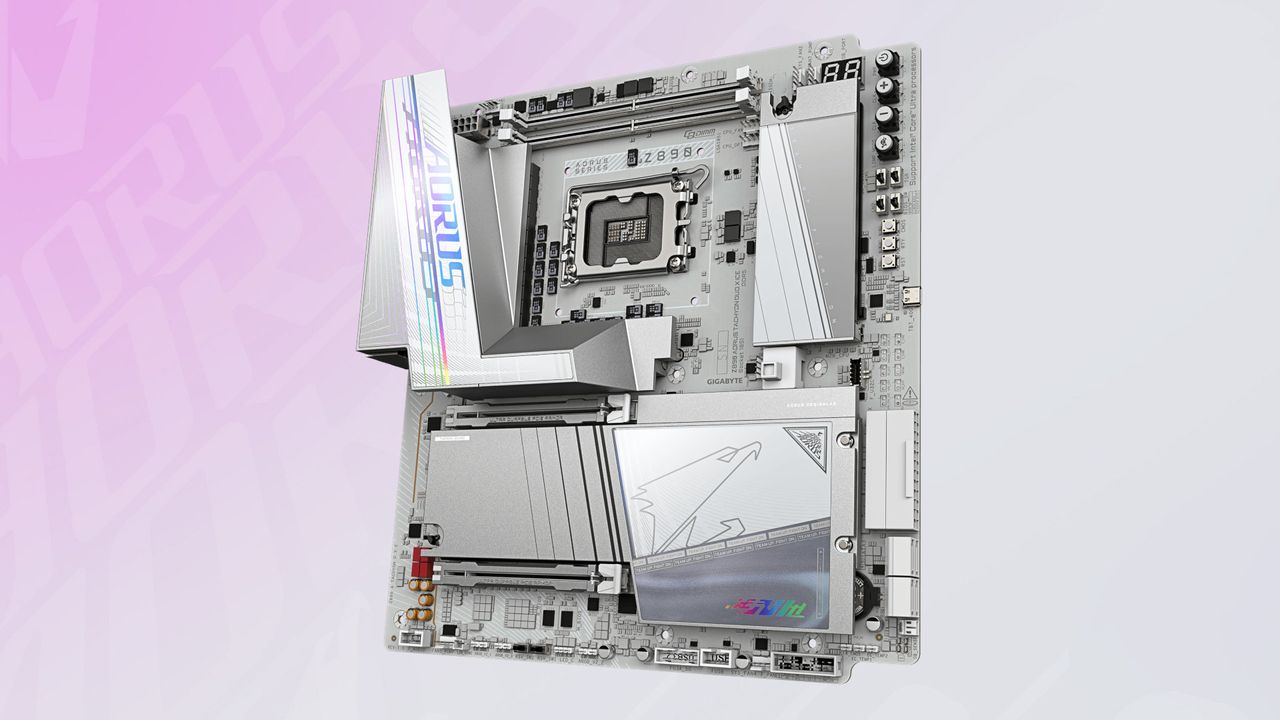
Gigabyte Z890 Aorus Tachyon Duo X Ice: A Sideways Approach to 10,400 MT/s
When it comes to motherboards, manufacturers rarely attempt anything unconventional, as the market is usually flooded with familiar layouts. However, Gigabyte has taken a different path with its newest Intel Z890 offering, specifically targeting serious overclockers who demand extreme memory performance. The result is the Gigabyte Z890 Aorus Tachyon Duo X Ice, a board that appears normal at first glance but features a radically sideways design to achieve speeds up to 10,400 MT/s.
While it might look like just another white Intel motherboard initially, closer inspection reveals the DRAM slots and primary M.2 SSD connectors in "wrong" positions. Even the CPU power sockets are relocated, and the rear I/O panel appears unusually sparse for a modern high-end board. This unique layout is not a mistake but a necessity driven by Gigabyte's D5 Duo X technology, which aims to revolutionize memory capabilities.
Unleashing Extreme Memory Speeds with CQDIMMs
The primary reason for the funky DIMM placement is the implementation of D5 Duo X technology. This system delivers traditional 4-slot maximum capacity using only two DIMM slots, effectively unleashing extreme overclocking potential. The board officially supports speeds up to DDR5-10400 MT/s, though users can also install a set of CQDIMMs rated for DDR5-8000.
CQDIMMs are essentially CUDIMMs equipped with quad-rank memory modules, allowing enthusiasts to fit 256 GB of RAM into their rig without sacrificing performance. This massive capacity is achieved while maintaining the high-frequency speeds required by overclockers, making it a unique selling point for this specific hardware.
However, acquiring such a kit comes with a significant financial hurdle. While there are no CQDIMMs currently available on the market to price-check, a 48 GB DDR5-8800 CUDIMM kit costs $900 at Newegg. Consequently, even if you manage to find a set of CQDIMMs, the price tag will be absolutely astronomical for most consumers.
Design Trade-offs and Practical Gaming Considerations
Despite the clever layout designed to maximize memory performance, this motherboard lacks several features that make it ideal as an everyday gaming PC board. While you do get four M.2 slots for storage, which is a reasonable number, the rear I/O panel remains quite bare. The connectivity options include:
- One USB 3.2 Type-C port (20 Gbps)
- Five USB 3.2 Type-A ports (10 Gbps)
A grand total of six ports would not support half the devices needed for a modern main PC setup, making it less versatile than typical gaming motherboards. Furthermore, there is a puzzling design choice regarding the large heatsink covering both the I/O panel and CPU VRMs. This massive block seems to clash hard against the primary PCIe slot, creating concerns about fitting a beefy graphics card unless it has a very slim backplate.
It is possible that this visual awkwardness in images does not reflect the physical reality, as Gigabyte would likely not design a board marketed for gaming only to make it difficult to use with standard hardware. Regardless, while the Tachyon won't appear on general enthusiast wishlists, hardcore overclockers will undoubtedly be interested in its unique capabilities. At this stage, there is no indication of the motherboard's specific price tag, but given that super-fast and high-capacity DRAM is already ridiculously overpriced, Gigabyte may find sales to be quite limited.