The shift from passive information retrieval to active task execution marks the definitive transition of search engines into autonomous digital agents. This evolution is becoming tangible with the latest updates to Google’s AI Mode, which moves beyond text generation and into the realm of real-world logistics. Instead of merely pointing toward an answer, the engine is now beginning to actively pursue it on behalf of the user.
How Google’s AI Mode Bridges Digital and Physical Retail
The most significant development in this rollout is the ability for Google's AI to bridge the gap between digital intent and physical availability. For users navigating local commerce, a new feature within Google’s AI Mode can now verify product stock at nearby retail locations by contacting stores directly. This capability moves the needle from "showing results" to "performing actions," essentially acting as a remote concierge for consumer needs.
The functionality allows for highly specific, conversational inputs that traditional keyword-based searches struggle to parse. A user might describe a niche requirement—such as finding specific clip-on polarized sunglasses that fit over existing prescription frames—and the AI agent will attempt to facilitate discovery through direct communication with local merchants. This feature, which saw an initial launch on Google Search last November, is now expanding across the United States in the coming weeks.
This transition toward agentic AI represents a fundamental change in how local businesses may interact with the digital marketplace. As Google begins making calls and sending automated inquiries to local inventory managers, the boundary between search engine optimization (SEO) and real-world availability becomes increasingly intertwined. For consumers, the benefit is clear: the reduction of manual research and the elimination of "dead-end" trips to stores that lack necessary stock.
Precision Logistics in Travel Planning
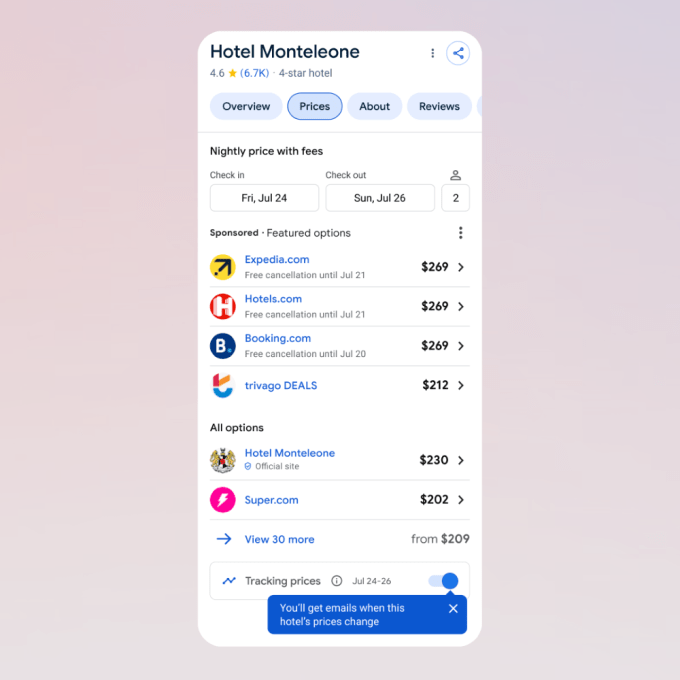
As the summer 2026 travel season approaches, Google is also leveraging this automated intelligence to refine how users manage travel costs. Beyond simple city-level price monitoring, the updated system allows for granular, hotel-specific price tracking. This level of precision enables travelers to move away from broad market surveys and toward a strategy of targeted monitoring for specific accommodations.
The implementation varies slightly depending on your hardware:
- On Desktop: Users can identify a specific hotel by name and activate a new price-tracking toggle within the search results.
- On Mobile: The functionality is integrated under a dedicated "Prices" tab, making it accessible during on-the-go itinerary adjustments.
- Notification System: Once enabled, the system triggers automated email alerts if a price fluctuation occurs during your selected travel dates.
This move into specialized monitoring aligns with broader consumer behavior shifts. Recent data indicates that search interest in "AI travel assistant" and "AI concierge" has surged by 350% over the past year. The demand for automation is no longer a niche interest; it is becoming the standard expectation for modern travelers looking to optimize budgets without constant manual oversight.
The New Landscape of Global Travel
The integration of these tools comes at a time when specific global destinations are seeing heightened interest via Google Flights. As the AI continues to digest massive datasets regarding travel trends, certain locations have emerged as frontrunners for the upcoming summer season.
Current trending destinations include:
- St. Maarten
- Stockholm, Sweden
- Kansas City, Missouri
- Sarasota, Florida
As search queries like "how to use AI to find flight deals" and "AI flight booking" see triple-digit growth—with the latter jumping by 315% in just one month—the infrastructure of travel is being rebuilt around automated intelligence.
The trajectory for Google is clear: the goal is to move the user from a state of searching to a state of knowing. By automating the tedious work of checking stock and monitoring price volatility, Google’s AI Mode is positioning itself as an indispensable layer of middle-management for everyday life. While this may reduce the need for users to visit dozens of different tabs, it also centralizes significant power within a single, automated ecosystem. The era of the search engine is ending; the era of the agent has begun.