I recently watched The Magic Faraway Tree, in which Andrew Garfield plays a dad with dreams about making homegrown tomato sauce in the country. I was particularly charmed by a scene in which Garfield generates enough electricity for his tween daughter to enjoy a shonky video call via pedalling a busted-up bike alone. Well, one YouTube creator has leveraged this thrifty approach to energy generation to experiment with human powered CPU cooling.
The Mechanics of the V-Belt Setup
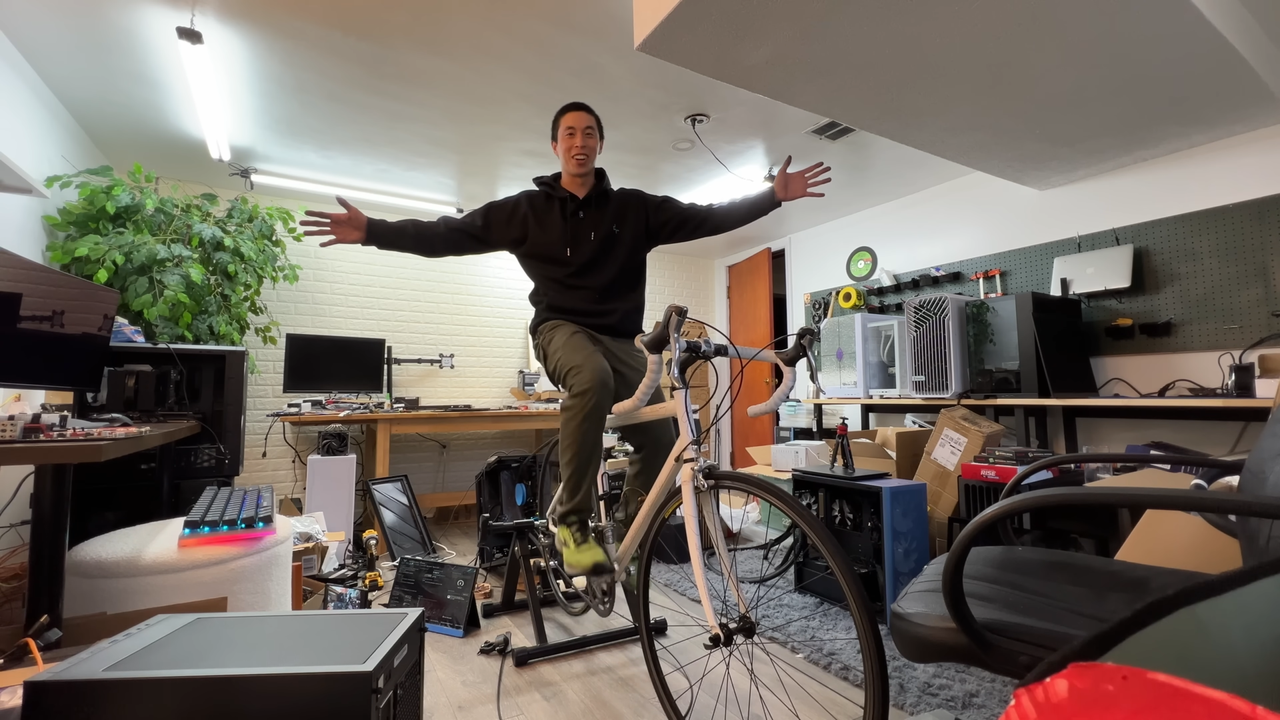
"Every year you're spending thousands and thousands of watt-hours to simply power the fan that cools your CPU," YouTube creator mryeester began in a recent video, "Which got me thinking, what if we could manually cool our computer with human grit and determination?"
To attempt this method of human powered CPU cooling, mryeester implemented a specific mechanical chain:
- Replaced the bike's back tire with a V-belt.
- Attached a custom sheath to the CPU fan.
- Connected the belt directly to the fan via that same sheath.
It sounds simple enough, but as you can imagine, you should probably add "buckets of sweat" to the list of requirements for this build. You certainly won't see this particular experiment recommended in our best CPU coolers guide anytime soon.
Engineering Hurdles and Hardware Risks
Ensuring the V-belt doesn't strike any other PC components as it rotates presents a massive challenge. To mitigate this, the YouTuber decided to tilt his entire PC and open up the top of the case. This provided more direct access to the CPU fan without smashing into other vital hardware guts.
Personally, I am left wondering why mounting the 3D printed sheath indirectly to the CPU fan via a short pole—to offer clearance outside the case—wasn't explored. Is it due to physics and tension? I suspect it is.
Unfortunately, the experiment hit a literal breaking point. After getting the temperature down to 39 °C, the glued-in-place sheath promptly popped off the fan cover. This highlighted a major point of failure in this human powered CPU cooling contraption. The other obvious failure point is that even the fittest human cannot pedal forever, especially when the setup only saves roughly three bucks a year at most.
Testing the Limits in CS2
Undeterred by the mechanical failure, mryeester jumped back into testing. This time, he booted up CS2 to see if he could pedal long enough to secure some kills.
Despite the expectedly wobbly aiming and added resistance from the V-belt, he managed to get a handful of kills before becoming a puddle of sweat. When it comes to working up a sweat, though, I think I'll follow James' lead and stick with the VR headset.