ChatGPT’s New Role in Personal Finance Management
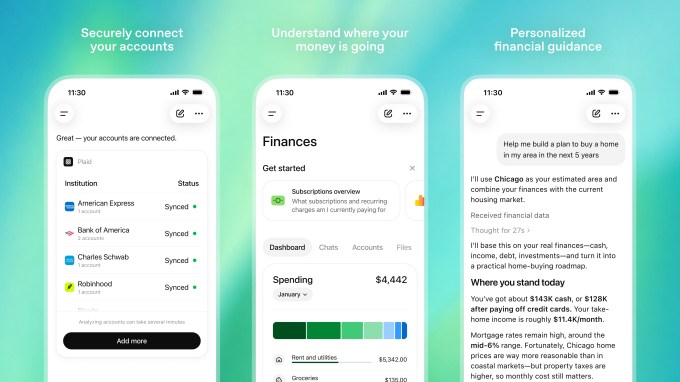
OpenAI has officially launched ChatGPT for personal finance, marking a significant expansion of the platform beyond simple conversation. This new capability allows users to securely connect their bank accounts directly within the app, transforming ChatGPT into a unified financial dashboard. By integrating with Plaid’s network, the tool now accesses data from more than 12,000 financial institutions, including major banks and brokerage services.
This integration enables users to gain a comprehensive view of their financial health. Through an interactive interface, individuals can track spending patterns, monitor investment performance, and keep tabs on upcoming financial obligations. The goal is to provide a seamless, real-time look at personal finances without requiring users to switch between multiple banking apps.
How Account Connectivity Works
The foundation of this feature is account connectivity via Plaid, a trusted infrastructure provider for financial data. The process prioritizes user control and security:
- Authorization: Users must explicitly authorize third-party access to aggregate their financial data in real-time.
- Data Aggregation: Once connected, ChatGPT pulls information from linked accounts to provide contextual insights.
- Revocation: Users retain full control, with the ability to revoke access at any time via Settings > Apps > Finances. This disconnect lasts for 30 days, ensuring users can regain privacy quickly if needed.
Powered by GPT-5.5 for Complex Financial Queries
To handle the nuances of personal finance, OpenAI has leveraged the GPT-5.5 model. This version offers enhanced contextual reasoning capabilities, allowing it to address complex questions that go beyond simple data retrieval. Users can now ask nuanced questions about:
- Expense analysis: Understanding where money is going across different categories.
- Savings goals: Tracking progress and receiving tailored advice on how to meet targets.
- Tax implications: Getting preliminary insights into how financial decisions might impact tax liabilities.
This focus on contextual reasoning aims to improve accuracy for intricate scenarios, such as assessing the likelihood of mortgage approval or understanding the tax impact of investment strategies.
Strategic Expansion and Rollout Details
The launch of ChatGPT for personal finance aligns with OpenAI’s broader strategy following its acquisition of Hiro’s team, specialists in finance automation. This move signals sustained investment in domain-specific expertise. The company cites over 200 million monthly financial queries on ChatGPT, highlighting the strong demand for integrated financial assistance.
However, immediate availability is restricted. The feature is currently limited to ChatGPT Pro subscribers in the United States. OpenAI plans to expand access to broader user tiers after implementing iterative improvements based on early feedback. This phased approach allows the company to refine the tool’s stability and accuracy before a wider release.
Industry Context and Future Implications
This move places OpenAI in direct competition with other AI providers like Anthropic and Perplexity, which have introduced similar specialized tools. The industry is shifting from generalized responses to vertical depth, emphasizing specialized capabilities in areas like finance and healthcare.
By embedding financial planning into everyday interactions, OpenAI is helping to reshape expectations around digital banking. As AI continues to mature in financial contexts, the balance between utility and privacy remains critical. OpenAI’s emphasis on user-controlled data access aims to build trust, ensuring that the convenience of automated financial insights does not come at the cost of security.