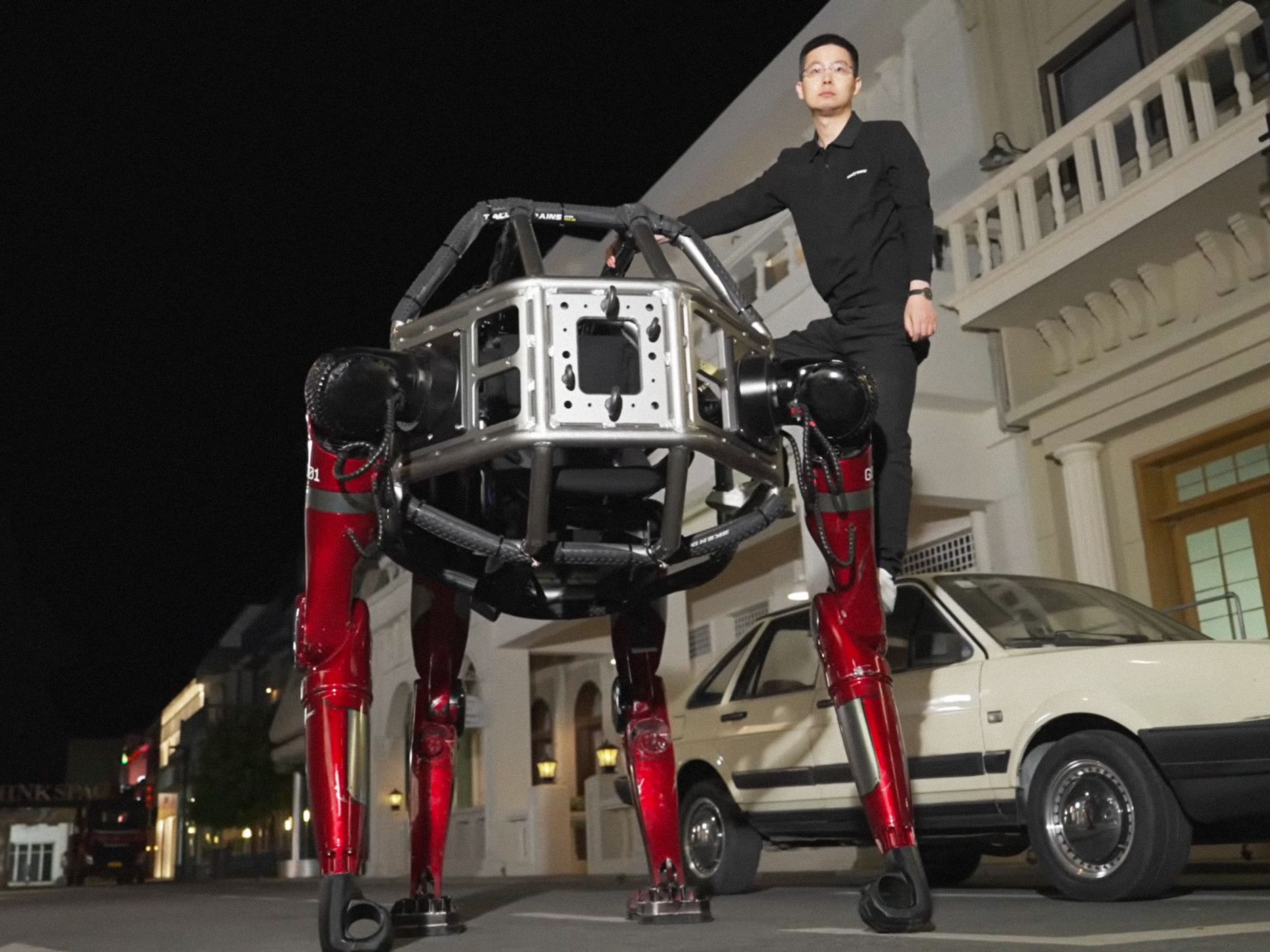
The first glimpse of the Unitree GD01 is startling—massive, metallic limbs unfurl from an open chassis as a thundering rock riff underscores the moment. Operators clamber inside the robot’s exposed torso before it pivots, bends backward, and scuttles across concrete like a mechanical arachnid on a mission. A human hand disappears into its belly, then reemerges on an elevated platform as the unit slams a wall of cinder blocks into dust and rubble. The scene feels both absurd and inevitable, blurring the line between toy and trophy.
Unitree’s latest offering upends its reputation for affordable, whimsical robotics by pivoting toward spectacle and strength. The GD01—priced around $650,000—transforms from a compact companion into a giant mecha robot capable of wall-smashing and dynamic reconfiguration. While the company first gained traction with playful humanoid models like G1 that perform acrobatics, this new machine signals a bold shift toward sheer scale and destruction.
Design Philosophy and Mechanical Impact
The GD01’s structure prioritizes impact over dexterity. Its red-limbed limbs and articulated joints enable powerful strikes rather than delicate manipulation. This design choice is deliberate, focusing on the raw power required to destroy structures rather than perform fine motor tasks.
Media posts have showcased the robot’s belly access point, emphasizing both transparency and theatricality—a hallmark of Unitree’s marketing style. By allowing operators to physically enter the machine, Unitree creates a visceral connection between human and machine that few other robotics companies can match.
Key design elements include:
- Exposed Chassis: Highlights the mechanical complexity and allows for direct human interaction.
- Reinforced Joints: Designed to withstand the torque of high-impact movements.
- Theatrical Entry: The belly access point serves as both a functional interface and a dramatic stage for demonstration.
Technical Realities and Operational Constraints
Despite its imposing exterior, the GD01 operates under constraints familiar to Unitree’s broader portfolio. The platform remains semi-autonomous, with operators guiding movements via remote control for precision tasks. While it can perform synchronized maneuvers—such as parkour or martial arts sequences—the unit lacks advanced AI decision-making. Complex actions depend on pre-programmed sequences or live direction from a human controller.
This reliance on human input is a critical distinction for potential buyers. The GD01 is not a fully autonomous agent; it is a remote-controlled powerhouse.
- Durability vs. Dextrousness: Heavy-duty construction ensures survival against repeated impacts but sacrifices the fine motor skills needed for tasks like object manipulation.
- Control Latency: Precision tasks require direct operator input, meaning the robot’s effectiveness is tied to the skill of its pilot.
Market Positioning and Cultural Resonance
By targeting niche collectors and exhibition spaces, Unitree sidesteps direct competition with industrial-grade robotic manufacturers focused on logistics or medical applications. The GD01 is not built for factory floors; it is built for spectacle.
The GD01’s debut coincides with broader shifts in consumer attitudes toward experiential tech. Ownership becomes performance art—a statement of financial confidence akin to custom automobiles but with mechanical flair. Its presence at events like televised festivals underscores how robotics can merge entertainment, engineering, and branding into a single spectacle.
Unitree’s trajectory reflects China’s accelerating role in reshaping global robotics paradigms. By leveraging manufacturing scale, vertical integration, and audacious product concepts, the startup bridges the gap between hobbyist projects and commercial-grade machines. The GD01 isn’t merely a toy; it’s a demonstration of how affordability can coexist with ambition—even if its primary function is destruction for effect.
Future Implications for Robotics
As Unitree prepares for potential public listings, the GD01 marks both an artistic and strategic milestone. Its success will depend less on technical sophistication than on sustained media momentum and collector demand. The robot’s ability to convert attention into value demonstrates how emerging platforms blend utility with spectacle—a trend likely to influence subsequent generations of hardware entrepreneurs.
Whether it remains a curiosity or evolves into a practical tool depends on iterative refinement and cultural appetite for larger-than-life machines. The GD01 proves that robotics can captivate beyond laboratory walls when paired with bold vision and executional rigor. For now, its legacy rests in the image of a man climbing into a robot’s hollow core before both vanish into motion and mayhem—a moment that captures the intersection of imagination and industrial possibility.