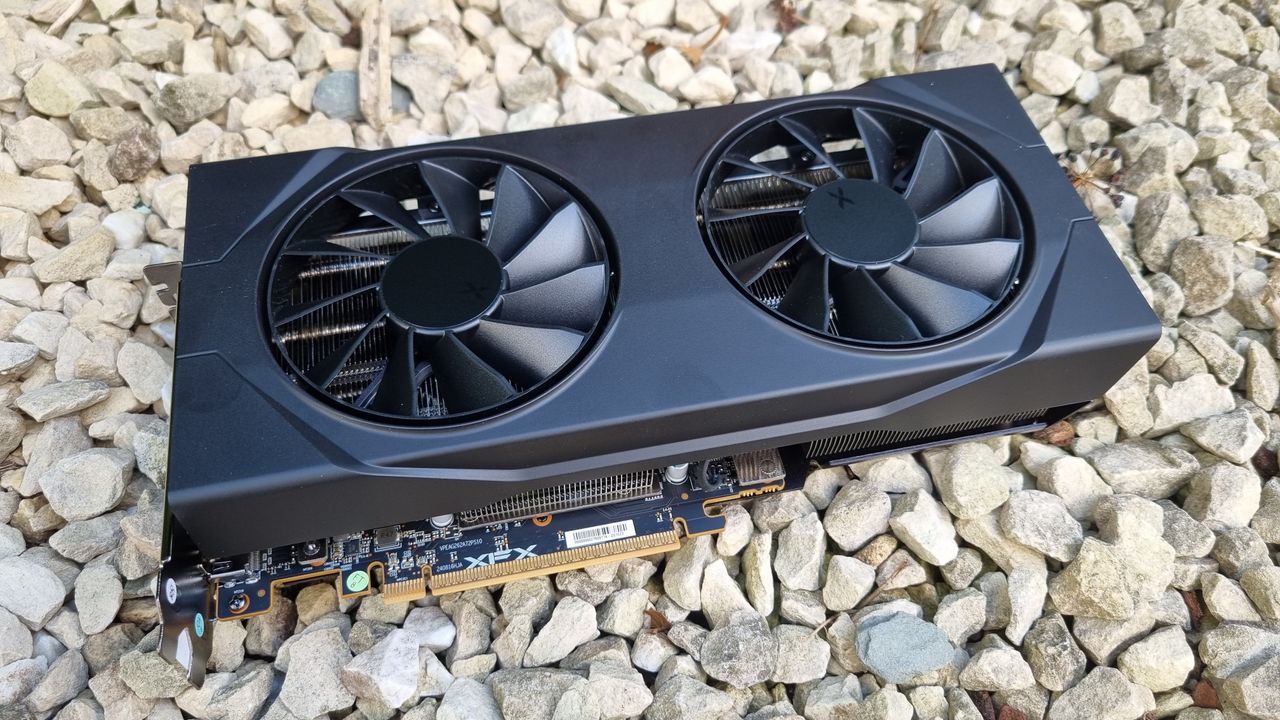
Amidst a hardware market dominated by rising prices, some unexpected whispers from the grapevine suggest relief may be on the horizon for budget gamers. Reports indicate that AMD is planning a new budget graphics card featuring a highly unusual specification profile that defies traditional tiering logic.
The Surprising Specs of the AMD Radeon RX 9050
According to recent leaks from VideoCardz, a new low-end GPU known as the AMD Radeon RX 9050 is in development. While the source notes these specifications are preliminary and single-sourced, the data reveals a strange hardware configuration regarding its core count.
Most surprisingly, the RX 9050 reportedly shares the same number of Stream Processors (SP) as the higher-tier RX 9060 XT, rather than the standard RX 9060.
| Model | Stream Processors | Game Clock | Boost Clock | | :--- | :--- | :--- | :--- | | RX 9050* | 2,048* | 1,920 MHz* | 2,600 MHz* | | RX 9060 | 1,792 | 2,400 MHz* | 2,990 MHz* | | RX 9060 XT | 2,048 | 2,530 MHz | 3,130 MHz |
*Rumoured specifications
How the New Budget Graphics Card Functions
The hardware architecture suggests that this AMD budget graphics card will utilize the Navi 44 GPU. While it carries the full 2,048 cores found in the RX 9060 XT, AMD appears to be intentionally limiting its performance through lower clock speeds.
The reported trade-off involves a significant reduction in both game and boost clocks compared to its siblings. This strategy could serve several purposes:
- Silicon Utilization: AMD may be using surplus Navi 44 chips that possess high core counts but cannot maintain the stable, high clock speeds required for the RX 9060 or XT models.
- Market Segmentation: Providing a lower-cost entry point for consumers who need raw compute power but don't require high frequency stability.
- Product Tiering: Offering a unique value proposition for budget-conscious builders.
Memory and Bandwidth Details
In terms of VRAM, the RX 9050 is expected to ship with 8 GB of GDDR6 memory running over a 128-bit memory bus. The reported memory bandwidth sits at 288 GB/s with a speed of 18 Gbps, which aligns it directly with the standard RX 9060.
While the 8 GB capacity might draw criticism from enthusiasts, it is a standard expectation for an entry-level product in the current market. If these leaks hold true, enthusiasts may even find that these cards offer significant headroom through overclocking or undervolting, potentially pushing them closer to the performance of the RX 9060.