The ARR Mirage: How AI Startups Inflate Metrics to Win VC Funding
The air conditioning in the conference room hummed steadily, but the atmosphere in the pitch deck was hot enough to melt silicon. A founder stood before a panel of venture capitalists, smiling with unshakeable confidence as he pointed to a slide proclaiming $50 million in ARR. To the untrained eye, it looked like a triumph of SaaS growth. To the seasoned investor in the back row, it was a house of cards built on committed ARR (CARR) and free pilots.
The revenue wasn’t in the bank; it was in the future tense, contingent on successful implementation, customer retention, and the sheer will of the market to forgive aggressive accounting. This is not a glitch in the system. It is the system.
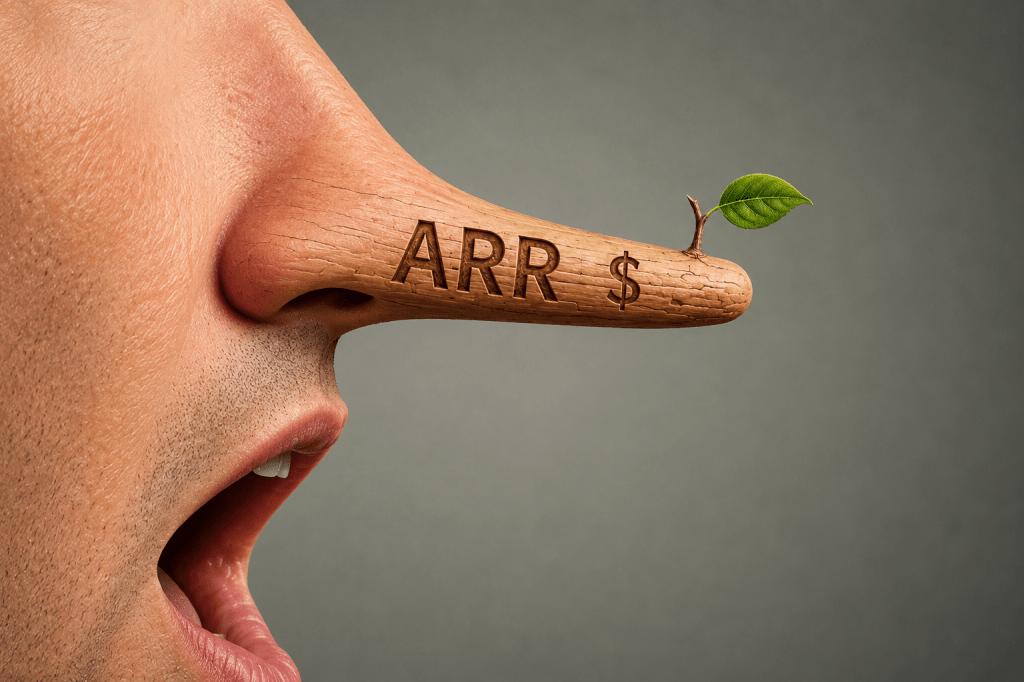
As AI startups flood the market with valuations that defy traditional SaaS logic, a quiet consensus has emerged among founders and their backers: Annual Recurring Revenue (ARR) is less a financial metric and more a marketing tool. By inflating these numbers, both VCs and founders are creating a feedback loop where credibility is purchased through obfuscation, and truth is sacrificed for the narrative of runaway growth.
The CARR Camouflage Strategy
The primary mechanism for this inflation is the substitution of committed ARR for actual recurring revenue. Traditional ARR represents the total value of signed, sealed, and active contracts. CARR, however, includes revenue from signed contracts that have not yet been onboarded or implemented.
In the AI sector, where implementation can be lengthy and uncertain, this distinction is critical. Investors and founders alike are aware that a signed contract is not cash, nor is it even guaranteed revenue. Yet, the pressure to keep pace with competitors forces many to blur the lines.
Startups are employing several tactics to pad their top-line numbers:
- Pre-Implementation Revenue: Startups count revenue from contracts before the product is even live. If implementation fails, that revenue vanishes, but the headline number remains intact.
- Free Pilot Inclusion: Some companies include substantial, year-long free pilots in their ARR calculations, counting the eventual paying portion of the contract as if it were already earned.
- Churn Neglect: Unlike true ARR, CARR often fails to account for expected customer churn or "downsells," inflating the figure by ignoring the reality that customers will leave or reduce their spend.
One VC admitted to seeing startups report $100 million in ARR when only a fraction came from paying customers. The rest was locked in the limbo of signed-but-unimplemented deals. This is not an anomaly; it is a strategy. When one startup in a category inflates its metrics, others follow to avoid looking like laggards.
The Annualized Run-Rate Illusion
Beyond CARR, a second, more problematic metric is gaining traction: annualized run-rate revenue. This method extrapolates current revenue over a 12-month period based on a short snapshot, such as a quarter or even a month.
For AI companies that charge based on usage or outcomes rather than fixed contracts, this is particularly misleading. Revenue spikes driven by temporary demand or promotional pricing are annualized, creating a false sense of stability. The run-rate assumes that what happened in the last month will continue indefinitely, ignoring the volatility inherent in early-stage AI adoption.
This approach distorts financial reality in three key ways:
- Short-Term Spikes: A sudden influx of users in one month is projected forward, ignoring seasonal or promotional factors that may not recur.
- Usage-Based Ambiguity: AI costs are often variable. Projecting a month of high usage as a yearly constant ignores the likelihood of cost optimization by clients.
- Lack of Contractual Security: Without multi-year agreements, these figures are highly susceptible to rapid decline, yet they are treated as permanent growth indicators.
General Catalyst’s Hemant Taneha has noted that the expectation for AI growth is no longer linear. "Going from 1 to 3 to 9 to 27 is not interesting," he said. "You got to go like 1 to 20 to 100." This pressure to show exponential growth drives founders to use the most aggressive metrics available, regardless of their accuracy.
The VC’s Dilemma and Silent Complicity
Venture capitalists are not passive observers in this scheme. They are active participants, incentivized by the need to justify their valuations and attract future LPs (Limited Partners). When a portfolio company reports inflated ARR, it attracts top talent and customers who perceive the company as the category leader.
The dynamic between investor and founder creates several perverse incentives:
- Narrative Control: VCs help create a story of runaway success to secure press coverage and future funding rounds, often encouraging founders to present data in the most favorable light.
- Silent Complicity: Many investors are aware of the inflation but look the other way because it benefits their own returns. If the valuation goes up, their paper gains increase.
- Market Distortion: By tolerating inflated metrics, VCs raise the bar for all startups, forcing even honest founders to consider similar tactics to compete.
As one VC noted, "Investors can't call it out. Everyone has a company monetizing CARR as ARR." The collective action problem ensures that no single player will reset the standard, even as the edifice becomes increasingly fragile.
The Coming Reckoning
The danger lies in the gap between perception and reality. ARR inflation creates a bubble of confidence that is difficult to sustain when the AI market inevitably matures. Founders who prioritize short-term gains over financial hygiene risk facing a harsh correction when the market demands transparency.
As the industry matures, the cost of deception will rise. Customers and investors will increasingly scrutinize the quality of revenue, not just the quantity. Startups that rely on inflated metrics will find their valuations hard to justify, while those that prioritize clean, auditable numbers may gain a competitive advantage in trust and longevity.
The current era of AI hype is built on a foundation of sand. Eventually, the tide will come in, and only those with real, recurring revenue will remain standing.