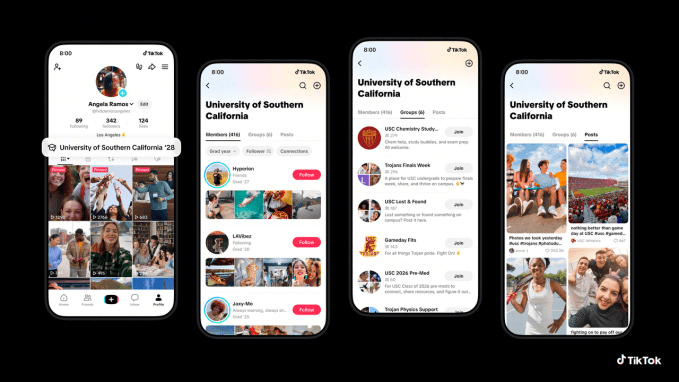
Social media’s next great battlefield is not the global newsfeed, but the localized university ecosystem. With the launch of TikTok’s new ‘Campus Hub’, the platform is moving beyond pure short-form entertainment and into the territory of utility-driven social networking. By integrating dedicated group chats and personalized, institution-specific feeds, ByteDance is attempting to capture a demographic that currently relies on a fragmented landscape of communication tools.
The Tech Behind TikTok’s New ‘Campus Hub’
The technical foundation of this initiative rests on the app’s existing campus verification infrastructure. Through a strategic partnership with UNiDAYS, a student verification platform, TikTok can confirm the academic status of users across more than 6,000 universities. This verification process allows for a much tighter, gated social experience that prioritizes proximity and shared identity over global virality.
Once a user’s student status is confirmed, the Hub provides access to several specialized features designed to maintain community ties even during academic breaks. The most significant addition is the implementation of group chats, which can accommodate up to 300 verified classmates. These digital spaces are intended to serve as a bridge for students who may be physically separated during summer months, providing a centralized location for planning reunions or maintaining social momentum.
The expansion includes several core components:
- Verified Group Chats: Private communication channels exclusive to students at the same institution.
- Personalized Campus Feeds: A curated content stream surfacing trends and updates specifically related to a user's university.
- Unified Identity: The ability to link a specific college campus directly to a TikTok profile for easier peer discovery.
- Institutional Scaling: Support for over 6,000 global universities via the UNiDAYS integration.
A Strategic Pivot Toward Utility
While these features may appear to be simple social additions, they represent a calculated move toward platform utility. For years, TikTok has dominated the attention economy through algorithmic entertainment, but it has struggled to become a primary tool for functional communication. By introducing tools that facilitate club discussions, class updates, and campus events, ByteDance is positioning itself as a direct competitor to established players like Discord, Facebook Messenger, and Instagram.
This move mirrors the historical trajectory of early social media giants. The original iteration of Facebook was built almost entirely around the concept of the ".edu" ecosystem, leveraging the exclusivity of college email addresses to foster high-trust environments. TikTok is attempting to replicate that same sense of localized intimacy within a much larger, global framework.
The Competitive Landscape
The competition in this niche is already significant. Meta has recently implemented similar campus verification features on Instagram, allowing students to browse and connect with peers via profile banners. However, TikTok's strategy relies on the aggressive integration of content and conversation; rather than just showing who attends your school, the Campus Hub seeks to show what is happening at your school through a customized lens.
The Verdict: Entertainment vs. Infrastructure
The success of TikTok’s new ‘Campus Hub’ will depend on whether TikTok can transition from a destination for passive consumption to a tool for active coordination. Capturing attention is one thing, but capturing utility is far more difficult. To displace Discord or WhatsApp in the university setting, the platform must prove that its group chats are more reliable and culturally relevant than the specialized tools students already use for academic and social organization.
If ByteDance can successfully marry the high-engagement nature of its algorithm with the functional necessity of campus communication, it may create a closed-loop ecosystem that is much harder for competitors to penetrate. If not, the feature risks becoming nothing more than another ephemeral addition to an app that remains, at its core, a place to watch videos rather than a place to live your digital life.