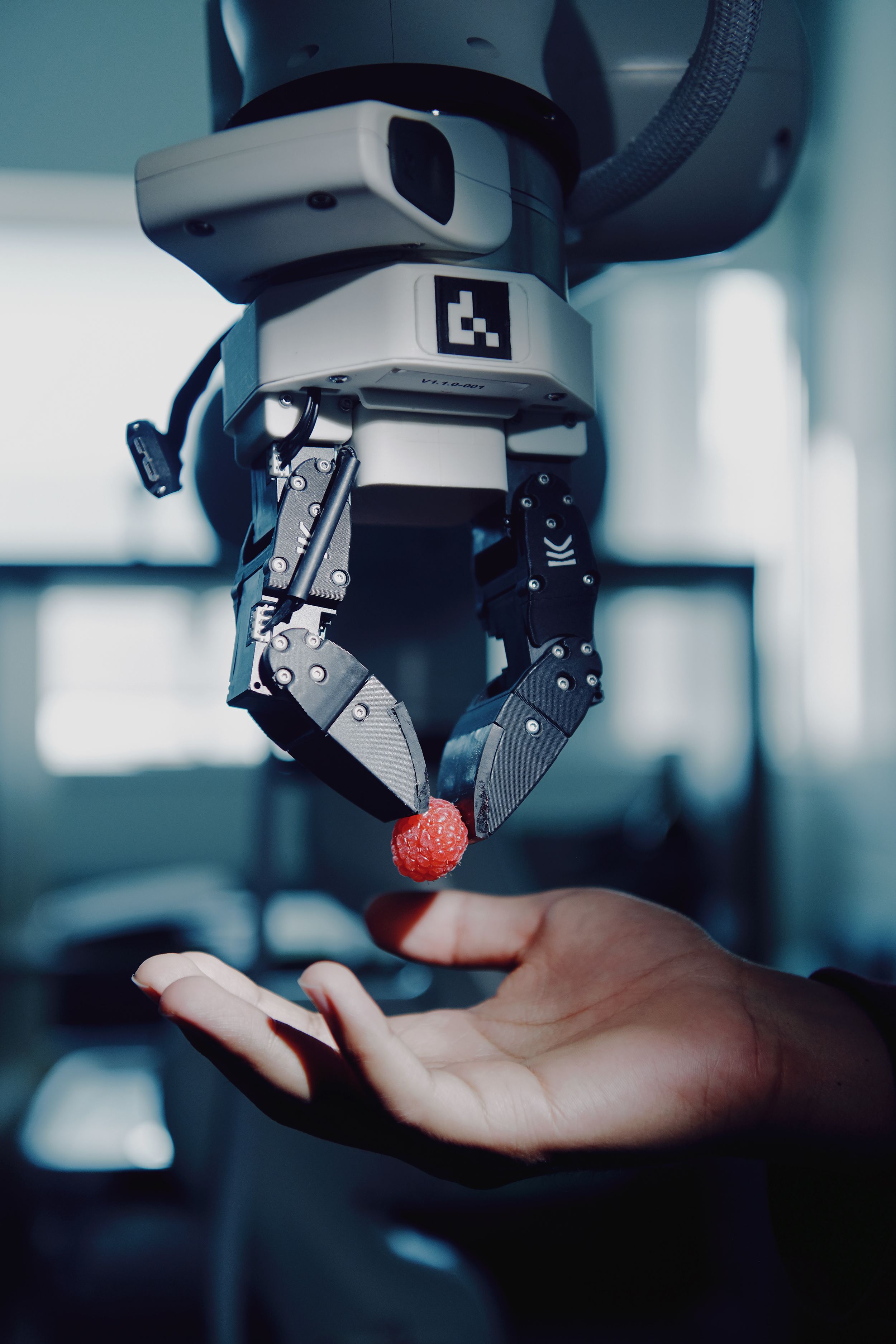
A mechanical claw hurtles toward a glass light bulb, decelerating just before impact to gingerly probe the tabletop. It searches for grip, nips at the rolling object, and eventually drives the bulb into a socket with unsettling precision. This level of fluid, tactile movement represents a significant departure from the rigid, pre-programmed motions that have defined industrial robotics for decades. As we approach a robotic ChatGPT moment, these developments signal a shift toward true physical dexterity.
While most robotic arms on the market today remain "clumsy" tools designed for repetitive factory tasks, new advancements in Cambridge, Massachusetts, are pushing the boundaries of what machines can achieve.
The Challenge of Physical Intelligence
The robotics industry has long grappled with Moravec’s Paradox, the observation that high-level reasoning requires very little computation, while low-level sensorimotor skills require enormous computational resources. While large language models can compose poetry or write complex code, teaching a machine to grasp a slippery raspberry or screw in a bulb remains an immense hurdle.
Previous attempts, such as OpenAI's Dactyl project, demonstrated that machines could solve a Rubik’s Cube in simulation, but these systems often lacked the "physical intelligence" necessary to recover when an object slipped or changed angle. The core difficulty lies in the sim-to-real gap.
In a digital environment, variables like friction and gravity can be controlled, but the real world is chaotic. When OpenAI’s Dactyl functioned, it relied on sensors within the cube itself to provide feedback. Without those specific external sensors, the system could'0t adapt to the unpredictable nature of physical reality, leading many researchers to believe that achieving human-level dexterity through pure simulation was a dead end.
Achieving a Robotic ChatGPT Moment through Physics
Eka Robotics is attempting to bridge this gap through a novel approach to training that prioritizes physics over imitation. Founded by MIT professor Pulkit Agrawal and former Google DeepMind researcher Tuomas Haannoja, the company focuses on a vision-force-action model.
Unlike many contemporary efforts that rely on observing human videos—known as vision-language-action (VLA) models—Eka’s robots learn through massive amounts of reinforcement learning within highly accurate simulations. This method moves away from simple imitation and toward self-directed mastery. To ensure digital success translates to physical competence, the training process incorporates several critical elements:
- Physics-integrated simulation: Modeling not just joints and motors, but the complexities of mass, inertia, and gravity.
- Tactile feedback loops: Utilizing custom grippers that incorporate a fundamental sense of touch to detect slippage.
- Algorithmic autonomy: Using an approach similar to AlphaZero, where the robot discovers its own strategies for manipulation rather than merely mimicking human movement patterns.
By focusing on how movement affects pixels and how weight interacts with grip, the system learns to predict the physical consequences of its actions before they occur in the real world.
Toward a Superhuman Standard
The implications of mastering dexterity extend far beyond factory floors and warehouse logistics. If machines can reliably navigate the "trillions of dollars" worth of tasks handled by the human hand, the potential applications reach into restaurants, retail, and even domestic households. The ability to handle varied textures—from soft hairbrushes to hard, jagged keys—is the prerequisite for moving robots out of cages and into the human workspace.
While much of the current industry focus is on achieving human-level imitation, Eka’s roadmap points toward a more ambitious milestone: superhuman dexterity. The goal is not merely to replicate what a human can do, but to develop a level of precision and speed that exceeds biological limitations.
As these vision-force-action models continue to scale, the distinction between programmed automation and true embodied intelligence will blur, marking a definitive robotic ChatGPT moment for the next era of capability.